Friday, February 14, 2014

Diplomatic row brewing over U.S. Ambassador's decision to meet with Dominican LGBT leaders

Ambassador James "Wally" Brewster with his husband Bob Satawake at the U.S. embassy quarters in the Dominican Republic as photographed by Ritmo Social and shared on Twitter.
A diplomatic row might be brewing over a meeting held this Tuesday by openly gay U.S. ambassador James "Wally" Brewster and his husband Bob Satawake with several Dominican LGBT leaders just a month after the new U.S. ambassador took office.

Messages and photos of the meeting were shared through the embassy's official social media accounts but no official statement has been posted on the embassy's website:

Based on our report, the Washington Blade reached out to the embassy on Wednesday but they did not reply. And now we might have a reason.

Victor Grimaldi
Yesterday Dominican newspapers reported that the Dominican Republic Ambassador to the Vatican Victor Grimaldi sent an open letter to the Pope criticizing Brewster for the meeting.

In the letter to Pope Francis Grimaldi points out that a constitutional ban on same-sex marriage was approved just four years ago with what he says was 99 percent of Dominican's approval and then takes a swipe at Brewster's marriage:
Just when the State Constitution of the Dominican Republic establishes that marriage is between a man and a woman here comes the new United States ambassador - "married" with a man - to meet with a gay and transsexual collective that has confronted the Catholic church and alleges that the Dominican Republic is a secular state. 
A campaign to attack Cardinal Nicolás de Jesús López Ródriguez on these and other issues has existed for quite a while as they see the Archbishop from Santo Domingo as the head that needs to be dethroned.
The good Cardinal, of course, is the homophobe who has repeatedly referred to gay and lesbian Dominicans as "maricones" (faggots) over the years and used that same word when joking about Brewster's nomination in front of a number of reporters last year.  He has since toned down his language and there are reports that a few weeks ago he asked church goers to respect the ambassador.

Brewster, on the other hand, has avoided any direct mention of the Cardinal.

Those who were present at Tuesday's meeting do say that the topic came up and that the ambassador personally thanked them for defending his nomination last year in light of the attacks.

"The pair of diplomats [Brewster and his husband] thanked the collective for the June 2013 campaign to defend him from the rejection expressed by some sectors opposed to his nomination as the country's ambassador" says a statement from the transgender-rights organization TRANSSA.

Grimaldi's letter to Pope Francis apparently drew strong private rebuke from José Manuel Trullols, the Dominican Republic's Vice Minister for Foreign Affairs.

In a second letter sent to the press and published today Grimaldi says that the government official contacted him in what Grimaldi characterized as an attempt to intimidate him:
Excellent Minister: You have never called me on the phone before. And you threatened me for a letter I addressed to Pope Francis.
After today's call I warn you that christian-phobia is a type of religious persecution contrary to the liberty enshrined in our Constitution, which I swore to defend and obey. 
I reject your threats, even if I am sacrificed like John the Baptist for simply because as an Ambassador [to the Vatican] I obey the Constitution and as a christian I follow the freedom of thought.
It's not the first time that Grimaldi has used his Vatican credentials to vehemently defend the Cardinal.  In December he wrote another public letter to the Pope slamming Peruvian Nobel Prize winner Mario Vargas Llosa for calling on the Vatican to remove the Cardinal from his position.

Vargas Llosa, taking note of moderate statements made recently by the new Pope, called on the Vatican leader to remove "stone age" representatives of the church such as the Dominican and Peruvian cardinals.

The Cardinal's popularity in the Dominican Republic has taken a beating in recent years with people questioning his role in a still expanding sexual abuse scandal and, more recently, being caught on camera last week calling a Jesuit priest "shameless" and a left wing radical for daring to help needy undocumented Haitian immigrants [the Dominican Republic is currently embroiled in a debate on Haitian citizenship after the Dominican Supreme Court retroactively stripped children of undocumented Haitian immigrants of their citizenship even if they were born in the Dominican Republic].

Dominican citizens have taken to Twitter to demand the Cardinal be removed from his post using the hashtag #destituciondelcardenalrd.

Among the LGBT advocates who attended the meeting on Tuesday are Leonardo Sánchez of Amigos Siempre Amigos, Chris King of TRANSSA, Reverend Wilkin Lara from the ICM Church in the Dominican Republic, transgender rights activist Nairobi Castillo, and LGBT-rights activists Marianela Carvajal. Francis Taylor and Harold Jimenez.

Update #1: Asked today by Dominican media about Grimaldi's letters and accusations of a plot against the Cardinal, Ambassador Brewster said "I don't usually respond to false accusations."

Also, at least one Dominican paper - El Ortodoxo - is asking Grimaldi to resign as a result of his attack against the U.S. Ambassador.

Update #2: The Dominican government through the Foreign Affairs Ministry has released a statement that says that Grimaldi has not been authorized to speak about ambassador Brewster in the name of the government and says the statements made in the letters are purely personal in nature. They also expressed support for the U.S. ambassador:
The Dominican government recognizes the work that ambassador James B. Brewster on an wide array of issues related to the bilateral agenda.
Update #3: The Dominican Republic Foreign Affairs Ministry has tweeted their statement distancing the government from Grimaldi's comments.

RELATED:
PREVIOUSLY

Tuesday, February 11, 2014

Dominican Republic: U.S. Ambassador and husband meet Dominican LGBT advocates

U.S. Ambassador to the Dominican Republic James "Wally" Brewster and his husband Bob Satawake (center) meet with LGBT and human rights advocates from the Caribbean island (photo taken from the Ambassador's Instagram account)

James "Wally" Brewster, who is still listed as a member of the board of directors of the Human Rights Campaign and who gained national visibility as one of the gay men who raised the most funds for President Barack Obama's re-election campaign has been on quite a charm offensive since he took the U.S. ambassadorship duties in the Dominican Republic a month ago.

This is a marked change from the silence he observed during the nomination process as a number of religious leaders in the Dominican Republic criticized the nomination of an openly gay man for the diplomatic post.  Leading the charge was Cardinal Nicolás de Jesús López Rodríguez who called the then-nominee a 'faggot' on national television...


...but once the nomination was secured Brewster faced the criticism head on and introduced himself to the Dominican public with a video in which he included his husband Bob Satawake...


Brewster and Satawake also became the first same-sex married couple to grace the cover of the Dominican high society magazine Ritmo Social in an exclusive interview published on January 25th.
Ritmo Social: You have worked with the gay community and human rights. Can you talk about your experiences in those areas?
Brewster: It's our belief that every person has the inherent right to to a dignified and transparent life without the far of being pursued or discriminated. We firmly believe that each person has value and that the entire world should have an opportunity to contribute to the common good. We have worked with different types of organizations who serve marginalized communities and grant them equal access and development opportunities. As people of faith we take into account our responsibility to bring growth opportunities to others as many other people have granted us both.
RS: The Dominican Republic is, on the whole, a Catholic country and some people believe that it's not right to send a gay man - and on top of that an out activist - to represent the U.S. as a Dominican Republic ambassador. What is your opinion?
Brewster: We both have felt welcomed by the Dominican Republic for many years and since my arrival as an ambassador that has not changed. I was nominated by President Obama to represent his government and the North American people as a reflection of our country, its diversity and its mission. I am committed to serve that ideal. President Obama was aware of our knowledge of the Dominican Republic and knew we would work diligently to advance the extraordinary relationship between our people and our countries.
RS: Let's talk about your relationship with your husband Bob...
Brewster: Bob and I met, as many other couples, when we were in our twenties. We have gotten older and shared our lives together learning from each other.  We are very fortunate to have loving parents and, even though my mother is no longer with us, we treasure the love she gave us every day.  Our parents have been extremely understanding and offered us great support all these years we have been together.  In October we celebrated our 25th anniversary together and, thanks to the leadership of President Obama, we were able to legally marry in Washington, DC, surrounded by our families and many of our friends from the U.S. and the Dominican Republic. We live life day to day and we thank God every day for the blessings he has given us.

Ambassador Brewster meets with Dominican LGBT leaders: As the nomination process was taking place and as the State Department and Brewster himself kept quiet on the attacks he was receiving from conservative religious leaders in the island, some of his strongest supporters were members of the Dominican LGBT community who were thrilled about the nomination.  But considering Brewster's privileged life in the United States I often wondered if the new ambassador would acknowledge their support or engage them in any significant way.

Today, just a month after taking the diplomatic post and in a sign that he will be a strong ally to the Dominican LGBT community he welcomed them to a reception at the embassy which included his husband.

Among the LGBT leaders who attended the reception were Leonardo Sánchez of Amigos Siempre Amigos (Friends Always Friends), Chris King from the transgender rights organization TRANSSA, LGBT rights advocate Harold Jimenez, and Reverend Wilkin Lara from the ICM Church in D.R.

There has been no official statement from the Embassy on the meeting nor a full list of attendees but photos of the meeting were sent out through the Embassy's Twitter account and the ambassador's Instagram account.

Conservative religious leaders still fuming about nomination, get support from U.S.-based religious websites: A small number of very vocal conservative religious leaders in the Dominican Republic remain furious that a gay man is now the U.S. ambassador.

On Friday, even before today's meeting with LGBT leaders, Reverend Luis Rosario staged a press conference to say that the arrival of the new ambassador and his husband sent an "extremely negative message" to the Dominican people.

"It's a very sad state of affairs we are living at this moment," Rev. Rosario added, "and it makes our nation seem like a great hospital for the sexually ill."

Last year right-wing U.S.-based religious sites such as CNS News gave credence to homophobic threats warning Brewster would be forced to leave the Dominican Republc or else run the risk of being attacked. CNN also picked up on the so-called "Black Monday" protests against Brewster's nomination which never actually materialized (those were also promoted to no avail by conservative U.S. conservative sites such as LifeSite News).

If anything it mobilized Dominican LGBT advocates such as Giónver Castillo who hung this rainbow flag outside his balcony to protest the calls for a "Black Monday."

During the 2012 Dominican pride parade Castillo was stopped several times by police authorities for carrying a flag he made in which he changed the colors of the Dominican flag to resemble the rainbow flag.  Authorities threatened to stop the parade unless Castillo handed the flag over to them since they considered the rainbow colored Dominican flag an affront to the nation's patriotic symbols.

Parade organizers who were afraid that they would be forced to stop the celebrations before the evening's cultural events agreed with the authorities and distanced themselves from having any role in the creation of the flag. Castillo was not among the leaders who attended today's reception but some of the parade organizers did.

Cardinal López Rodriguez, who called Brewster a "faggot," asks Dominicans to be respectful of the new ambassador: Nevertheless in a sign that religious conservatives are losing support for their vitriolic and homophobic language against the ambassador, on January 14th, just a week before Brewster took the diplomatic seat, it was Cardinal López Rodriguez - the same man who called Brewster a "faggot" last year upon hearing of the nomination - who urged church goers to show respect for the new ambassador.

Reaction:
Note: This is an re-edited version of the original post that went up on February 11th, 2014.

Friday, January 31, 2014

Venezuelan LGBT advocates and allies launch major marriage equality effort


Representatives of 47 Venezuelan LGBT organizations and their allies gathered outside the National Assembly in Caracas this morning and handed in 20,000 signatures asking legislators to consider a civil marriage equality bill in their next legislative session.

For months, LGBT organizations had canvassed for signatures throughout the country and earned the support of legislators affiliated with President Nicolas Maduro's government - including former president Hugo Chávez's brother - as well as opposition party politicians.

Efforts to bring these signatures to the capital have received comprehensive coverage by tightly controlled official media channels including the Venezuelan News Agency (AVN).

According to AVN several socialist party legislators welcomed the signatures and vowed to process the request.

"It is our obligation to accept the proposals the people bring to us and it is our obligation to hand these proposals to the [National Assembly's] executive committee for them to assign the matter to the appropriate legislative commission," said socialist party member Elvis Amoroso.

Amoroso added "Our commander Hugo Chávez as well as the President of the Republic Nicolás Maduro always expected us to attend to those who govern us - the people of Venezuela - and here before us is part of those people we represent."

That's not quite accurate. As president the late Hugo Chávez rarely discussed LGBT issues and when he was asked about same-sex marriage in 2009 he said Venezuela wasn't ready for it and he personally didn't see it as a "good thing."

Maduro, for his part, ran one of the most homophobic presidential campaigns in recent Latin American history even as he professed love for the gays and welcomed their votes.

But, at least rhetorically, there seem to be signs of an increasing willingness to at least consider addressing the needs of Venezuela's LGBT community.

Estimated at 300, the crowd that gathered outside the National Assembly this morning chanted "If the Pope were gay, [same-sex] marriage would already be legal" as heard in this video clip from the AFP.

Here is Edgar Manuel Baptista from the Pro-Inclusion political party addressing reporters about the importance of the proposed marriage equality legislature:


Pedro Zerolo sends his support from Spain: There will be a day in which the untold history of how the Spanish Socialist Worker's Party (PSOE) and the Spanish National Federation of Gays and Lesbians (FELGBT) traveled to Latin America and planted some of the seeds for marriage equality in Argentina and Uruguay after securing passage of their own law in 2005. Those efforts were led by the Venezuelan-born attorney and Spanish councilmember Pedro Zerolo who never lost sight of Latin America despite living in Spain for more than two decades.

On January 7th, El Pais broke the devastating news that the long-time LGBT rights activist had been diagnosed with cancer.  He has vowed to fight the illness but, amazingly and movingly, took time from his treatments to tape a message supporting these marriage equality efforts in Venezuela:

Pedro Zerolo: Dear friends, January 31st of 2014 will be a historic day in Venezuela.  It marks the first step towards the recognition of LGTB men and women's equality and dignity. And I am specifically saying "dignity and equality" which means enjoying the same rights others do and with the same terminology. Friends, on January 31st a marriage equality bill will be presented before the National Assembly. A legislative bill properly vetted and supported by a social network that I am certain will make it a reality sooner than later. Why? Because love has to be legal. Love. Has. To. Be. Equal. Because it is a bill that does not attempt against anything or anyone but is in favor of a diverse Venezuela that has to recognize equal rights of all its citizenship. Because Venezuela belongs to all of us - including lesbians, gays, bisexuals and transgender individuals. Friends, from Madrid, I send my full support. If we did it in Spain, we can also do it in Venezuela. Venezuela can and has to be on time with a rendezvous with equality. It has to recognize the equality of its citizens. I am certain we will be able to accomplish this.  That's why, from Spain, I send all my energy, all my strength and the strongest of hugs.
Same-sex couples with marriage licenses from Argentina ask the Venezuelan government to recognize their marriages:  In the meantime, a number of couples holding marriage licenses from Argentina are also taking a different route and have gone to the courts to ask that their marriages be recognized by the Venezuelan government.

A year ago in January Roberto Di Giacomo and José Ramón Merentes went to court to ask that their partnership of 16 years be recognized as a civil union.

On November 30th of 2013 that petition was dismissed along with those of two other couples on the basis that the Venezuelan constitution made it clear that civil unions and marriages were only allowed for heterosexual couples (the petition handed to the National Assembly this morning asks that the constitutional language be changed to lift those restrictions).

But a week before their petition was denied Di Giacomo and Merentes were actually getting married in Argentina which allows marriages between same-sex couples from other countries (that's Mr. Di Giacomo and Mr. Merentes in the photo above receiving a marriage license from a judge in Buenos Aires on November 22nd).

Now they are joining two other couples who received marriage licenses in Argentina in challenging the government to recognize those marriages as valid.


The other two couples are Raymer Diaz and Edwin Erminy and Migdely Miranda and Giniveth Soto Quintana (pictured above at today's rally holding marriage licenses from Argentina).

On December 16th, a civil court turned down the petition by Ms. Miranda and Ms. Soto but they are appealing that decision.

Speaking to a reporter for the National Assembly's website, Ms. Soto explained that her wife Migdely was three months pregnant and that she wanted to be recognized as a married couple to protect her wife and their unborn child.

"We want the legislators of the National Assembly to recognize our child and our family," she said, "we are being forced to emigrate to other [South American] countries such as Argentina where these laws are recognized."

Ms. Soto also said she would be lobbying her uncle Fernando Soto Rojas, an influential member of the ruling socialist party and former president of the National Assembly to gather support for marriage equality among his colleagues.

More scenes from the rally...


Related:

Will Shakira and Rihanna unequivocally stand up for LGBT rights?


Twelve years ago when international pop star Shakira was embarking on her first U.S. tour in support of her first English-language album "Laundry Service" a close friend of mine had a unique opportunity to attend a press conference and ask her a couple of questions on behalf of a now-defunct Latino LGBT news magazine.

Ricky Martin had yet to come out and few Latin American superstars dared talk about LGBT issues so I was hoping it would be an opportunity for someone like Shakira to stand up for a segment of the community that helped to make her a star. Instead she proved defensive and guarded in her response.

From Hoy on September 26th of 2002 (no online link available):
Some difficult questions were asked including whether part of the tour earnings could be used to help people with HIV in Colombia to which she said she always was willing to offer a helping hand as when she launched the "Bare Feet" foundation.   Regarding heterosexual and homosexual freedoms, she evaded making any commitments and said "I have always believed in liberty for all social and racial groups."
Diana De La Pava, who asked both questions, said Shakira seemed caught off guard when she was asked serious questions at what was supposed to be a promotional media event.

Twelve years later, after selling millions of albums, getting a number of multimillion advertising contracts and securing a spot on the hit NBC television show "The Voice" it is still hard to find any on-the-record statements Shakira has made in support of the LGBT community.

Of course, that is part of her prerogative. It might be part of a larger general strategy not to get involved on so-called "controversial" issues and risk losing international commercial contracts or reflect her conservative upbringing in Barranquilla, Colombia. But to those of us who advocate for the Latino LGBT community it has always been a source of disappointment that some of our biggest pop stars shy away from the subject.

This is particularly true when it comes to Shakira's home country of Colombia which is embroiled in a red hot battle for marriage equality.  Shakira raising her voice on behalf of those same-sex couples seeking to get married would make huge waves not only in Colombia but throughout Latin America.

I wouldn't be writing about this if not for the launch of a video for Shakira's first single from her upcoming album "Can't Remember to Forget You" featuring Rihanna.

In it, the two superstars cavort in a number of erotically charged scenarios that show them as lesbian lovers. Not that this is groundbreaking or hasn't been done before but it seems more than a bit exploitative when you are  not even willing to speak up on LGBT rights.

Come to think of it, Rihanna hasn't necessarily been a beacon of light for the Caribbean's LGBT community either or advocated for changes to homophobic policies in the regions despite her huge influence there.

If that's the game they are playing, it's high time for both singers to unequivocally and visibly stand up for LGBT rights.


Related:

Sunday, January 26, 2014

Boxer Ana Laura "La Monita" Esteche comes out after winning world championship belt

Professional boxers Ana Laura "La Monita" Esteche and Yohana "Yoki" Giménez (with the pink hair). Photo used by permission courtesy of Martín Canevaro and the 100% Diversity & Rights collective.
In what observers are calling a stunning upset, professional Argentine boxer Ana Laura Esteche defeated three-time defending light welterweight World Boxing Association champion Monica Silvina Acosta when the two met in San Clemente del Tuyú on January 20th (you can watch the whole fight here).

Friends since childhood, Acosta did not wait for officials to announce the fight score and instead took her championship belt from the official who was holding it and handed it to Esteche herself in a show of respect and admiration for the woman who had just defeated her. "It's yours, take care of it, you won fairly and let God guide you," said Acosta - an evangelical preacher outside the ring - to Esteche according to ESPN.

For Esteche, better known in Argentina as "La Monita," it was her second try at the championship and her first world title. It was also the night she became the second professional boxer to ever come out while still active in the sport following the steps of Puerto Rican boxer Orlando Cruz who came out in October of 2012.

In a ringside interview immediately following the fight, Esteche was asked if it had yet dawned on her that she was a world champion. Caught in the moment and overwhelmed by tears, Esteche began by thanking her trainers but extended those thanks to "her woman and my mother-in-law."

She also said she had gave her all during the match to demonstrate the tremendous day-to-day efforts she had put into the fight along with her trainers and "my woman."

Here is that interview after the fight and an additional interview done last week:


In that follow-up interview, which comes at the 4:16 minute mark, the sports anchor asks Esteche about those comments and, with a smile, she says the following of her partner:
Thanks to her, I wake up every morning at 6 or 5 in the morning because I am a bit weak when it comes to sleeping in and she always tells me "c'mon 'gorda', let's go, let's go because this is the time you will get it!' and later she would train with me and my physical trainer on my same level as if she had to fight four rounds and I had to fight ten.  So she would train with me and sometimes better than me because she is is great physical shape. And she would train and box with me, she is truly and excellent person.  And, to be sincere, I am very happy to have a woman like that
Photo via Ring Side
Amazingly, Esteche's partner - who you can see in the video standing behind her with her pink hair color - happens to be another WBA professional boxer who tied in a match earlier that same night:  Johanna "Yoki" Giménez.

In the video Esteche also dedicates her victory to her parents "because it has been a long time since I told them I love them."

Speaking to ESPN's Carlos Irusta, Esterche says that while she is not entirely distant from her parents they do not see each other often and says that they do not approve of her relationship to Giménez.

She also tells him they both come from such poor background that they have to make a living scavenging construction materials from building that have to be torn down in the poorest districts of Buenos Aires. "It builds muscles," Esteche jokes.

Finally, on her decision to come out, Esteche says "It's that it's something that you should not hide, after all happiness is not something you should hide, it's something to be shared and I - we - are happy."

Related:
Might update as additional details emerge.

Thursday, January 23, 2014

Colombia's Marcus Bachmann-look alike launches senate campaign, vote for Elizabeth Castillo instead


Javier Suarez Pascagaza might be a bachelor but he has an uncanny resemblance to Marcus Bachmann and perhaps similar proclivities.
For one, they bot think homosexuality should be cured.
Not much has been seen of leading Colombian anti-gay marriage leader Javier Suarez Pascagaza since some former seminary classmates claimed he had been thrown out of Catholic school for being gay back in November.  But the self-appointed director of the one man Husband and Woman Foundation finally emerged this week to promote a Senate campaign with some spectacular imagery straight of the very gay Pierre et Guilles cannon (see above).

This week, Suarez also denounced a re-election campaign ad by Senator Armando Benedetti featuring a gay couple and a lesbian couple in asking Colombians to be respectful of others:


Last year Senator Benedetti introduced a marriage equality bill in the Colombian Senate which was struck down by a majority.

Addressing Senator Benedetti in an interview with El Espectador published Monday Suarez said that the ad was "an affront and a threat to Colombian families and children" and said he would go to court to block it from being aired on national television.
"Two men might try to have as much sex as they want but they will never be able to get each other pregnant," he said, " and this is clear evidence that homosexuals do not have nor will ever have the same rights as those of a man and a woman."
Yes. he said that.

He also participate on a radio debate on Tuesday and responded to allegations he is a closeted gay man:
"These are opinions that come from the bottom of the barrel and have been used to attack my good name and honor as well as the prestige of the [one man] Husband and Woman Foundation with the hopes of discrediting the full authority in which we have strongly and clearly opposed [same-sex marriage] regardless of any ideological, Christian or religious basis as they have also claimed... In response to such slanderous and damaging allegations we have launched a lawsuit on my behalf for the sum of five thousand million Colombian pesos against those who made the allegations, Marcela Sanchez of [the LGBT-rights organization] Colombia Diversa and El Espectador because they have no right to play with a person's image and lobby personal attacks against someone who has simply made strong legal arguments against same-sex marriage and adoption rights for gays."
Notice that he thinks being called gay is slanderous and damaging but he never comes out and denies being gay.

Lesbian senate candidate Elizabeth Castillo (right) who was also part of the debate and happens to be one of the first women to be granted a marriage license in Colombia - despite an unsuccessful court challenge by Mr. Suarez-  put him in place:
"Mr. Suarez is prone to launching legal attacks and he does it badly," she argued, "He might claim to have gone to law school but he's not a lawyer;  he might claim he has studied theology and it might be true but he's not a theologist and the way he has used the law is an affront to legal theory; he uses 'tutelas' and lawsuits in a manner that is totally inappropriate and in ways that create total confusion. Tomorrow I could easily go and sue him for five hundred million dollars or five million dollars because I feel personally afflicted by his systematic persecution against my marriage which I might point out is still valid despite his efforts."
The main question about Mr. Suarez is not his legal abilities (he has lost every effort to challenge the few same-sex marriage licenses that have been granted in Colombia) but who is funding his one-man efforts.

He clearly has an ally in the office of the ultra-homophobic and powerful Inspector Genera; Rafael Ordoñez but it is rumored that his anti-gay efforts and senate campaigns are receiving a lot of money from U.S. based religious institutions as well.

If you would like to support a truly inclusive Colombian senate campaign, please follow Elizabeth Castillo on Twitter (here) and YouTube (here). As if it needed to be said, full disclosure, the amazing Elizabeth Castillo is a friend of mine.

Friday, December 27, 2013

Gays are not allowed to serve in military because they are neither female or male: Bolivian Defense Minister

Bolivian Defense Minister Rubén Saavedra.

The stupid, it hurts!

An article published ten days ago in a Bolivian newspaper indicating military leaders had reached an agreement in principle to include gays in the Bolivian military must have ruffled some feathers higher up because today the nation's Defense Minister publicly rejected those speculations.

The rumors began when Bolivia's Minister of Decolonization Félix Cárdenas spoke to El Deber on December 16th and said an agreement on allowing gays and lesbians in the military had been in the works since 2010 and that a number of higher military officials had committed, in principle, to begin those efforts during a meeting he organized between military leaders and members of the general population.

"No limits should be placed on any person that wishes to join the military," Cárdenas said indicating that the Bolivian legislature should follow up on the agreement and work on instituting these changes.

Today it is a different story with Página 7 reporting the nation's Defense Minister Rubén Saavedra is having none of it.

"The Political Constitution of the Sate indicates that only males can participate in mandatory military service and only males and females can join military institutes and schools, there is no other option" Saavedra said.

"Take it for certain, you have to be male or female," he added.

In other words gays and lesbians are neither female or male and this they cannot serve in the military. LOL.

This of course from the Defense Ministry of a country whose president Evo Morales once claimed that eating imported non-organic chicken might lead to homosexuality.

When reached by Página 7 some of the higher military leaders also denied ever signing the previously reported agreement.

The only point on which the Defense Minister and the Minister of Decolonization agree is that if gays and lesbians ever allowed to serve in the military it will have to happen through a legislative measure.

Venezuelan government urged to provide political asylum to gay Ugandans


On Wednesday members from a number of "sexually diverse" organizations friendly to the Nicolás Maduro government announced they would petition the Venezuelan Foreign Ministry to grant political asylum to any LGBT Ugandan citizen seeking refuge in the country.

The announcement, carried by the official government news agency AVN, said the groups would submit a written statement to a Foreign Ministry representative urging the government to "suspend any type of collaboration or plans to strengthen a relationship with Uganda by making a public statement addressed to the international community and Uganda and to and grant political asylum to gay Ugandans."

On Thursday, members of the Hugo Chávez Command for Sexual Diversity, Equality Venezuela and the Venezuelan United Socialist Party Youth Committe handed the letter to an an unnamed representative outside the Foreign Ministry offices and said that they decided to speak up as citizens of an important nation.

"The reason we came to the Venezuelan Foreign Ministry is that we do not consider the Bolivarian Government to be just any government at this time in the world - at least among third world countries," said Chea Rodriguez speaking to the EFE news agency, adding "this is a country that has great influence."

The LGBT community in Venezuela is as politically polarized as the general Venezuelan citizenship with LGBT allies to the Maduro government preferring to call themselves the "sexually diverse" instead of lesbian, gay, bisexal or transgender.

They have defended him from charges he used homophobic tactics against the opposition in the past and believe that his government will grant them rights never achieved in the many years Hugo Chávez held on to the presidency.

But, as surprising as it is that AVN carried the first reports of plans by these "sexually diverse" organizations to ask the government to condemn Uganda's homophobic policies it remains to be seen if the Maduro government actually responds considering he has also met and enjoys a friendly relationship with Iranian President Mahmoud Ahmadinejad and has never raised a finger to protest Iran's policies towards the Iranian LGBT population.

RELATED:

Thursday, December 26, 2013

Spain to sign bilateral accord with Russia banning Spanish same-sex couples from adopting Russian children

Scene from a 2013 marriage equality demonstration in France.
The Sochi 2014 Winter Olympics are only six weeks away and there are no signs that the Russian government is anywhere close to disavowing any of its recently enacted anti-gay policies despite international pressure.

France, Germany and the United States have already announced they will be keeping their top diplomats away from the event and the U.S. and has also said their official delegation will include three openly gay former athletes in a clear dig at Russian policies.  Similarly the European Parliament condemned these laws in June and European Commission Vice President Vivian Redding announced she was boycotting the games on December 9th:
Until now most of the international attention has focused on so-called "anti-gay propaganda laws" which ban the "promotion" of homosexuality but some have also expressed dismay about recent Russian efforts to clamp down on international adoptions as well.

The Los Angeles Times took a look on the impact of a Russian law restricting adoptions from the United States that went into effect on January 1st:
The new Russian law banning adoptions by U.S. families that took effect Jan. 1 erased the Nagels' plans to bring Timofey to America in March. In all, it stranded more than 330 families who had already begun stitching hoped-for Russian adoptees into the webs of their lives.
"We have all these sorts of feelings of grief that we could process — if we didn't know he's still out there," said Andy Nagel, 31, an assistant pastor at a Presbyterian church in Germantown, Md.
The estimated 1,000 Russian adoptions annually by American families has been a tender subject in the Kremlin for years. Though an estimated 300,000 orphans languish in about 3,000 facilities across Russia, handing them over to a former Cold War enemy can strike a painful note.
The occasional story of a Russian adoptee abused or neglected in an American home — as in the case of 21-month-old Dima Yakovlev, who died in 2008 when his American father left him in a hot car for nine hours — sparks outraged headlines across the country.
But critics say the motivation for the ban was not so much concern over potential harm — they point out that far more orphans die after being adopted in Russian homes — as it was reprisal for a U.S. statute focusing on human rights in Russia.
Furthermore in July, a week after the "anti-gay propaganda" laws were signed, Russian president Vladimir Putin also signed a law explicitly banning adoption rights for same-sex couples.

In effect the law applied to all same-sex foreign couples wishing to adopt as well as heterosexual couples from countries that allowed same-sex couples to marry.

Though little noticed at the time, the effect was felt immediately in countries such as Canada ("Russia quashes Halifax couple's hope of adoption"), Sweden ("Russia stops adoptions to Sweden") and Spain ("Hundreds of Spanish adoptions halted by Putin's homophobia").

Shockingly instead of condemning these discriminatory turn of events both Sweden and Spain have shown a willingness to change their adoption treaties to meet Russia's homophobic demands and last week El País said Spain was ready to sign a new bilateral adoption agreement which would, in fact, kick Spanish same-sex couples to the curb.

The agreement would open up the possibility for Spanish heterosexual couples to adopt Russian children once again as long as Spain makes a commitment to keep Russian children from being adopted by same-sex couples. From the article:
The government has authorized the international accord on adoptions between Spain and Russia - pending since 2009 - during a meeting that took place on December 20th at the Council of Ministers.
The announcement was made by Vice President Soraya Sáenz de Santamaría, who said the accord was adopted at a meeting between Spanish and Russian authorities that took place on October 3rd in Madrid. 
Last August the Russian Supreme Court which ordered a hold on any proceedings with countries that allow gay marriage until there was a bilateral accord guaranteeing the children would not be raised by homosexuals including in the case of orphans. 
Since then 500 Spanish families have been affected and, as a result, negotiations between Madrid and Moscow had intensified. "We would like to renew these adoptions," said Santamaría.
Governmental sources tell the paper that the accord will be signed in January and might go into effect by April after Russian authorities had a chance to process the paperwork.  In cases the adopted children are abandoned in Spain or lose their Spanish parents Russia also requires Spain to report where they have been relocated to make sure that even in those circumstances the Russian child does not end up being raised by a Spanish same-sex couple.

A sad development in the country that became the first Spanish-speaking nation to pass a marriage equality law back in 2005.

UPDATE #1: The pro-Putin Voice of Russia reported on December 23rd that bilateral adoption agreements with the U.K. and Israel were also in the works although it doesn't mention whether it would demand those countries place restrictions on same-sex parents.

It does say that an agreement with Ireland is on hold due to concerns that there were too many American couples with Irish passports who might try to circumvent the blanket ban keeping U.S. citizens from adopting.

UPDATE #2: It appears that Canada might also be considering signing a bi-lateral agreement with Russia to "unfreeze" a number of stalled adoptions in process ("Russia's gay marriage memo puts Canadian adoptions at risk", The Globe and Mail, Jan. 8, 2014).

ADDITIONAL SPANISH LANGUAGE SOURCES:
REACTIONS:

Saturday, December 21, 2013

Historic: Cuba protects workers from discrimination based on sexual orientation (Report)

Cuban parliament as they debated adding adding anti-LGBT discrimination language to the island's labor laws (via CubaDebate)
In what Cuban LGBT advocates are calling a historic victory the Cuban parliament has reportedly adopted changes to the island's labor codes to include language that explicitly bans employment discrimination based on sexual orientation.

Blogger Francisco Rodriguez who is better known by his nom de plume Paquito El De Cuba broke the news on Friday evening with a series of tweets in Spanish that read as follows:

"Experienced a countless number of emotions today at the Parliament. We now have the 1st law that protects gays, in this case at the workplace. The intense parliamentary debate left it almost for certain that the labor law will also ban discrimination based on gender identity. [President Raul Castro's daughter] Mariela Castro proposed banning discrimination based on gender identity and obtained the support of Christian and intellectual parliamentary leaders."

The parliament is currently taking a look at suggested changes to the labor code and approving them section by section during a series of parliamentary debates which began on Friday.

In a follow-up blog post in which he expanded his thoughts Francisco stated that a majority of the parliament voted in favor of banning discrimination based on sexual orientation at work ("We succeeded! The first Cuban law to protect LGBT people's rights").

He also said that while other protections had yet to be approved Mariela Castro, daughter of Cuban president Raul Castro and newly elected member of the parliament, stood up and called for additional language banning employment discrimination on the basis of gender identity, HIV status and disability.  Francisco says that while some deputies spoke against the measures they received immediate support from Miriam Ofelia Ortega Suárez who is also the first woman to be ordained as pastor of the Presbyterian Church in Cuba as well as deputy Pablo Odén Marichal who is an Episcopalian pastor as well.

Cuban vice president Miguel Díaz-Canel, who also has a seat in the parliament, said he recognized the political value of Mariela Castro's proposals and suggested the creation of a parliamentary commission to study and implement the suggestions.  President Raul Castro who led the Friday parliamentary sessions backed the proposal and a majority voted in favor of sending the additional proposals to a committee.

The specific language banning employment discrimination specifically based on sexual orientation was approved by the same majority vote and is, in effect, a done deal according to Francisco.

Writing before the vote took place blogger Camilo Garcia - better known as k1000g - wrote that, if passed, it would "be the first time in the history of Cuba when there is a bill explicitly protecting the rights –specifically at their working environment– of the people who have decided to live openly in contrast with heterosexual norms" ("On the eve of a significant step").

Camilo ends by writing the following:
It also constitutes a valuable step, because it was the citizenship participation that brought this issue to the legislation. It happened without any public action, because –as expected-- the national media did not say a word about it during the numerous press reports they have published in the last few months during this process... Something like this makes us think in two things: It may be a demonstration that the perception of the Cuban people about sexual orientation is changing, slightly for good, and that people have lost their fear to talk about it and to defend openly their rights openly. Then we are also talking about an important step against patriarchal power in Cuba... It will also be an action of historic fairness ¿How many people we know that haven’t had access to a job, or have left their profession, due to homophobic actions? ¿How many we know who has suffered in silence all their lives, or have taken more radical decisions –emigration or even suicide– as a result of homophobia? It is clear that this step brings more challenges. Among them, the necessary changes in regulations not to leave the new Working Code to fall on deaf ears. The subject of “gender identity” is still pending because –although people don’t understand it– trans people may not be homosexuals… and they still remain excluded from this piece of legislation. Besides, there’s still an urgent need of a wide and effective education campaign among the general population that addresses respect to sexual rights. In May 2013 the ILGA map recognized that 66 countries have adopted explicit protection rules over these peoples. Cuba might be number 67 and keep taking new significant steps… because it is important to work out on policies that protect the rights of all people – and including sexual orientation as it was done at the 2012 Party Conference – but it is more important to make those commitments real by making them the law.
During the Friday session President Raul Castro also honored the late former South African president and human rights giant Nelson Mandela.

UPDATE #1: In a previous post before the law was approved Francisco took a look at the pluses and minuses of the measure and highlighted removal of language that would have protected Cubans from employment discrimination based on "political opinion" which had been included in a first draft.  Francisco called it a major step back.

UPDATE #2: Michael Lavers at the Washington Blade touched base with some of the leading critics of the Cuban government in the U.S. regarding this post. None of them were aware of the developments but they try to walk back some of the statements in this post.

Cuban-born Republican U.S. Representative Ileana Ros-Lehtinen was particularly dismissive of any claims that the Cuban government might be advancing on LGBT rights telling the Blade as follows:
The tyrannical regime in Cuba likes to fool those who are easily fooled but, unless there are human rights for all, there can be no true rights just for gays. One would have to be quite gullible to give any credence to reports that the non-freely elected sham of a parliament has passed an non-discrimination law regarding individuals who are LGBT. The Castro regime allows no freedom but it knows how to sugar coat its horrid human rights record by promoting a law that will never mean a thing. The Cuban people deserve freedom, whether they are gay or straight. Liberty knows no gender identity.
You can read more here.

UPDATE #3: Rep. Ros-Lehitenen tweets:
UPDATE #4: Well known Cuban government dissident Orlando Luis Pardo, taking notice that language prohibiting discrimination based on political opinion was eliminated from the bill, took to Twitter to express his displeasure.

"CUBAN POLITICAL APARTHEID," he writes adding a link to Francisco's blog post, "You can be LGBT or black in Cuba but not a Democrat of anti-Castro".
To be updated as more information becomes available.

RELATED:

Friday, December 06, 2013

World Premiere: "Sambayón" from Dani Umpi


You want some unapologetic queer music from Latin America? You might as well head down to Uruguay where Dani Umpi has been rocking the charts with his unique style and extravagant gender-bending music videos.

Tonight I share with you the video premiere of his song "Sambayón"...


It comes from his 2011 album "Mormazo" which you can download from his personal webpage.

Also from "Mormazo" the video for the catchy "Trés Pasos" can be seen here.

And from his 2006 album "Perfecto" the astoundingly beautiful song and video for "No me vas a sacar a bailar" ("You won't take me out to dance").


To learn more about Dani Umpi...
  • Follow him on Twitter here.
  • Follow him on Facebook here.
  • Follow him on YouTube here.
  • Visit his website and download his music here.

Tuesday, November 26, 2013

Ecuador: Santiago and Fernando want to get married


You might remember back in May when Ecuadorian president Rafael Correa went on the offensive against marriage and adoption rights for same-sex couples and a gender identity bill currently making its way through the nation's legislature. There was enough of an international backlash for him to extend a semi-apology but he still stood behind his statements and proclaimed he was the best president the LGBT community in Ecuador had ever had.

One unintended consequence of the president's stand against marriage equality was the emergence of a marriage equality movement in Ecuador which had been dormant but jumped into action as LGBT advocates realized their president wasn't necessarily on their side.

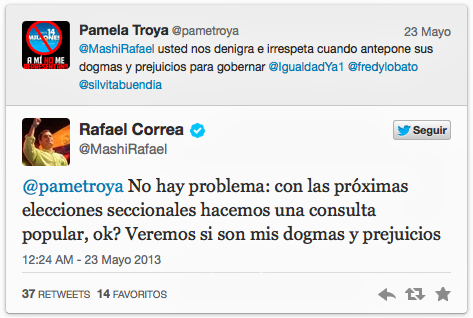
Among them was Pamela Troya who angrily denounced President Correa on Twitter telling him he was denigrating and disrespecting people like her by using dogma and prejudice to govern.

His response? "No problem," he twitted on May 23rd, "We'll launch a popular referendum in the next elections and we'll see if those dogmas and prejudice are my own."

Since then Pamela Troya and her partner Gabriela Correa launched the Civil Marriage Equality initiative and on August 5th they headed to a civil registry office and filed paperwork requesting the right to marry

On August 8th the court denied that petition on the basis that the constitution defines marriage as that of a man and a woman.  They have appealed that decision and are awaiting for a response.

Until now, Pamela and Gabriela had been the public face of the Civil Marriage Equality initiative but this week they announced that a second couple in Guayaquil would be filing paperwork to request a marriage license and this morning Santiago Vinces and Fernando Saltos did just that.


Carrying signs that read "Love is equality", "Without equality there is no liberty" and "Love does not discriminate" two dozen people including Pamela and Gabriela, attorney Silvia Buendia and television soap opera star Erika Velez acted as witnesses for the couple and marched with them as they made their way to the civil registry office and submitted their paperwork. As with Pamela and Gabriela, the court has 8 days to respond and the couple will appeal that decision if they are denied the right to marry.

Gabriela Correa and Panela Troya.
In defending his stance against marriage equality, President Correa highlighted his work in securing passage of a 2008 constitution which allowed civil unions for same-sex couples even as it also defined marriage as that between a man and a woman. At least on paper, the constitutional reform meant that same-sex couples would have all the rights of married heterosexual couples except for the right to adopt.

In practice, though, an upcoming study to be released by Silueta X which surveyed civil registry offices in Guayaquil found that only 1.2% of 2,805 same-sex couples had registered their civil unions in the five years since the constitution was adopted and, of 42 civil registry offices in the city, only two reported having recently completed a civil union registration.  Silueta X says they will release the full results of the study on November 29th and report whether some registries are throwing roadblocks for same-sex couples who might want to enter into a civil union.

Advocates face an uphill battle in repealing constitutional language that bans same-sex marriages but President Correa's opposition certainly has lit a fire in them and as other countries in the region allow same-sex couples to marry it raises the bar for other regional leaders to follow.

There are signs that President Correa is willing to listen to some of these actions and appeals. At least on the issue of the gender identity bill he has continued to have a dialogue with transgender rights advocate Diane Rodriguez in the months since he publicly stated that he saw the bill as a Trojan horse attack on the institution of marriage.

In the meantime, while he "evolves", the resurgence of a visible LGBT rights movement in Ecuador is reason to rejoice.

UPDATE (Nov. 29th, 2013): It took just one day for the Ecuadorean government and its civil registry office to say Santiago and Fernando did not meet the qualifications for a marriage license since they were not a man and a woman.  Helpfully, it did urge the couple to come back if and when they manage to gather enough proof to prove otherwise.

The Ecuadorean Civil Marriage Equality initiative has said that they expected the ruling and will be appealing it. They also say they are recruiting same-sex couples who might be interested in joining their movement and launch similar petitions before the civil registry offices of Ecuador.

News report (Spanish):


Additional info:
  • More photos of this morning's press conference and rally here.
  • Follow Ecuador's "Matrimonio Civil Igualitario" on Twitter here.
Related: