Those reports were based on an online article posted by On February 4th by Cuban newspaper Gramma and most of them seemed to skip over another passage I have taken the liberty to translate:
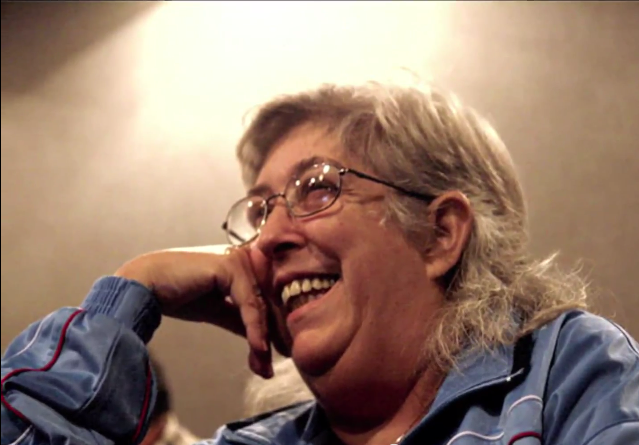
Diana Balboa, the ashes of whose partner Sara González will be scattered over the waters of Havana Bay on Saturday, joined Fidel on the stage at his request. He put his arms around her and championed her dedication and care towards the iconic Cuban trova singer during the months her intense battle with cancer lasted. "I know you were courageous", said Fidel, to which she replied "She was the courageous one, Comandante. She showed a lot of valor and, as long as she was lucid, she was mindful of her work and her patriotic Cuban identity - and she did rest in peace, she did not experience a tragic end".
Sara González was one of the founders of the nueva trova music movement in Cuba and among the few that remained in Cuba in support of Fidel Castro and the Cuban revolution. She was also mercilessly mocked by Cuban critics outside the island for her support of the Castro government.
In Cuba, more than a few people took note of the Gramma 'outing' of Ms. González and Ms. Balboa's long term relationship in February including Cuban blogger Mayktel who wrote about the ash-scattering ceremony on his blog.
I found it striking that Fidel made a point of acknowledging Ms. Balboa's relationship with Ms. González and I wanted to leave and English-language record of the exchange.
There are some amazing images of Ms. González in the following YouTube video with a background soundtrack of her singing "Su Nombre Es Pueblo". It includes an image of Ms. González (in blue) and Ms. Balboa (in red) at the 1:14 minute mark. She is also shown standing next to Mariela Castro at the 1:46 minute mark.
Image: Mariela Castro, Director of the Cuban National Center for Sexual Education, listens to a translator at an event held at the New York City Public Library (Photo credit: Andrés Duque/Blabbeando).
NOTE: This will be a slog for some looking for the juicy bits. If you are looking for those, please skip to
the bottom where I've posted three exclusive videos taken at the event.
Background: In the six years since I started this blog, I have covered some pretty amazing developments happening on Latin America when it comes to LGBT rights. Argentina, the first country in the region to pass a marriage equality law back in 2010, probably leads the pack particularly after just approving the most progressive gender identity law in the world. But I would argue that no other country in the region has experienced as big and fast a turnaround on LGBT issues as Cuba.
No small feat, considering its history of persecution and harassment against the LGBT community in the 1960's and 1970's and the quarantine policies it practiced against people with HIV in the 1980's.
The CENESEX: It would be also fair to say that these changes are due in large measure thanks to Mariela Castro's leadership as the head of the Cuban National Center for Sex Education (CENESEX).
During the past decade or so, Ms. Castro has used her considerable influence to raise the visibility of the LGBT community in Cuba and expose the challenges that they face. Through the CENESEX, she has also pressured the government to extend rights to the LGBT population. It doesn't hurt, of course, that Ms. Castro is the daughter of current Cuban president Raúl Castro and the niece of former president Fidel Castro.
My first inkling that change was afoot came in 2006 when a television soap called "The Other Side of the Moon" became a sensation in Cuba. Purportedly, the soap was produced with input from the CENESEX to educate the Cuban public on the risks of HIV transmission, but what made it a must-watch event was that it was the first state-sponsored telenovela to feature a love story between a married man the gay man he falls for.
That same year saw the launch of a series of cultural events on the month of May in observance of the International Day Against Homophobia and Transphobia. The events are now held on an annual basis and has featured the Cuban premieres of of U.S. films such as "Milk" and "If These Walls Could Talk" and a few episodes from "Grey's Anatomy" and "Glee", which might surprise some readers.
And while entirely symbolic in nature, in January of this year the Communist Party of Cuba officially embraced LGBT rights for the first time in history by including the following two "Work Objectives" in an official statement meant to spell out its commitments (a PDF of the full document can be downloaded at this Spanish-language page):
Confront prejudice and discriminatory conduct based on a person’s
color of skin, gender, religious beliefs, sexual orientation, country of
origin and other issues that are contrary to the Constitution and to
the law, that threaten national unity, or that limit the free exercise
of a person’s freedoms.
Portray Cuban reality in all its diversity through audiovisual,
print and digital media in a professional and faithful manner according
to their particular characteristics, including the economic, employment
and social situation, people’s gender, color of skin, religious beliefs,
sexual orientation and country of origin.
Mea-culpas: In the meantime, there have been a couple of less than forthcoming apologies for the sins of Cuba's past.
"There is no repression against gays in Cuba," she said, "what does exist is the same sociocultural response that exists in other nations."
According to Brito, Ms. Castro admitted that the Cuban Communist Party had acknowledged it had been an error to persecute the LGBT community in the 1960's and regretted banning them from reaching top political posts in the 1970's but, when pressed about it, she admitted it was something dealt as an "internal issue" and never discussed with the Cuban public.
Then came Fidel Castro's apology in an August 2010 interview with another journalist from La Jornada in which he chalked up all past abuses to the homophobia of the day and denied he ever personally held any homophobic sentiment. It was only when the reporter insisted on whether the Cuban Communist Party should have been held accountable that Fidel took ownership and admitted that if anyone was to blame it was him (Walter Lippman has a translation of the interview here).
Dissidence: Some critics, mostly those outside the island, have tried to minimize the impact of the CENESEX achievements and have argued that they are part of a public relations campaign to cover up Cuba's past and ongoing human rights violations. Dissident voices within the island also claim that efforts to organize outside the CENESEX umbrella are often met with government interference, censure and outright persecution.
In 2008 reports emerged that the Cuban government had successfully stifled what would have been the first ever Cuban LGBT pride march by harassing organizers and detaining them. Ms. Castro herself would later categorically deny the allegations and said that the reason the march had failed to materialize was that none of the six organizers were gay or had any followers and that their only intent was to discredit Cuba before the eyes of the world.
Cuba Encuentro, which has a long history of editorializing against the Cuban government, identified at least two of the organizers as being gay: Spokesperson Mario José Delgado González who was identified as the director of the Reynaldo Arenas In-Memoriam LGBT Foundation, and Ignacio Cepero Estrada who was identified as the director of the Cuban Human Rights Commission for People Living with HIV and said to have been detained for at least two hours.
Last year, when the AFP reported that a dozen individuals had finally been able to march down the streets of Havana in what they called the first such event, Mr. Estrada was among them.
Two months later Mr. Estrada would go on to gain wider notoriety when he announced he would be marrying Wendy Iriepa, a transgender woman who had worked briefly for the CENESEX, and called it Cuba's "first gay marriage". Ireipa had reportedly left the CENESEX alleging that she had been victimized by the agency but the couple said there was no animosity and said they had sent a wedding invite to Ms. Castro. The maid of honor? Cuba's best known dissident voice Yoanni Sánchez. The BBC was thrilled.
Adding to the parochial feel of the confrontation, Ms. Castro actually responded to the wedding invite. "I am thrilled [Ms. Iriepa] is getting married even if it's not to a heterosexual man as she would have wanted," she told the EFE news agency tongue firmly in cheek, "but it seems she found the love of her life and we wish her much happiness".
She then went on to say that there were foreign forces at play. "There is North American government funding to launch LGBT organizations to counter the positions [of the CENESEX]," she told EFE, "It's political, it's a media campaign against Cuba that has a lot of money behind it and there are people who let themselves be seduced by such things."
I have opened with this long introduction because there is a lot out there about Cuban politics and dissident voices but few, if any, that thread these tensions within a recent LGBT context. It is also a preamble that contextualizes why I was looking forward to a rare U.S. appearance by Ms. Castro that took place at the New York Public Library on May 29th.
Controversy: The event announcement at the Library came only a few days after Ms. Castro got news that she had been granted a visa, a decision by the Department of State that immediately drew withering criticism from long-time critics of the Cuban government.
Before coming to New York, Ms. Castro made a few appearances in San Francisco where she got the ball rolling by insulting Castro government critics in Florida as a tiny "Cuban mafia" holding U.S. policy towards Cuba hostage to their rancor. She also made some headlines by telling anyone who would listen that, yes, she would vote for Barack Obama for president if she was able to cast a vote in the U.S. presidential elections.
The Library also came in for some harsh criticism for changing the registration process only days before the event from one that was open to the public on a 'first come, first seated basis' to one that was by registration only with full capacity reached almost immediately as the change was announced online. Anti-Castro critics accused the Library of deliberately manipulating the registration process as to giving them the power to choose who could get in and who to keep out. The Library absolutely denied the allegations.
During the event I was able to sit in the second row as press and noticed that the first row had been reserved for dignitaries and staff members of the Permanent Mission of Cuba to the United Nations. No surprise there since securing Ms. Castro's appearance must have taken some diplomatic wrangling. My hunch is that while I very much doubt that Library staff specifically set out to select a specific audience it would not surprise me if the Mission received notice of the change in registration policy and sent out alerts to make sure their allies registered on time. In any case, where the critics are correct is in that the event turned out to be unusually welcoming and warm towards Ms. Castro.
The program: So what actually happened at the event? Glad you asked because I took some notes!
The event started almost an hour late and lasted a little more than sixty minutes. Carey Maloney, Co-Chair of the Library's LGBT Committee, began by introducing Ms. Castro and guest moderator Rea Carey, Executive Director of the National Gay and Lesbian Task Force.
In an opening statement with the help of a translator, Ms. Castro said she had prepared a PowerPoint presentation she had decided to scratch due to time limitations. Nevertheless, she said she had been very impressed with the number of illustrations about Cuban art and culture that Microsoft had included in the software. It was the first of many lines that drew hearty laughter from the audience.
Instead, Ms. Castro introduced a 10 minute documentary reflecting some of the events that took place at the 2009 anti-homophobia cultural festival (Pt. 1 is here and Pt. 2 is here).
First question - Transgender rights in Cuba: Ms. Carey began by making note of the controversy surrounding Ms. Castro's visit and the many e-mails she had received in favor and against the event. To start, though, Ms. Carey alluded to an earlier off-stage conversation they'd apparently had and she asked Ms. Castro to share the journey she had taken from an advocate for women's rights to one who was a staunch advocate for transgender rights. She congratulated Ms. Castro on getting the government to cover gender-reassignment surgery back in 2008 and asked her to explain the process that took place before securing that victory.
Ms. Castro's response: Ms. Castro began by thanking Mr. Maloney and his husband Hermes Mallea for their hospitality and pointedly saluted the fact that their marriage was now recognized by the State of New York. She also thanked the event organizers for giving her an opportunity to meet Ms. Carey.
She then spoke of the groundbreaking work her mother Vilma Castro Espín had done on women's rights and Cuba's vanguard role on the issue. She noted that Cuba had instituted an equal wages law back in 1959 mandating that women must be paid the same as men for equal amounts of work and that the Cuban women's movement had embraced gender issues as far back as the 1960's giving them the advantage of seeing the issue as a mental construct. "We are all transvestites, an invention, a fashion, a style," she said.
She spoke of the human habit of controlling and dominating others through the invention of rigid schemes and the serious trouble some people could get into simply by breaking away from those schemes. And she said that by focusing on gender as a construct provided a tool to confront those privileges.
Women in Cuba were already challenging homophobia and transphobia as far back as the 1960's, she said, but progress was extremely slow because they lacked the methodological tools to change society's attitudes. She reminded audience members that homophobia at that time was not unique to Cuba and that most of the countries in the world saw homosexuality as an illness that should be stamped out. And she reminded the audience that, to this day, most medical science leaders throughout the world still categorize being transgender as a mental illness in a way that excludes transgender individuals from the rest of the world. "Why pathologize and stigmatize human beings," she asked, "are we all permanently ill people?"
Providing an answer to her own question, Ms. Castro said that it was a ploy to make others feel inferior while sustaining heterosexual privilege and not having to share power. She argued it was the same reason why minorities keep being attacked as being immoral, ill, evil beings and pedophiles and why all bad things in the world are often blamed on minorities.
Ms. Castro took scientists to task for helping to create a world of power imbalance. "How many of these illnesses were named after male doctors?" she asked, "A male doctor was the one who first invented the female G Spot as if women didn't already know they had one!"
The audience roared.
Ms. Castro then said that knowledge was power and that, unfortunately, there were many ignorant people in the world who let doctors have "medical omnipotence" over them. "When people feel bad," she said, "people run to their priest, their witch-doctor, their doctor, their santero."
In this context, Ms. Castro argued that sexual education was a liberating force and represented a form of human emancipation and that all forms of discrimination stemmed from the same root and led to inequality.
Finally, Ms. Castro shared an analogy between discrimination, the economy and a piece of bread. She said that when there is not enough bread for everybody but someone wants more than what they received, they have to come up with a convincing reason for others to willingly hand their bread over. Once they get their way they gain power. And once they gain power they gain the ability to denigrate other people's religion, call them ugly or call them fat - and they can come up with a number of reasons to take away people's rights.
"When we fight for LGBT people we are not taking rights from heterosexuals," she said, "we are sharing privilege and power and the same is true for transgender rights."
Second question - Respect for different political and religious views: Highlighting once again the flood of e-mail messages she had received in advance of the event, Ms. Carey said many people clearly saw Ms. Castro as a powerful advocate for LGBT rights but added that to others this seemed to be contradictory in the broader context of human rights in Cuba.
"Many of us feel that LGBT progress is about the freedom to express our true self," Ms. Carey stated and asked Ms. Castro if she would be willing to expand her advocacy to issues of freedom of self and expression which included "people with different political and religious views."
Ms. Castro's response: Saying that she had understood only part of the question, Ms. Castro said that her work on LGBT issues was inclusive of other communities that experienced discrimination.
NOTE: At this point, someone in the audience interrupted Ms. Castro and translated the second part of the question. In what must have looked as planned to most of the audience, the first translator left the podium and was replaced by my friend Pedro Julio Serrano who was there as the Communications Manager at the Task Force and told me later that he was just as shocked to have ended up translating for Ms. Castro.
Ms. Castro's response (continued): Ms. Castro said that she too imagined what Cuba might become; a Cuba that might be able to sustain full sovereignty.
That elicited a spontaneous standing ovation from the audience and shouts of "Long live socialist Cuba!"
By 'a sovereign Cuba', Ms. Castro continued, she meant having to choose their own path to freedom.
She said that all representatives to the Cuban National Assembly were chosen by a popular vote and that their legislative process was a form of socialism that always sought full justice.
Ms. Castro then argued that by standing up to other nations, the Cuban government actually practiced a form of global dissidence. She said that she considered herself to be a dissident and saw all the leaders of the Cuban Revolution as dissidents in that they held positions that made other governments 'uncomfortable.'
Picking up themes from earlier in the presentation, Ms. Castro said that the Cuban government was often discriminated for having chosen, as she called it, "the historic process towards full emancipation of the human being."
Clearly enjoying the moment as well as the thunderous applause from the audience, Ms. Castro stopped and smiled and then challenged the reporters present to quote her directly. "I want to see the 'freed' ones who will publish that!" she exclaimed.
Finally, Ms. Castro said that if there was a reason why she was fighting so hard to change the cultural heritage of reproducing discrimination that existed in her own country it wasn't just on behalf of the CENESEX but also to improve the lives of the LGBT community in the island. Invoking Brazilian philosopher and education theorist Paolo Freire, she said this involved a spontaneous lesbian, gay, bisexual, transgender, intersex and heterosexual movement - an LGBTIH movement which was inclusive of the 'I' as in 'intersex' and the 'H' as in 'heterosexual' - coming together to change society and the world towards full human emancipation.
This, she said, was the reason other nations wanted to punish Cuba.
Third question - Marriage equality: Ms. Carey mentioned recent news reports in which Ms. Castro had gone on the record as being in favor of same-sex civil unions and other reports that said the Cuban government might be ready to allow same-sex marriages. She said it was unclear from reports if Ms. Castro herself would be fighting for marriage equality in Cuba and asked her to clarify what her position was on same-sex unions.
Ms. Castro's response: Ms. Castro stated that a few years ago the CENESEX had approached the Cuban Communist Party and proposed a study a study on whether there were any codes and laws that were discriminatory on the basis of sexual orientation and the Party agreed to back it. She also said that when a new family code was proposed, the CENESEX had worked with several non-governmental organizations to pour over the family code text to make sure that it would extend same-sex couples the same rights as heterosexual couples. "After all, who am I to deny those same rights?" she said, and added "There is no argument there from me and no reason for it not to be equal."
But when Ms. Castro specifically brought up the issues of same-sex marriage and adoption rights for gays, she said she met tremendous opposition from business interest groups and religious institutions and was told they would not go anywhere. Instead, the CENESEX presented a strategic plan to educate the Cuban public on these issues and got the go ahead from the Communist Party.
Speaking about the current situation, Ms. Castro said that there still existed a firm resistance from Cuban society to these issues and that it was clear that if they were put up for a vote they would be rejected. But she also said that the CENESEX had continued to work tirelessly on educating the public to change these attitudes and that this was the first year she truly felt that Cuban media had finally come around and began to support LGBT rights.
Ultimately, Ms. Castro said there were no current efforts to grant marriage rights to same-sex couples or, as she also framed it, to "touch the sacramental word that is 'marriage'
"In Cuba almost nobody gets married anyway," she joked.
Ms. Castro also said there were no plans to touch adoption rights and that this was based on the recommendation of LGBT advocates working with the CENESEX who advised her that it was too loaded an issue to try to push forward at the moment. She added that it might not make sense on a practical basis either since there were very few children in the Cuban adoption system and a waiting list of 300 heterosexual couples awaiting a chance to adopt.
As a result, the CENESEX had decided to focus on securing patrimonial rights for same-sex couples and making sure that when one partner dies the other has the right to handle inheritance rights. Specifically, she said, the CENESEX would focus on these areas:
Establish within the new family code the legal responsibility all Cuban families have towards members of the family who happen to be lesbian, gay, bisexual or transgender.
Establish protections under child abuse regulations for children who come out or are outed to their families and end up being insulted, abused or kicked out of home by their own parents.
Monitor a number of upcoming legislative changes to secure that the laws spell out specific protections for the LGBT community wherever they apply and, in doing so, insure the full inclusion of the LGBT community in the Cuban Revolution.
With that, the floor was opened to audience questions.
First audience question - Cuba's democratic LGBT process: Identifying himself as a member of Cuba Solidarity Movement in New York, a man said that Ms. Castro had a lot of friends in New York City who were fighting against the U.S. "war" against Cuba and advocating for the release of "The Cuban Five." He said that in the United States, the Cuban government was often portrayed as a dictatorship and asked Ms. Castro to talk more about the political process in Cuba and the democratic way in which LGBT rights are are taken up legislatively.
Ms. Castro's response: Ms. Castro said that the Cuban democratic process still had room to improve but was working fine. Legislative representatives were voted into office by members of the communities in which they lived, she said, and measures were taken to insure that each person's ballot choice remained private. She also said that political candidates were not allowed to run campaign ads which meant they had to rely entirely on community support to be elected.
As a result, Ms. Castro said, the Cuban legislature was truly diverse and ranked 4th in female representation among all legislative bodies in the world. Where improvement was needed, she said, was in increasing racial representation and insuring that people of all ages gained access to the legislative body. She noted that her own father had made an issue of the later back in January when he said that he was concerned about "the prominence of old people" like himself at the top echelons of the Cuban Communist Party.
Ms. Castro said that there were decisions taken by the Cuban Communist Party she liked and others not so much but said she still had trust in the process. She said that she found some decisions to be too dogmatic or dialectical for her taste and a few she felt took the country a step backward. But she also saw others as a step in the right direction including a resolution approved at the national congress back in January in which the Party, for the first time, had backed a resolution to fight all forms of discrimination in Cuban society, including that based on sexual orientation and gender identity [NOTE: The actual text, as I mention in the introduction mentions sexual orientation and gender but I don't believe it actually mentions 'gender identity'].
She said that these developments indicated that there was political will but said that political will in itself was not enough and yet it reflected the current state in which they found themselves right now and that it gave her hope that Cubans would eventually gain full justice and equality. She said that humans had a tendency towards discrimination and that overcoming certain ideas would take a continuous battle. "It is the difficult, challenging and complex creative process in which we are at the moment", she said.
Second audience question - Should Cuba apologize for having sent LGBT individuals to forced labor camps?: Identifying herself as Anabel Evora, an audience member stood up and said that she had been born in Puerto Rico to Cuban parents and still considered herself to be more Cuban than Puerto Rican. She said she knew the Cuban community in Miami from having lived there and was well aware how difficult it might be to work with them but she said that she suspected many of them might stand with Ms. Castro and support her work if only for a single reason.
Ms. Evora said that many members of the Cuban LGBT community that lived in Miami had fled the island after being held in concentration camps for being gay.
At this point, Ms. Castro stepped in and said Ms. Evora was probably referring to individuals who participated in Cuba's mandatory military service, including gay and transgender individuals, but denied there had ever been concentration camps in Cuba.
Ms. Evora said the issue was that these men were still held against their will for being gay and said that they might appreciate it if Cuba apologized for the way they had been treated.
Some audience members who were clearly annoyed asked Ms. Evora if she was done with her question but Ms. Castro hushed them and calmly told her to go on.
Ms. Evora finished by asking if Ms. Castro might be able to talk about it with her father Raúl.
Ms. Castro's response (VIDEO): I wasn't planning to capture any part of the presentation on video partly because I didn't think that I had enough memory in my portable camera to do so but I wanted to capture Ms. Castro's response to this specific question and so I did.
Ms. Castro thanked Ms. Evora for a "wonderful question" and said that the estimated number of Cubans living in the United States was 1.5 million which she thought was a wonderful thing. She said she enjoyed close communication with many Cuban immigrants but blamed what she called "a tiny group of people without scruples" for manipulating information and lying about Cuba with the sole intention of enriching themselves at the expense of U.S. taxpayers.
Ms. Castro blamed them for the travel ban to Cuba and said that this was a violation of the civil rights of the people of the United States. She ended with an anecdote about President John. F. Kennedy not having wanted to sign the Cuban travel ban because he didn't want to see his access to Cuban cigars restricted and noted that the ban was only enshrined into legislative policy when President Ronald Reagan handed the power to decide on it to Congress. The audience corrected her on that last point and said President Bill Clinton was actually the one who took that step.
You can see a low-quality video of that part of her response here.
Ms. Castro then discussed government-sponsored homophobia throughout the world and the fact that a number of countries today still have death penalties for gays. She referred to the majority of Caribbean countries that still impose jail terms for anyone found to be gay and said that these policies needed to change.
Ms. Castro said allegations that gays were ever sent to concentration camps in Cuba were false but said that there were a few years in which gay men and transgender women who enrolled in mandatory military service were sent to segregated Military Production Support Units - or UMAPs - which kept them separate from the heterosexual quarters. She revealed that the CENESEX had started an oral history project just this year to document these experiences and claimed that the military itself had decided to shut down the gay units three years after they were instituted because the policy was not working. She made no mention of the hard labor endured by some at the UMAP's and compared the homophobic treatment of some individuals to that of other governments at the time.
In perhaps the most disappointing part of her presentation, Ms. Castro shot down the idea that Cuba might ever apologize for its past treatment of LGBT individuals in the island. That part of her response starts at the 2:10 mark.
"Asking for forgiveness would be an act of hypocrisy and won't change the past," Ms. Castro answered before saying that an apology would only benefit Cuban critics. She insisted that what was needed, instead, was to build on the current track and continue to fight for LGBT rights in Cuba.
She later argued that if Cuba did ask for forgiveness, then it would be up to other nations to ask for forgiveness for an array of human rights violations which meant you'd never see the end of it. An easy way to evade responsibility.
Third and last audience question - How to keep the LGBT movement from replicating patriarchal models:Naomi Brussel from WBAI stood up and said that she had visited Cuba in 1980, 2000 and 2009 and seen the changes that had taken place on the issue during that time. She asked if Ms. Castro thought it would eventually be possible for an "autonomous" LGBT group like the Task Force to form in Cuba perhaps indirectly raising the issue that few voices represented the face of the LGBT community in Cuba other than Mariela Castro's.
Mariela Castro's response (VIDEO): Ms. Castro said that she expected such a time would come but that in the meantime she was dedicating her time to train activists from a "profound ideology of non-exclusion". She said she was worried that in promoting LGBT rights others might promote certain hegemonic ideologies that she sees in the global LGBT movement that perpetuate patriarchal models. "Gay men dominate in ways that hurt the lesbian and transgender rights movements," she said.
This is were the conversation picks up in this final video:
Ms. Castro said that she was surprised by what she saw at The Castro museum in San Francisco when she saw documents and flyers from the 1960's showing that the modern LGBT rights movement used to be much more open to different movements and ideologies and embraced activists from the Communist Party of the United States. She also said she was shocked to see that they didn't just fight for LGBT right but also other sorts of discrimination including that based on race. She joked that for years she thought she was the one who had invented such a progressive outlook. To close, she argued that it was the fight for HIV funding that created divisions with people fighting over who experienced more discrimination than others.
The hosts of the event closed the presentation and a member of the audience handed Ms. Castro a bouquet of flower.
Accepting a bouquet of flowers from an audience member, Ms. Castro then led the crowd in a chant to "Free the Cuban Five".
Coda: It has been a month to the day since the event took place and her comments are still reverberating online and in the press. Ms. Castro herself is back in Cuba and posted her own thoughts on the visit on her blog in Spanish and English ("A Message of Friendship").
According to reports they also handed a document to parliamentary representatives in which they ask the government to protect their rights. Interestingly, they also demand that the CENESEX launch an investigation of the UMAPs and their discriminatory record during the 1960's which Ms. Castro preempted in New York by saying that an investigation had been launched.
I'll ad one more detail just in case people are still reading this far down the post: Even as Ms. Castro was evasive about Cuba's responsibility for human rights abuses and invokes the fact that other nations had worse records when it comes to LGBT rights, Iranian Vice President Ali Saeedlu was in Havana announcing "bilateral ties" with Cuba on the same day she appeared at the New York Public Library.
Iran, of course, is one of the countries Ms. Castro indirectly invoked as having death penalties for gay men found guilty of sodomy. One would think that if Cuba is truly committed to eradicating homophobia throughout the world, they would put pressure on Iran to change their policies as well.
The historic event, known in Cuba as the Girón Beach Battle, has always been celebrated with a huge annual military parade and fireworks akin to the 4th of July or Veteran's Day celebrations in the United States.
It's also preceded and followed by huge public rallies dedicated this year to the younger generations by Cuban president Raúl Castro (he expressed concern that those who surrounded him were reaching his age or were older and said he wanted to promote the participation of younger generations in Cuban revolutionary party politics).
His daughter, Mariela Castro, was also there as the director of the National Center for Sexual Education (CENESEX) and led an unofficial LGBT contingent who proudly carried the rainbow flag next to the Cuban flag (that's Mariela Castro at the center in the picture holding the rainbow flag).
On their site, CENESEX posted additional photos and noted that their participation in the historic ceremony comes in advance of the 4th Annual Congress Against Homophobia which will take place in May and feature cultural and educational forums throughout the island including Havana, Camagüey, Ciego de Ávila, Granma, Villa Clara and, yes, Guantanamo.
No word on whether U.S. actor Sean Penn will show up after taking a rain-check last year when he was invited to the Cuban premiere of Gus Van Sant's "Milk" during last year's anti-homophobia events.
Once again Cuban television surprises us with the broadcast of a series from the United States in which the respect towards diversity, including sexual diversity, is treated openly and through clear messages. We had already noted the airing of "Six Feet Under" a few months ago, but this time the TV series "El Coro" ("Glee") comes to us on a privileged day and time, in which everyone can see it: Saturdays at 5:45pm, on Cubavision...
...what draws our attention is how the series treats the case of Kurt, an extremely effeminate gay, who showcases the most divine of extravagant fashions and even reaches the tone of a soprano when singing. With his 'bothersome' look (to those who are the most homophobic), he proudly confronts his way of being, and challenges the world with his amply demonstrated talents and virtues, even in the harsh game of football. His father, an apparently dumb mechanic, gives us a masterclass in sensitivity and humanity in defending his son against any discriminatory attempts based on his physical appearance, his mannerisms or his sexual orientation.
For all these lessons that reach the viewer in a fresh and entertaining way and which do so much good when exposed to society, let "Glee" be welcome on the Cuban screens. Although it's a shame that it has to be a foreign series - and from the United States to top it all off - that brings clear and powerful messages in regards to diversity. How much longer do we have to wait for these type of messages, but "made in Cuba?"
Cuban television has tackled LGBT issues in the past beginning with a government sponsored series in June of 2006 called "La Cara Oculta de la Luna" ("The Dark Side of the Moon"). The series was produced with the backing of the CENESEX and had an educational HIV prevention angle but a storyline involving the relationship of a gay man with another married bisexual man caught the country's imagination and led to as frank a depiction of man to man love as had been presented on Cuban television up until that time.
CENESEX, under the leadership of its director, Mariela Castro Espín, has also organized an annual cultural celebration in May in observance of the "International Day Against Homophobia" which has brought actors, directors, artists and performers to celebrate LGBT culture.
Last year, in its 3rd year, the event drew some international attention for showcasing Gus Van Sandt's "Milk" and Castro Espín's open invite to American actor Sean Penn to attend the film's showing. Sean Penn said he was otherwise occupied at the time but promised to show up at a later date.
Castro Espín also happens to be the daughter of Raúl Castro, the current Cuban president.
NOTE: Most of Latin America catch subtitled episodes of "Glee" a few weeks after they air on U.S. television on multi-national cable networks that license the rights to rebroadcast the show outside the country. A few unlucky viewers catch dubbed versions of "Glee" (instead of the subtitled versions).
I'm not sure if the version being aired in Cuba is a subtitled version or a dubbed version. The clip above is from Mexico's Azteca TV network.
Penn himself remains mum on the subject but Mariela Castro Espín, Director of the Cuban National Center for Sexual Education, daughter of Cuban president Raul Castro, lead organizer of the summit, and the person who extended the original invite to Penn, was quoted today by the AFP as saying that Penn was otherwise occupied with a humanitarian effort to assist people affected by the recent catastrophic earthquake in Haiti (we knew that) and was also under contract to return to the United States and join a previously scheduled film shoot running through the May 18th screening (we didn't know that).
A week from now or so, several countries around the world will be officially and unofficially observing the annual "International Day Against Homophobia and Transphobia" (IDAHO).
The events, loosely coordinated through a French website are the brainchild of French academic figure Louis-Georges Tin, who launched the IDAHO idea in 2004.
This year, the IDAHO committee has made a call for participating organizations to hold a "Great Global Kiss-In". Participants are being encouraged to call for a public gathering at a national or local monument, urge poeple to carry the flag of their country, wear clothing that represents their nation, hold a public kiss-in and tape it and then upload it at the Global Kiss-In page.
The Latin American countries listed so far are Colombia, and Peru.
Not listed in the kiss-in page but holding their third annual week-long "Day Against Homophobia" cultural summit will be Cuba, under the auspices of the National Center for Sexual Education (CENESEX) and it's director Mariela Castro Espín, daughter of current Cuban leader Raúl Castro.
The final version of the official program, which describes an array of events taking place in Havana from May 11th through the 18th, includes educational workshops and panels (one event will bring together pro-LGBT religious organizations), concerts (including an event called "Rockers Against Homophobia"), receptions (a mother's day themed event is limited to providing a space for transgender people and their moms), photo and art exhibits.
There will also be an incredible number of LGBT-themed television and film screenings including Germany's "Aimée and Jaguar", India's "Fire", Argentina's "XXY", Great Britain's "Kinky Boots", Taiwan's "Beautiful Boxer", Rainer Werner Fassbinder's "Querelle" and Cuba's "Where Forgetfulness Does Not Live". Cuba has certainly come a long way since it wouldn't even allow it's own "Strawberries and Chocolate" to be shown in local theaters.
The United States is also represented by the 2003 TV movie "Soldier's Girl" the 2001 documentary "De Colores: Lesbian and gay Latinos", 2002's "Unconditional Love" with Kathy Bates, and, perhaps most surprisingly, an episode from the 4th season of "Grey's Anatomy" titled "The Becoming" which features this storyline.
What is not surprising is that Gus Van Sandt's "Milk" will also be screened. In March of 2009, CENESEX announced that a screening of the film would be a key component in a new CENESEX initiative against homophobia and at this year's cultural summit it will be screened once again to close the week-long event. A panel discussion will also follow.
At a press conference held on Wednesday to announce details of the summit, Mariela Castro said that she had sent a special invite to Sean Penn, the American actor who plays the role of Harvey Milk in the film, to attend the screening.
Controversy: In 2008, Penn came under criticism for hanging out with Venezuelan President Hugo Chavez and Cuba's Raul Castro (before he became the island's president) for an "investigative report" for The Nation and The Huffington Post. It wasn't the first time he'd visited with Chavez (their first meeting came in 2006) and he'd also met Cuba's then president Fidel Castro on an earlier trip to Cuba.
The week "Milk" premiered in the United States was the same week The Nation published the Sean Penn piece in 2008 and it drew a particularly myopic attack from the gay right in the United States in the form of an essay published in The Advocate authored by James Kirchick ("Sean Penn's Blind Spot"). At the time, I didn't necessarily disagree that Sean Penn should have been criticized (at the time I wrote "I have little patience for Hollywood actors going on 'fact finding trips' to countries like Venezuela and Cuba when it's obvious that the access they get to the upper echelons of power is due to their political leanings and their fame") but in Kirchick's diatribe he ignored the fact that on LGBT issues there had been a sea-change when it comes to Cuba (Kirchick, to give you an idea of where he was coming from, also went to endorseJohn McCain in the last presidential election).
But, then again, when it comes to LGBT issues in Cuba, things remain far from perfect and there is reason to believe that the rights of LGBT political dissenters in the island are still being curtailed, That's why I also thought that Cleve Jones' defense of Sean Penn, also on the pages of The Advocate, was a bit naive as well.
I would actually love to see Sean Penn be able to make it to the "Milk" screening in Havana on May 18th. I might not agree with his political views or stands but it would shine a light on some of the more positive developments when it comes to LGBT rights in Cuba in recent years. If he does show up, I'll give you the update when it comes.
Extra fact: Radio Guantanamo, broadcasting from Cuba, reports that Guantanamo will also join Havana in observing an international response against homophobia. Activities include screenings of movies like the United States films "Quinceañera" and "Gods and Monsters" and a special gala on May 17th to celebrate the "International Day Against Homophobia". The events are sponsored by CENESEX.
Marriage equality in Cuba: A reader has also tipped me to the following YouTube video from a show that was broadcast on Venezuelan television on May 6th (its the 1st of 6 clips from the show). Venezuela, following Cuba's example, is launching their own version of a government-sponsored series of cultural events this coming week around the IDAHO theme. The invited guests are Mariela Castro Espin and Gabriela Ramirez, the Venezuelan government's ombudsperson.
I won't translate the whole thing but, early in the clip, at the :57 second mark, Castro says the following:
...and there we are indeed proposing, within the Family Code, for the establishment of, the recognition of legal unions, we don't say 'marriage' because it would create a lot of controversy, we'll leave that category to the heterosexual world, and we are proposing another category, which would be marriage between people of the same sex, and that their right to adopt is also recognized...
Somewhere on this earth, Sean Penn must be smiling.
Mariela Castro, daughter of Cuban president Raúl Castro, and Director of the Cuban Center for Sex Education (CENESEX), announced the launch of a campaign to demand respect for the freedom of living one's sexual orientation.
The campaign, which was announced yesterday, will combat homophobia in the Caribbean island through messages and activities developed by and targeted at younger generations.
The Center, according to the AFP, will sponsor a series of weekly academic and public events at the University of La Habana, including public screenings of HBO's "If These Walls Could Talk 2" (which portrayed the life of three separate lesbian couples living during different points in time) and - wouldn't you know it! - Gus Van Sant's "Milk" (in which Sean Penn portrays Harvey Milk).
Penn has been criticized for writing about his recent visits to Cuba and Venezuela - and Presidents Raúl Castro and Hugo Chávez, respectively - and painting a mostly favorable picture of life in both countries under each authoritarian figure (here is the latest). This has come, specifically, in light of his portrayal of Harvey Milk and the reported violations of human rights against gays in these countries (ehem, even I piled on Penn back in December).
Among critics, few acknowledge that there have been advances on LGBT rights in either country and that's the basic flaw in their criticism. Cuba has jumped ahead leaps and bounds from Fidel Castro's sorry LGBT rights legacy. Chávez, not so much. But it's great to know that both countries seem to be engaged in increasing the recognition of rights for their LGBT populations.
Related:
Official site for Cuba's "Diversity is natural" campaign site here
On January 1st, Russia Today which bills itself as "the first 24/7 English-language news channel [to] bring the Russian view on global news" posted an interview with Mariela Castro, Director of the Cuban Center for Sex Education, which was originally taped in Havana, Cuba (see YouTube video above).
Initially she answers some questions on her relationship with her father, Cuban President Raúl Castro, and her uncle, Fidel Castro, but at the 3:28 minute mark she also addresses issues such as same-sex unions, a gender identity law, the use of mass media to raise awareness about LGBT issues, the homophobic nature of Cuban society, HIV/AIDS, Barcak Obama as President of the United States, etc. It's a wide-ranging interview and a site that I had previously not known - LGBTCUBA - has transcribed most of it.
I hope they don't mind me posting it below:
Anastasia Haydulina One day your uncle Fidel Castro… is going to die. Do you think his death will change the status quo of your Cuba?
Mariela Castro Espín First of all, the death of Fidel will bring great suffering for the Cuban people, and it will be an enormous loss. But as far as I can see, the Cubans are willing to continue on the path of socialism even when our Comandante is no longer with us, even when my father and other forefathers of the revolution are not. Our people want socialism. Of course, we're very self-critical, so what we need is a better and rich social reform that will resolve most of the existing contradictions. People themselves are proposing actions necessary for the survival of our socialist society, a society that should always guarantee social justice, equality, and solidarity within the nation, as well as in relations with others. We want welfare, but not as exaggerated as that of consumer societies. I think that socialism in Cuba will survive and become what we have considered to be a utopia.
Haydulina Same-sex unions in a Communist, originally Catholic, state?
Castro Yes, I believe that, in societies like ours, same-sex unions are possible. It's true that, in the history of countries that have tried to create socialism, sexuality-related prejudices from the capitalist past have persisted. But in the Cuban version of socialism it will surely be possible to make fundamental changes in the lives of men and women according to their sexual orientation and other elements of their sexuality that haven't been contemplated by other socialist nations to date. Of course there are very strong influences of religions predominant in our cultures, but they are not going to become obstacles to achieving the aim of guaranteeing human rights socialism must guarantee. That is why we proposed a bill to legalize same-sex unions to parliament.
Haydulina What makes you feel you can overcome the stigma within the Communist Party and legislative barriers to pass it as well?
Castro As head of the National Center for Sex Education, not as daughter of the president, I presented an educational strategy strongly based on the mass media to bring the attention of the Cuban society to various expressions of sexuality within it.
Haydulina Realistically, when do you think we are going to see this bill passed here in Cuba?
Castro We've already accomplished a lot. For example, we've achieved a resolution by the public health ministry that guarantees transsexuals specialized attention, including sex change surgeries. The first of these types of operation are about to begin. They were first performed in 1988 but were interrupted due to people's incomprehension. We're proposing important changes to the family code that include the right of people of the same sex to legalize their unions. We're also working on a gender identity decree law that will make it easier for transsexuals to change their sex and identity papers, regardless of the sex change surgery. Because not all of them are automatically eligible for this operation, but nevertheless people do need society to recognize them in accordance with their gender identity, not by biological sex.
Haydulina Tell us more about the history of homophobia in this country.
Castro Just like any other patriarchal societies in the world, Cuban society is homophobic. In the 1960s and 70s, it expressed itself as a political decision that discriminated against homosexuals, especially men. That was a general criterion coming from not only religions but even from sciences. Psychiatry classified homosexuality as a mental disorder. There were even therapists to change homosexuals into heterosexuals, since that's what was considered normal and healthy. So, the Cuban politicians, educationalists, and doctors acted in accordance with the scientific precepts of the time as well. Neither teachers nor doctors could be gay. Today, no military person can be gay either. But there are homosexuals everywhere, whether out in the open or not. So we attend to them in our center, because humanity is about diversity. The most important thing here is that there have been discussion and change ever since. And in order to avoid this [homophobia] in the future, we've got to be explicit in our laws and policies. Homosexuality is a reality to be taken into account, not got rid of.
Haydulina Two thirds of Cubans with HIV/AIDS are homosexual men. Are they provided due treatment? Are the Cubans with HIV provided the treatments they need?
Castro In 1983, when Fidel learned about the existence of AIDS, he asked the doctors of the Pedro Kourí Institute of Tropical Medicine to carry out research to avoid the tragedy on our island. Since then the state began designing its policies for HIV/AIDS treatment and prevention. Each patient infected with the virus is provided with all the medical assistance at the cost of the state. Although the medicines are very expensive, as well as prevention matters, these are fundamental to avoid the spreading of the epidemic. Even though Cuba maintains the lowest level [of infection] in the region and in the world, it keeps rising, so we need much more effective prevention and treatment. For example, the island buys condoms for the pharmacies, but many are donated and distributed free of charge as part of the center's educational activities across the country. Thanks to this efficient work, [HIV] infection hardly occurs among adolescents. Unfortunately the existing prejudices impede us from many of the educational activities planned for the homosexual male population.
Haydulina Is your father supportive of your work?
Castro Yes, he's supportive of my work, thanks to the past influence of my mother, on sexual education, and mine. Of course, from time to time we have discussions meant to convince him of the need for quicker solutions. He's also influenced by other people that disagree with my work, and it's those people who create obstacles. But I believe that dialogue is fundamental to progress, so whenever I have a chance to sit down and talk with my father to convince him, I do so.
Haydulina Your mother was an internationally recognized champion of women's rights. What challenges remain for women in Cuba?
Castro There are still the remains of machismo and inequality between men and women. Although there are few women in top governmental positions, we observe rising percentages of women technicians, lawmakers, vice ministers, ministers, as well as among the regional party leadership. Besides, in the last two hurricanes that hit the island, the actions of the women governing the two worst affected provinces made Cubans, and especially women, very proud. In troubled families, women keep returning to household chores and the upbringing up of children, because most of them still think that is our job, that "nobody can do it better than us." But men's participation in all these household duties is no less fundamental, especially in a time of crisis.
Haydulina What other changes would you like to see in Cuba?
Castro I would like the US government to lift the financial, economic, and commercial blockade that it has imposed on our island for fifty years against the Cuban people and that has considerably prevented us from achieving our development goals. It has affected our economy, commercial relations, and financial mechanisms. Cuba doesn't receive credit from any bank, and it's very difficult for us to survive in the field of international economy. The companies that trade with Cuba are being penalized. We have big problems with the Internet without the access to optical fiber. It would be fundamental for life in Cuba to change, for its economy to grow, the salaries to rise. Then, we'd be able to produce, obtain, more materials and use the latest technologies. For example, I'd like to see improvements in democratic participation mechanisms on the island, so that our government could function more fluently. It has a very peculiar and good structure, like no other in the world, and we like its maturity. That's why we need to cultivate mechanisms for people's participation. It's one of the things that preoccupy me most and will bring about a whole range of other changes.
Haydulina What do you expect from the new president of the United States? Castro I expect wonderful changes for the world and for the people for the United States. The people of the United States deserve a president like Obama and the faith and ideal he espoused. They and all of us need civilization and not barbarity. We need intelligent, honest world leaders. I think that with Obama's presidency a whole new era will begin. It will be a totally different story in the US and all over the world.
News roundup.
-
The main stream media seems to be more fixated on an ideological
difference within the Democratic party, than they are actual fascism being
practiced b...
Great Sex Games For LBGT Acceptance
-
The following are some great sex games for everyone to enjoy, regardless of
their sexual preference. They can be used in a number of different ways and
t...
Schön Küche Renovieren Aus Alt Mach Neu
-
cool gros einbaukuche weiss hochglanz einbauk c3 bcche from küche
renovieren aus alt mach neu Dieses ist erstaunlich, wie man Farbe aus einer
alten Tür e...
White Feminism Did Not Save Us
-
It is the morning after and my feed is full of angry posts about who is
responsible for this. I have a suggestion:
Back off from third party voters or eli...
Club Fonograma's Best Music Videos of 2015
-
*“Amor Fantasma”*
((The Plastics
Revolution))
10. Sefárdico
"One day, when you sober up, we can be the Coen Brothers or whoever you
want..." sighed by w...
Diversidad Capital: discriminación por edad
-
Esta semana en Diversidad Capital por Capital 21 hablamos sobre
discriminación por edad con: Ana Francis Mor. Humberto Álvarez. Victoria
Beltrán del Consej...
MIT Fellowship and Relocation
-
Very excited and grateful to begin a new chapter in my life. The
Massachusetts Institute of Technology has awarded me one of ten Knight
Science Journalism ...
The Years Of Writing Dangerously
-
Thirteen years ago, as I was starting to experiment with this blogging
thing, I wrote the following: [T]he speed with which an idea in your head
reaches th...
Joining the Trans Advocacy Network
-
Post by Christopher Argyros, Pride Agenda Transgender Rights Organizer I’m
excited to announce that the Pride Agenda has joined the nationwide Trans
Advoca...
Chess, anyone?
-
Art by MUROB
From Wikipedia...
Chess Records was an American record label based in Chicago, Illinois. It
specialized in blues, R&B, gospel music, early ro...
Blabbeando does not claim credit for any images featured unless otherwise noted. Usually we try to give credit when we can. All visual content is copyright to its respectful owners.
If you own rights to any of the images, or are depicted thereof, and do not wish to appear here, please contact us for prompt removal.
The views expressed on this site are my own. They do not reflect the views of my employer, or any professional, or legal organization of which I am affiliated.



 Posts
Posts


