Showing posts with label Honduras. Show all posts

Sunday, July 08, 2012

US Embassies in Latin America celebrate LGBT pride


Photo: Members of the US Embassy in Panama participate in the annual Sexual Diversity March that took place in Panama City on May 25th of 2012 (From the Embassy's flickr photo account).

[NOTE: Updated on July 18th, 2012. Latest updates at the bottom of this post]

It would be hard to overstate just how amazingly LGBT-friendly the US State Department has been under the leadership of Hillary Clinton even as she prepares to depart later this year.

I first took note of the changes at hand in January of 2011 when the U.S. Ambassador to Honduras took the highly unusual step to publicly put pressure on the Honduran government to investigate an increasing number of attacks and murders committed against dozens of transgender women throughout the nation.  That was soon followed by a Statement by President Barack Obama himself and offers from the State Department to provide intelligence and legal assistance.  It all culminated with Honduran authorities grudgingly announcing that they had launched a special hate crimes unit in November of that year.

Then came that extraordinary speech Secretary Clinton gave before the United Nations human rights office in Geneva in which she most memorably proclaimed 'gay rights are human rights' and made commitments to fight discrimination against members of the LGBT community throughout the world.

There was also the protracted fight over the confirmation of Mari Carmen Aponte as US Ambassador to El Salvador which some sought to derail in part because she had published a local essay in a Salvadorian newspaper applauding the Central American nation for the steps it had taken to prevent discrimination against its LGBT citizens.

That essay was published on June 2011 during pride month following directions from the State Department for embassies to be visible on LGBT human rights issues on a local level.

This year in her pride month remarks, Secretary Clinton made it a point to highlight the diplomatic work being done by US Embassies and Missions throughout the world on LGBT issues:
United States Embassies and Missions throughout the world are working to defend the rights of LGBT people of all races, religions, and nationalities as part of our comprehensive human rights policy and as a priority of our foreign policy. From Riga, where two U.S. Ambassadors and a Deputy Assistant Secretary marched in solidarity with Baltic Pride; to Nassau, where the Embassy joined together with civil society to screen a film about LGBT issues in Caribbean societies; to Albania, where our Embassy is coordinating the first-ever regional Pride conference for diplomats and activists to discuss human rights and shared experiences. And through the Global Equality Fund that I launched last December, we have strengthened our support for civil society and programs to protect and promote human rights.
With such strong public commitment from the State Department and Hillary Clinton it is no surprise Ambassador Aponte felt in her right and duty to be visible on the issue last year.

This year a number of US Embassies throughout Latin America felt the same way.

HONDURAS: On June 20th, US Ambassador to Honduras Lisa Kubiske tweeted "The US Government supports the Honduran LGBT community in their fight for equality and respect #humanrights #LGBTpride" on her Twitter account (she also sent the message in Spanish).

Critics of US support for Honduran president Porfirio Lobo Sósa quickly jumped on the comment and asked if US police and military funding to Honduras would be conditioned on ending killings against members of the LGBT community to which she indirectly replied "Many Honduran ‪#LGBT‬ have repeatedly told me how much they appreciate USG support of SVU which has arrested 12 ppl connected to LGBT murders."

It turns out that on the same day Ambassador Kubiske sent those tweets she was holding a public LGBT pride month event in which she reiterated some of the warnings her predecessor Hugo Llorens had given the Honduran government a year and a half earlier.

Here is a translated excerpt of her comments that day as reported by La Tribuna:
Honduras has serious issues towards the LGBT community because it does not respect their rights and for us that is a key issue. That's the reason why several officials from United States have come to Honduras to ascertain that investigations of these crimes are done in an effective and prompt manner... All vulnerable groups need protection and when crimes are committed against them they deserve an investigation and a proper judicial process.
El Heraldo also quoted the Ambassador as saying the following:
We certainly acknowledge the advances made during the previous year but we have to keep in mind that the number of violent attacks against the LGBT community have continued to increase, unfortunately.
La Tribuna also noted Interim Director for the USAID office in Honduras Ken Seifert was a guest of honor "announced" he was gay and read excerpts from his published novel "The Rising Storm".

USAID, as I wrote last month, is on the verge of launching an LGBT Global Development Partnership Initiative.

COSTA RICA:  US Ambassador to Costa Rica Anne Andrew celebrated an LGBT pride "roundtable" on June 27h inviting several Costa Rican LGBT advocates to her residence for breakfast.

On the Embassy's online site, Ambassador Andrew also highlighted the 2008 wedding of Cynthia Wang to an unnamed female partner and runs an essay from Ms. Wang on the meaning of LGBT pride.

Ms. Wang is the current Vice Consul in the American Citizen Services section of US Embassy in Costa Rica.

An excerpt from her essay:
Since we moved to Costa Rica my wife and I have felt extraordinarily well received. Some of our most intimate friends are ticos [ed. - a diminutive term for Costa Rican].  We feel a deep love and respect for this country and its culture and at a moment in time in which Costa Rica is debating LGBT rights let us hope that tolerance, compassion and a commitment to protecting human rights - a Costa Rican tradition - will also be reflected in public policies.  Here is hoping that the Costa Rican government and its civil society extends protections to all citizens, whether they be gay or heterosexual.
Two days before the breakfast roundtable Ambassador Andrews also posted the following video on YouTube under the Embassy's account...


CHILE: My friend Michael K. Lavers covered it for The Washington Blade just so I wouldn't have to and thus:
Jason Jeffreys of the U.S. embassy in Santiago spoke at the Gay Liberation and Integration Movement’s annual Equality and Human Rights for Sexual Diversity March. Jacqueline Vera, whose son Daniel Zamudio was brutally beaten to death in a downtown Santiago park in March, Education Minister Harold Beyer, a number of presidential candidates and lawmakers and Jon Benjamin, the United Kingdom’s ambassador to Chile, were among those who also participated.

“As the Human Rights Officer at the U.S. Embassy in Santiago, one of a number of policy objectives that Secretary [of State Hillary] Clinton has determined is the concept of equal protections for all, including the international LGBT community,” Jeffreys told the Blade. “I wanted to participate because I wanted to share with Chile the fact that the [U.S. government] stands with them in this regard.”

Jeffreys, whose boyfriend is Chilean, added that Zamudio’s death affected him personally. He attended candle light vigils and marches and spoke with Chilean politicians about what he described as the importance of anti-discrimination laws. Jeffreys also delivered a letter on behalf of the U.S. ambassador to Chile, Alejandro Wolff, to Zamudio’s family at his funeral.

“I jumped at the chance to be able to speak at this event to continue with this support,” he noted.
Chilean lawmakers in April passed an LGBT-inclusive hate crimes and anti-discrimination bill that had languished for seven years. President Sebastián Piñera and other leading politicians backed the measure in the wake of Zamudio’s death.
Apparently that is a grande latte cup in his hand. Are there Starbucks in Chile? Oh, and he only spoke in English according to the Embassy's website. ¡Inglés sin barreras!

Earlier in June, the Embassy also posted a podcast conversation with Julio Dantas, coordinator of Todo Mejora (the Chilean version of the It Gets Better Project) and Fulbright scholar Jenn Lerner who, according to the site, is conducting research on gay life in Chile.

PANAMA: If I hadn't asked my friend Augutín Clement, I probably would have missed this one.  It turns out that on June 25th the US Embassy in Panama actually sent a contingent to participate in Panama City's annual pride march.

In the description accompanying a photo from the event the embassy stated the following:
President Obama and Secretary of State Hillary Clinton have asked embassies throughout the world to promote and defend all human rights. Members of the US Embassy and their families participated in the Gay Pride March in Panama to celebrate diversity, promote tolerance and support the fight against HIV/AIDS.  This was the US Embassy's first official participation in support of this initiative in Panama.
"The US Embassy rocked," says Augustín, "They had shirts that said 'Estamos Unidos' ['We Are United'] and as they went by people shouted 'Long live, Obama! Long live equality!' It was truly moving."

That's a photo of Agustín, his hubby César Pereira and Duty Chief of Mission John Law as featured on the embassy's flickr account.

Johnathan D. Farrar, the current US Ambassador to Panama, did not join the contingent but he did invite Augustín to the embassy's July 4th celebration in honor of his advocacy for LGBT rights in Panama.

ECUADOR: A number of embassies not mentioned in this post did not necessarily actively participate in local pride events or held pride events of their own but added pride proclamations from Obama and Clinton on their websites as was the case with the US Embassy in Ecuador. Unlike those other unmentioned countries, they also went a step further.

On June 22nd, the embassy also released a statement by Ambassador Adam E. Namm in which he applauded Obama and Clinton for their pride month declarations and highlighted the embassy's role as one of several "co-sponsors of the GLBTI Pride Week activities in Quito" (others include UNAIDS and several local and national government agencies).

La Républica says that embassy staff participated in the inauguration of this year's film festival and a conference on human rights and the LGBT community.  In addition the paper says that the embassy promoted a "High Heel Race" in which men tried to outrun each other while wearing high heels.

The event is similar to annual events that take place in Washington, DC. and Madrid, Spain.  According to the paper, the embassy said that the event was meant to make people think about the role of social gender norms.  El Comercio has a photo gallery.

Interestingly, while it didn't receive as much media attention as Mari Carmen Aponte, Ambassador Namm was also among a number of Obama diplomatic appointees whose confirmation was blocked by Senate Republicans for months on end.  The lynchpin was Florida Republican Senator Marco Rubio who also had a large role in keeping Aponte's appointment in check until it became politically unsustainable for him to continue voting against their confirmation.

Ambassador Samm started serving in his current diplomatic position on May 31st, a year after the seat had been vacated.

EL SALVADOR: Finally, while Ambassador Aponte returned to El Salvador on June 30th and a bit late to celebrate LGBT pride, it was particularly gratifying to see her receive such a warm welcome despite claims from certain US Senators that she was not welcome there.

It is also particularly satisfying to see some of the most homophobic conservative religious elements in El Salvador and the United States recoil in frustration.  I won't translate this piece but will leave a link here for posterity.

Thank you, Madam Secretary Hillary Clinton.

--- UPDATES ---

MEXICO: On July 12th the US Embassy in Mexico invited a number of guests to the embassy and presented their entry into the "It Gets Better" project.  The video went live on YouTube on July 16th.


On their Facebook page, the embassy described the video as follows:
The US Embassy in Mexico has supported members of the LGBT community.  In this video we have included representation from the art, business and government worlds (including members of our Embassy).  All have come together to give an anti-bullying message to be shared with the It Gets Better Project.
And on the embassy's blog they host a post by my friend Enrique Torre Molina about the video's launch which includes a cute photo of Enrique hanging out with Gabriel Gutierrez Garcia and other friends at the event ("The Embassy Gets Better" - Spanish).

SPAIN (not part of Latin America, of course, but part of Ibero-America): On July 17th, 2012, the US Embassy in Spain held a historic first meeting with some of the top leaders of the LGBT movement in the country.  They included Pedro Zerolo, Carla Antonelli, Augustín López, Raúl Garcia, Toni Poveda and Boti G. Rodrigo, the current president of the Spanish State LGTB Federation (FELGBT).


On their Facebook page, the embassy posted additional images and described the meeting as follows:
Ambassador Alan D. Solomont met with leaders of the LGBT community in Spain at his residence on July 17th. They had a conversation about the history of LGBT rights in Spain, their successes and their challenges during the last few years and on how the Embassy can continue supporting human rights.  Participants showed enthusiasm for recent comments made by President Obama in favor of gay marriage in the United States and suggested steps the United States might take to support LGBT rights - particularly in countries were those communities suffer great persecution. Referring to comments made by Secretary Clinton in Geneva in December of 2011 that "gay rights are human rights and human rights are gay rights", the Ambassador expressed his wish that this roundtable would only be the beginning of closer relationship between the Embassy and LGBT groups in Spain.
Reactions:

Monday, November 14, 2011

Honduras announces LGBT hate crimes investigation unit after pressure from the United States

This week the Central American government of Honduras announced the launch of a special police unit dedicated to investigate crimes committed against members of the country's LGBT population ("Special unit will investigate crimes against 'gays'", La Tribuna, November 13, 2011).

The announcement follows years of local, regional and international criticism of the Honduran government's handling of a number of horrific crimes committed against the LGBT population in the past few years and, in particular, transgender women.

Of key interest in this announcement is not only that it's probably the first Latin American country to launch such an unit but also the direct and highly visible hand the United States government had in pressuring Honduras to investigate these crimes.

First came a statement from the office of U.S. Ambassador to Honduras, Hugo Llorens released on January 17th which read, in part, as follows:
The protection of Honduran law extends to all its citizens regardless of sexual orientation and the Lobo Administration has repeatedly expressed its commitment to defend the rights of all Honduran citizens.

It is in this regard that we call upon Honduran law enforcement authorities to vigorously investigate these crimes, bring to justice the perpetrators, and take all necessary steps to protect LGBT persons, who are among the most vulnerable to violence and abuse in Honduras.
Then came statements in late January from U.S. Secretary of State Hillary Clinton and U.S. President Barack Obama himself in which they alluded to the Honduran murders and offered assistance in the form of experts who could train local police officers on how to investigate the crimes ("United States to assist in the investigation of transgender murders in Honduras", Blabbeando, January 28, 2011).

In comments published yesterday by La Tribuna, Oscar Aguilar, the Spokesperson for the newly launched Sexual Diversity Unit of the National Investigation Chairmanship (DINIC), said that the unit would work closely with local LGBT-rights advocates and organizations.

"We know that many of these crimes are left unresolved due to a failure in determining the real causes why they were committed and that is the reason why the Sexual Diversity Unit was launched: To try to resolve them," he told La Tribuna.

In the interview Arce admits that officers have yet to be trained specifically on dealing with the LGBT community but highlights the unit's specific focus on investigating LGBT crimes.   The Unit opened it's first office in Tegucigalpa on Monday and are concentrating on local crimes but Arce says that he hopes to expand their reach and open other offices in other regions of the country down the line.

I am a little weary about Arce's admission that the Unit's officers have yet to receive specific training on how to investigate LGBT-related crimes despite the public offers for assistance from the United States.  It raises suspicion that the announcement might be more of a public relations effort to push back against international criticism rather than a full-faith effort to combat homophobic crime in Honduras.

It is still a remarkable example of how the United States can use pressure on Latin American governments to demand protections for their LGBT populations in a diplomatic but effective way. 

Photo: DINIC Spokesperson Oscar Aguilar via La Tribuna.

Previously:

Monday, August 22, 2011

Warning: This banner might induce transgender threesomes (UPDATED)

  • UPDATE: La Prensa reports that a number of unknown individuals identified themselves as members of the Free Expression Foundation to get past security and removed the banner overnight on August 22nd of 2011. The matter is under investigation by university authorities.
In January of this year United States president Barack Obama took the highly unusual step of publicly calling on the Honduran government to step up its investigations of a series of brutal murders committed in recent months against the LGBT community - and particularly against transgender women.  The statement was quickly followed by Honduran press reports that the U.S. Department of State, under Hillary Clinton, had committed to send trained personnel to investigate the murders.

I am not aware of additional information on efforts by the United States to assist Honduras in the investigate these crimes but a week ago members of the Honduran LGBT community staged a protest outside the Honduran Congress in Tegucigalpa once again calling for justice.

In such an environment you might think a campaign calling for respect for diverse communities might be welcome with open arms. Instead, a pro-diversity campaign organized by students at the National Autonomous University of Honduras has drawn the ire of some parents and faculty members who allege that a prominently placed banner promotes immoral behavior.

"I want the authorities in charge of making the banner visible to university youth to remove it for the sake of the mental health of the students - it does nothing more than to promote homosexuality among students" said María Antonia Cruz, identified by La Tribuna as the mother of two students attending their first semester at the university.

Editors at La Prensa, covering the story in yesterday's paper, stated rather matter-of-factly "This banner invites men to have relations with men, women with women and there is even an image of a threesome, which shows a man dressed like a woman grabbing the hands of two men."

Responding to the outrage and irresponsible press coverage, a representative of the non-profit student organization that developed the campaign said it only was meant to promote tolerance and that, while the focus of attention had been placed on a banner that alluded to sexual diversity, it was one of five different banners, including one promoting racial tolerance and another promoting and end to violence in sport events.

"Students are deeply engaged in their campaign because it's about tolerance, respect," said Angela Valladares of the Free Expression Foundation as quoted in Tiempo, "Young people have raised their voice [in favor of] tolerance, choice and respect".

The banner in the middle of the controversy shows a lesbian couple and a gay couple holding each other with a transgender woman in the middle holding the hands of a man and a woman.  A legend on the top of the banner reads "Freedom starts with the respect of differences; you decide if you want to free."  It hangs prominently from the side of a university building.

The banner promoting racial and religious tolerance shows five young women each holding a heart in their hands.  The legend reads "It's not the skin that makes you different, but what you hold inside; we are more than 7 ethnicities and 2 religions - we are what we can do with our minds."

Interviewed by La Tribuna on the decision to leave the banners up despite the protests, the university's director defended the student-led campaign.

"In this country I think we sometimes lack profundity in the analysis, and institutional functions are debated and misunderstood because the role of the church is one thing and that of the University is another" said Julieta Castellanos.

Castellanos said the University did not function as the church nor did it exist to preach the gospel.

Related:

Friday, January 28, 2011

United States to assist in the investigation of transgender murders in Honduras

BREAKING NEWS: The lat 48 hours have brought tremendously sad news when it comes to international LGBT activism:

42 year-old David Kato, by all accounts a tremendous LGBT rights advocate from Uganda, was bludgeoned to death with a hammer on Wednesday, months after he was prominently featured in a local newspaper as a man who deserved to die for being gay.  This, of course, in a country whose legislature is considering a "kill-the-gays" bill drafted with the help of right-wing Evangelical preachers from the United States.

His death, understandably, has elicited worldwide repudiation in what seems to be a turning point for the global LGBT rights movement.  Sometimes it's difficult not to make facile assertions about a specific moment, but this moment certainly reminds me of the immediate outrage that followed the beating and death of Matthew Sheppard in the United States, if on a global scale.

Today, U.S. Secretary of State Hillary Clinton released a statement which reads, in part, as follows:
We are profoundly saddened by the loss of Ugandan human rights defender David Kato, who was brutally murdered in his home near Kampala yesterday. Our thoughts and prayers are with his family, friends, and colleagues. We urge Ugandan authorities to quickly and thoroughly investigate and prosecute those responsible for this heinous act.
Hours later, U.S. President Barack Obama also released a statement. An excerpt:
At home and around the world, LGBT persons continue to be subjected to unconscionable bullying, discrimination, and hate.  In the weeks preceding David Kato’s murder in Uganda, five members of the LGBT community in Honduras were also murdered.  It is essential that the Governments of Uganda and Honduras investigate these killings and hold the perpetrators accountable.
Last week I posted my latest update on the horrible string of brutal murders that have been happening in Honduras involving, for the most part, victims who are transgender women.  In that post, I noted that the U.S. Ambassador to Honduras, Hugo Lllorens, had made the Honduran authorities responsible for the proper investigation of these crimes.

What I did not say in that post was that in my years covering LGBT rights in Latin America, I could not remember the last time an U.S. ambassador had spoken up specifically on the issue of human rights violations against a Latin American country's LGBT population.

Well, tonight, add the voice of a sitting United States president to that list. And words do matter.

Time will tell if the senseless brutal murder of David Kato will bring upon the sort national soul-searching and re-evaluation of common-held beliefs that needs to happen for Uganda to counter the virulent homophobia of its political leadership (it's too soon to tell but click here for a hopeful editorial from Uganda's The Monitor).

As for Honduras: Following today's statement by United States President Barack Obama, the Honduran president Porfirio Lobo Sosa held a press conference today and announced that the United States Department of State had committed to send trained personnel to investigate the recent number of transgender murders, even as he took the opportunity to play down the number of transgender murders.

According to La Tribuna, Lobo said that the U.S. Department of State had committed to send an expert on police investigations and a legal adviser who would evaluate all internal investigations on these crimes so far.  The Honduran president said that the assistance would come at his request and added that they would help to investigate "the murder of journalists and what is alleged to be one or two gays who were murdered".

Unites States pressure on certain countries, when it comes to human rights violations, can be very effective. I am glad to see the Obama administration take these steps and hope that they show a new and open willingness to engage Latin America and, particularly, the LGBT rights movement in the region.

Previously:

Saturday, January 22, 2011

Update: The United States Ambassador to Honduras addresses transgender murders


An update: As I wrote Wednesday, the United States Embassy in Honduras has taken the highly unusual step of releasing an official statement asking the Honduran government and it's authorities to investigate a number of recent murders committed against members of the LGBT community in Honduras.

Hugo Llorens (pictured), the U.S. Ambassador to Honduras, sat down to talk yesterday with La Prensa and was asked about the murders and the official statement from his office. Here is what he said:
"The gay community in many countries, including mine, is very vulnerable to discrimination and harassment. It's not an unique problem to Honduras, but it is worrisome that the five murders have occurred within a period of a little month than a month.  That's why we have asked the authorities in charge to apply the extent of the law [and] to see the situation as a threat to human rights."
I am so impressed that the ambassador doesn't shy away from admitting that gays in the United States are not immune to discrimination or persecution, nor from stepping up and firmly asking the Honduran government to take matters at hand.

This is the same guy who got into some WikiLeaks trouble when it was revealed he'd sent cables to the United States Department of Defense calling the 2009 ouster of left-wing president Manuel Zelaya "illegal" and "unconstitutional" (this from a Cuban-American guy appointed as ambassador to Honduras by President George W. Bush).

You might think that this might disqualify the Ambassador from being heard by the current right-wing administration of president Porfirio Lobo Sosa but you'd be wrong.

Combined with the pressure put upon the Honduras government by the International Gay and Lesbian Human Rights Commission (IGLHRC), UNAIDS, the Latin American and Caribbean Network of Transgender People (REDLACTRANS), the Inter-American Commission on Human Rights of the Organization of American States, and Honduran LGBT rights activists, there finally seems to be movement from authorities in resolving and preventing these crimes.

Yesterday, José Romero Luna, the Vice-Minister of the government's Security Commission, said the department was very well aware of the persecution against transgender people in Honduras and had launched investigations into these crimes, according to El Heraldo. He also said the department was ready to collaborate in developing preventive measures to protect the transgender community from these type of crimes.

Marco Palma, of the Honduran Criminal Investigation Division (DNIC), told the paper that their investigations had advanced and that they expected imminent arrests in at least three of the recent crimes.

The local, regional and international pressure on the Honduran government is definitely working.  If you haven't added your signature to a call for justice in these crimes, please do so by clicking here and completing the form.

Previously:

Wednesday, January 19, 2011

U.S. Embassy in Honduras expresses concern for recent killings of members of the LGBT community


Photo: LGBT rights advocates hold a press conference on the streets of Tegucigalpa on January 13th, 2011. The banner reads "No to hate crimes" and it highlights the brutality used in the recent murders of transgender women and gay men who have been stabbed, shot, strangled and incinerated (Source: La Prensa)
Earlier today The United States Embassy in Honduras released the following statement (Spanish version here):
United States Embassy Notes Concern for Recent Killings of Members of the LGBT Community
January 19, 2011

Tegucigalpa - The U.S. Embassy notes with concern the five killings that have been committed against members of the lesbian, gay, bisexual, and transgender (LGBT) community since December 18, with the latest being in San Pedro Sula January 17.

The protection of Honduran law extends to all its citizens regardless of sexual orientation and the Lobo Administration has repeatedly expressed its commitment to defend the rights of all Honduran citizens.

It is in this regard that we call upon Honduran law enforcement authorities to vigorously investigate these crimes, bring to justice the perpetrators, and take all necessary steps to protect LGBT persons, who are among the most vulnerable to violence and abuse in Honduras.
It's the highest-profile official statement I have seen since Honduran media began profiling a series of gruesome murders, mostly against the transgender community, that have taken place since December 18th and since the International Gay and Lesbian Human Rights Commission launched an action alert demanding authorities investigate these crimes (Warning: Graphic images).

On Monday, the Geneva-based UNAIDS also released a statement condemning the murders:
UNAIDS condemns killings of transgender people in Honduras

17 January 2011

GENEVA, 17 January 2011—UNAIDS is concerned by the recent reported killings of transgender people in Honduras. Since late November 2010, five individuals from the transgender community have been reportedly killed in separate incidents in the country. The motive for these killings has not been determined.

“UNAIDS urges the Government of Honduras to take every step to investigate these killings thoroughly,” said Mr Michel Sidibé, Executive Director of UNAIDS. “All forms of discrimination, including transphobia, block access to HIV prevention programmes and impact the quality of care for people living with HIV.”

Honduras has committed to protecting the human rights of all individuals in various international and regional resolutions. “I urge all states to provide adequate protection to transgender people,” said Mr Sidibé.

UNAIDS expresses its full support for the community of transgender people in Honduras and for the Latin American Network of Transgender People (REDLACTRANS) in their efforts to stop intimidation and violence against transgender individuals.
On January 13th, a number of LGBT rights advocates protested outside the national Public Prosecutor's office demanding action.  Holding banners that called for an end to hate crimes and graphic images of murdered transgender women that had been featured on the cover of several local tabloids, activists argued that the government-sponsored institution had done little to stem the violence.

According to La Prensa, activists called attention to the killing of of well-known and respected LGBT rights activist Walter Trochez on December 13th of 2009 and the fact that his murder was still unresolved a year after his murder.

José Zembrano, one of the protesters, said that there was hate in Honduran society towards sexual diversity.  "Just in the last 45 days we have learned of the killing of five of our [transgender] friends", he said.

The activists said they knew of 31 transgender women who had been murdered since June 28th of 2009.

Later, La Tribuna reported that Sandra Ponce, the Public Prosecutor herself, had stepped out of her office and expressed concern about these crimes:
The Prosecutor's Office is giving priority to every case, independently of whether it's our responsibility to pursue state officials who commit human rights violations while on duty; nevertheless, taking note that there might be an element of discrimination and homophobia in these killings, we have put them under investigation.
On January 17th, as today's U.S. Embassy statement mentions, La Prensa reported yet another murder of a transgender woman. The sixth transgender woman found murdered, according to the paper.

Tuesday, January 11, 2011

Honduras: Ask authorities to put an end to transgender murders


UPDATE #2: U.S. Embassy in Honduras expresses concern for recent killings of members of the LGBT community

UPDATE #1: There have been three more murders, including that of another transgender woman, since IGLHRC sent their original alert.  IGLHRC also says that 1,000 people have added their name to a statement condemning the murders and asking authorities to take action. You can ad your name by filling out this form]

From the International Gay and Lesbian Human Rights Commission (IGLHRC):
Over the past two weeks, three travestis have been murdered in separate incidents in Honduras. In two of the incidents, the victims were set on fire either before or after their deaths. This means that in the past year and a half, there has been a total of now 31 the murders of lesbian, gay, bisexual, transgender, and intersex (LGBTI) people in Honduras. Join the International Gay and Lesbian Human Rights Commission (IGLHRC) and the Honduran LGBTI organization Red Cattrachas in calling for immediate investigations and demanding state action to prevent future killings on the basis of sexual orientation and gender identity.
IGLHRC is using the Spanish word travesti which is more commonly used than transgénero (transgender) throughout Latin America. The details:
On December 22, 2010 in Comayagüela, a 23-year-old travesti named Lorenza Alexis Alvarado Hernández was found dead, her body visibly beaten and burned. Bloody stones near her corpse indicate that the bruises covering her body were caused by stoning. Her body was set on fire. Used condoms found nearby have led to the suspicion that she may also have been raped. After her death, the assailants threw her body into a ditch. News reports indicate that severe injuries to her face rendered her corpse virtually unrecognizable.

The same day, another travesti, Lady Oscar Martinez Salgado, age 45, was found burned to death in her home in Barrio El Rincón of Tegucigalpa. Her body showed multiple stab wounds. Neighbors report witnessing two suspicious individuals running from her house as the fire ignited.

Less than two weeks later, on January 2, 2011, a young travesti known only as Cheo was found murdered on the main street of Colonia Alameda in Tegucigalpa. Her body was left without legal documentation. She appears to have died from a severe stab wound to her chest.

These killings are not isolated incidents. Since the 2009 coup d'état in Honduras, there have been 31 murders of LGBTI people documented by Red Cattrachas. More deaths of LGBT people have likely gone unreported. At least one of those killed, Walter Trochez, was a prominent human rights defender. In the majority of the cases, there have been no investigation or prosecution of the crimes. Since the coup, all Hondurans, regardless of sexual orientation or gender identity, have been subjected to increased violence and have received little protection from authorities; however, LGBT people been particularly vulnerable to attack. Impunity nationwide has created this deadly spike in violence.
How to take action? Well, IGLHRC also has information on that as well.  Click here and, in a few seconds, you can ad your voice to those calling for justice in these killings:
In response to pressure from local human rights activists, the Honduran Minister of Human Rights and the Tegucigalpa Chief of Homicide have assigned two investigators to these murders. However, no one has yet been charged in the recent deaths, and there is little evidence that the investigations are underway.
Urge the Honduran authorities to conduct immediate investigations into each of the recent murders of travestis, to hold perpetrators accountable to the fullest extent of the law, and to prevent similar attacks in the future. Let officials know that the world mourns these tragic deaths and demands that LGBTI killings stop.
Those authorities include Honduran president Porfirio Lobo, from the center-right conservative political National Party, who has yet to say a word.


Friday, September 18, 2009

Homophobia in soccer, Part. 74: When a kiss is not what it seems

A soccer team is down 2-1. A player scores a tying goal shot. Team members surround him to celebrate. Caught up in the emotion, one of them embraces him and plants a huge wet kiss on his mouth.

According to several papers and television sport shows in Latin America this week, that was the scene in a Honduran soccer stadium on Saturday when Vida team member Baryan Beckeles tied a game with Savio Sports and team-member Orlin Peralta gave him apretty stunning kiss (right).

"A passionate celebration" says Argentinian news agency Telam, "Days of love in the times of soccer" says Los Angeles' La Opinion (which should know better), "They hooked up in midfield" screams Diario Show, "Love, Love, Love" says Peruvian tabloid La Primera.

Except the the kiss never happened. Or so allege the two players with some video evidence to back them up.

Here is Beckeles speaking to the Honduran newspaper La Prensa on Monday, after the photo was published:

“I am a little upset with what has been published and much more about the photo, since it is damaging to our work and family environments. I know that at no moment did I do that, I didn't kiss my teammate, and I will never kiss a man like me. I think all of this is a misunderstanding."

He added: "My family, in that sense, is at peace because I have defined who I am and what my tastes are; but I am certain, that whatever it is, this is uncomfortable because I believe that a mother or my brothers never expect to see a son or a brother in something like this, kissing another man."

Peralta, in the same article, backs Beckeles and says that they never kissed.

On Thursday, the Honduran sports paper Crónometro reported that a newly released video seemed to corroborate the players' statements (see video here). The video shows the players embracing at the time the photo was allegedly shot but it never shows them kissing passionately.

In an interview, the two players express relief that the new video has surfaced and say that it proves that they had been right all along.

The media “acted with full malice," says Beckeles, who says nobody questioned the photo's veracity.

“If they doctored that photo, it's of no interest to me, the damage is already done to me," says Beckeles, "there were many photographers and television cameras in the stadium and the only one to show up with that weird photo was that guy."

The players indicated they might sue on the basis of defamation of character and have certainly indicated that they are uncomfortable being portrayed as gay. All in all it's yet another instance in which both media and soccer players get caught in a homophobic tempest in a teapot. And none come off looking pretty.

Previously:

Tuesday, May 06, 2008

Homophobia in soccer, Part. 69: Honduran coach Edwin Pavón

Edwin Pavón, the coach of the Honduran soccer team Atlético Olanchano coach (pictured to the right) must have had a bee up his butt after his team's 2-0 loss to Hispano over the weekend.

According to La Prensa, coach Pavón was interviewed after the game by Cinco Deportivo and spoke against the José María "Chema" Martínez, coach of the opposing team, saying he was a homosexual, a drug addict and a corrupt man.

In the interview, which has since been uploaded to YouTube, a reporter asks (at the 1:45 mark) "Before the interview you mentioned the fact that there are people who drug themselves - Are there drugs in our soccer, as someone who is up close to it?"

Pavón replies: "Yes, there are drugs, and at the directors' level, there is homosexuality, corruption, there's everything, and there are people like Edwin Pavón who is a dummy, not smart, who has problems and defects as everyone else does, but that's the private life of a person."

So far, it seems a coach who is angry at himself just off a loss, trying to deflect criticism and saying that others also have faults (and, yes, bunching up homosexuality with all the other bad things he says exist in soccer).

La Prensa, though, says that later Pavón said that his comments were a direct reference to coach Martínez' conduct off the field.

"I challenge José for both of us to publicly go to a lab and I'll pay the tests and I hope he is not surprised when the results show that there are traces of drugs in his blood..." Pavón said, "Everyone in Comayagua knows who 'Chema' is, that he has to go to a clinic and stay for 7 to 10 days in detox."

Speaking to La Prensa the next day, Martínez made sure to note that he could not be gay because he'd already fathered ten children and denied any drug use. He told the paper that he'd be willing to have blood tests done.

Friday, November 16, 2007

Homophobia in soccer, part 64

Saturday night, Miami's Dolphin Stadium will be the host site for a friendly match between Guatemala and Honduras' national soccer teams.

As a number of Latin American sports journalists were interviewing Guatemala's coach Hernán Darío Gómez, he spotted Reinaldo Rueda, a Guatemala-born technical assistant for Honduras. He then walked over to him and planted a "thundering" kiss.

This according to Honduran papers La Prensa and El Heraldo, both which said that the coach's antics demonstrated his tremendous sense of humor.

Asked what the kiss meant, Gómez told reporters: "The kiss can mean anything, except that we are faggots."

He was certainly playing it up for the reporters and obviously thinks that playing up the fag angle is funny but when it comes down to it it's just more of the usual homophobic banter that happens in the world of soccer.

Wednesday, October 19, 2005

Gay Rights Under Attack in Honduras

On August 27 of 2004, three organizations - Kukulcan, Colectivo Violeta and the Sampedrana Gay Community - became the first LGBT advocacy organizations to be granted non-profit status in Honduras after fifteen years of community lobbying for the designation.

The decision, which seemed at the time to be a milestone for the Honduran LGBT rights movement, acually smashed right into a little noticed phenomenon: The meteoric rise of the evangelical church throughout Latin America in the past few years.

On September 13, 2004, close to a hundred people marched through the streets of San Pedro at the call of the evangelical church with chants and signs that warned that recognizeing these organizations was the first step towards the recognition of same-sex marriage and adoption by gay couples. Larger protests and organized mail-in campaigns followed.

Politicians, fearful of the religious back-lash, quickly began to draft a constitutional amendment that would ban both marriages between same-sex couples and adoptions by same-sex partners. In a stunning show of either a fear of - or pandering to - conservative religious forces, the amendment passed unanimously through Congress with a 128-0 vote (!). A second vote on the amendment, required by the constitution before its passage, came in March of this year with an equally lop-sided loss as the amendment enshrined into national law (ironically evangelical fundamentalists argued that they had to take action before the 'immorality' that defined society in the United States reached Honduras, when the truth is that it's actually fundamentalist evangelism that has spread from the United States throughout the area along with its virulent homophobia). Now, fresh off these victories, the religious right is now gunning for an order to invalidate the non-profit status of these LGBT organizations.

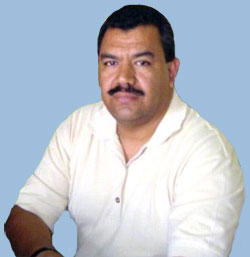
What brings me to comment on the issue today is an interview with Javier Medina, Director of KuKulcan (pictured above), which runs in today's issue of the Honduran newspaper Proceso.

Mr. Medina explains that the word KuKulcan is "associated with the name that the Maya people gave their highest god... [who] symbolized the start of any new stage in Maya life and represented the highest masculine deity."

He speaks of experiencing discrimination at previous jobs and being fired for being gay and of hospitals refusing to treat patients who self-identify as gay.

On the issue of marriage rights for same-sex couples, Mr. Medina says: "It's an issue we have not even contemplated, what's more, it was the church representatives who brought up the issue and made it relevant and - now that they have - why not consider it in the future?"

On God, he says: "I live my spirituality, I am not religious, I do believe in God... I do not believe in the Bible because it was written by men 90 years after the death of Christ, [and is based on a] translation from a dead language to a current language in the context of other writings."

On when he came out as being a gay man: "More than 20 years ago, in addition I am a public figure and why should I hide it?"

These are not easy times for gay people in Honduras. If you've read this far and are as outraged at the governmental trampling of their rights and the courage of people such as Javier Medina who are still willing to lead the fight I would urge everyone to take action by visiting this Amnesty International action alert page and following the steps to let the Honduran government how you feel about it.