Showing posts with label Paraguay. Show all posts

Thursday, May 14, 2009

Uruguay: President to lift ban on gays in the military

As The Huffington Post reported yesterday, a bill lifting the country's ban on gays in the military has reached the desk of the President of Uruguay and is expected to be signed into law in the following days (Rachel Maddow featured the news last night on her show - see above).

The Associated Press reports that the ban was implemented by the country's rulers during the dictatorship years (1973 to 1985) and had remained in the books since then.

Not surprisingly, today's El Pais says that retired military leaders are furious and have called it "a provocation" which will end up having detrimental effects on the Armed Forces' "morals."

Current officers, also interviewed anonymously, expressed surprise at the decree, which they say caught them off-guard, but were more open to the announced changes than the old guard.

Back in December of 2007, Uruguay became the first country in Latin America to allow civil unions between same-sex couples on a national scale.

UPDATE: President Vázquez signs the bill, President of Paraguay says that his country is not ready...

President Tabaré Vázquez has signed the bill into law according to Reuters.

"The Uruguayan government does not discriminate against its citizens based on their political condition, their ethnic condition or their sexual choice," said the president.

Reuters also reports that the president of neighboring Paraguay, Fernando Lugo, was also present at the bill signing and told reporters that he agreed with the need to end discrimination in his country as well. But, when asked about promoting a similar bill in Paraguay, he said that his country was far from being discussed, much less approved.

"In Paraguay the problem has not been presented" he said, "but, as a matter of fact, I am afraid it does exist. I believe that, in Paraguay, we often are late arrivals (and) we only tackle it after the fact."

Friday, May 18, 2007

IDAHO 2007 in Latin America

Most of the world, except for the United States, celebrated their own private and not-so- private IDAHOs (short for International Day Against Homophobia) as Doug Ireland reports on his blog.

Information over on the IDAHO website indicates the following activities took place in Latin America and the Caribbean:

• Brazil: Among several activities that took place in different cities throughout the giant nation, Grupo Gay da Bahia organized a "Day without Homophobia." During the event they honored members of the LGBT community lost to homophobic violence by writing their names on colorful handkerchiefs and hanging them on a line with clothespins. Photos here.

• Guyana: The Society Against Sexual Orientation Discrimination (SASOD) screened "Songs of Freedom" a documentary by Jamaican born director Phillip Pike that takes a look at homophobia in Jamaica. In doing so, organizers hoped to call attention on "the need of Caribbean societies to battle homophobia as one of the prejudices which retard the development of society." The country, which is located to the right of Venezuela and above Brazil at the north of the South American continent is populated by English-speakers and has stronger ties to Caribbean culture than to Spanish speaking South American countries.

• Venezuela: IDAHO reports that the Caracas-based Asociación Civil Unión Afirmativa (Affirmative Civil Union Association) was to hold a kiss-a-thon in front of the Venezuelan Supreme Tribunal to ask the court to rule on a petition submitted more than two years ago to determine if the Venezuelan constitution grants certain partnership rights to same-sex couples. I couldn't find coverage in the local press.

Newspaper articles from the last couple of days also reveal the following events in other Latin American countries:

• Mexico: The Human Rights Commission of the Federal District, the National Council for the Prevention of Discrimination and more than 60 non-profit organizations asked conservative Mexican president Felipe Calderon to designate yesterday as a "National Day Against Homophobia" (I don't think the president even replied) and highlighted a report that documented the murder of 337 individuals who were lesbian, gay, bisexual or transgender from 1995 through 2004. The organizations estimated that the number of murdered LGBT individuals might be much higher and reach into the 1,000's as homophobic violence still remains under reported in the country (La Jornada) [NOTE: A later article in La Jornada puts the number of murders at 387].

In the meantime, in Oaxaca, Amaranta Gómez Regalado also asked a local governor to designate the date of May 17th as a national day against homophobia (ADN Sureste). Amaranta was featured in the groundbreaking film "Juchitan: Queer Paradise" when she ran for political office as a muxe, neither a transgender woman nor a gay man, but a "third gender" accepted by Mexican indigenous communities as part of their culture much as some North-American indigenous cultures accept "two-spirit" individuals.

• El Salvador: Yesterday in San Salvador legislative members of the socialist political party Farabundi Marti National Liberation Front (FMNL) announced their support for a similar measure recognizing every May 17th as a "National Day Against Discrimination Based on Sexual Orientation and Gender."

The measure received a cold shoulder from members of the right-wing ARENA political party while more conservative members of the legislature reacted by insisting that the legislative body should be fighting for a same-sex marriage ban instead (El Diario de Hoy).

An amendment to the Salvadorian constitution banning same-sex marriages and adoptions by same-sex couples was approved a year ago by the Salvadorian National Assembly but still needs a second debate and vote before passage [NOTE: Both the article that describes yesterday's activities in El Salvador and a separate article also in El Diario that described the scene as LGBT advocates lobbied legislators referred to the activists as "high-heeled" or as "ladies" showing no editorial constraint in their homophobia, both by the reporters as well as the editors of El Diario. Pictured above, the great William Hernandez and members of his LGBT-rights organization Entre Hermanos, who we have featured before].

• Paraguay: The LGBT-rights organization Paragay announced a campaign to promote a bill that would amend an existing anti-discrimination law in order to protect specific social groups including gays and minorities from discrimination (Jakueke).

• Chile:
In Chile, the Homosexual Integration and Mobilization Movement (MOVILH) promoted conjugal visits for imprisoned gay, lesbian and transgender inmates (OpusGay).

• Argentina: The CHA launched an initiative to promote national and regional measures to ban discrimination, criminalization and persecution of individuals based on their sexual orientation and gender identity (Territorio Digital).

• Dominican Republic: Finally, in Santo Domingo, IDAHO was celebrated through an event recognizing the work of "seventeen individuals and eight institutions that have maintained a non-discriminatory attitude" towards gays and lesbians.

Among the honorees were El Nacional (who carried the story), the Presidential Council on AIDS and Elvira Lora, director of the cultural pages of another daily newspaper, Clave Digital.

Leonardo Sanchez, director of the gay-rights organization Amigos Siempre Amigos, announced the launch of a public campaign titled "Accept me as I am" (
El Nacional).

Monday, July 03, 2006

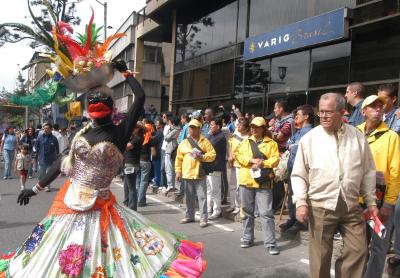
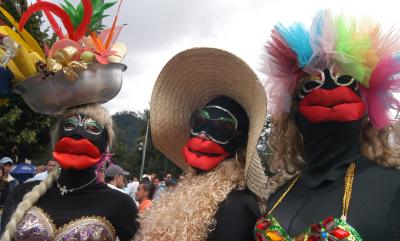
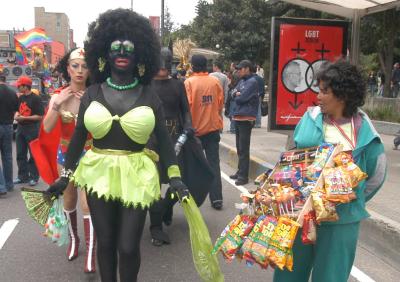
Blackface at Bogota Pride + Latin American Pride 2006


Some cities throughout Latin America celebrated gay pride this weekend including Santiago, the capital of CHILE, which observed it's first ever gay pride march and rally which drew 10,000 and a smaller "kiss-a-thon" which drew 1,500, according to some estimates. It was also a celebration of sorts for Chile's leading LGBT advocacy organization, MOVILH (which has a press release and a list of additional Spanish language coverage here), which is turning 15 years old this year [NOTE: That it was their first ever pride parade came as a surprise since back in September I had reported on another public LGBT demonstration in Chile which I thought was part of their observation of LGBT pride and now is apparent that it was just a public celebration of a decision by Chile's Education Ministry to adopt sexual-orientation non-discrimination language in the standard high-school sexual education curriculum].

AFP reports that close to 1,000 congregated and marched in VENEZUELA's 6th Annual LGBT pride celebration.

This is the same number of participants in Lima's LGBT pride celebrations in PERU according to
this AP article.

Buenos Aires, ARGENTINA, observed a trans-rights march which called for the elimination of "
repressive legislation" (Comunidad Homosexual Argentina, the country's largest LGBT advocacy organization, which organizes a larger LGBT pride parade in the fall, was not listed as a sponsor).

SentidoG.com also reports of pride marches in PARAGUAY and URUGUAY.

In the DOMINICAN REPUBLIC, participants did not march or rally but observed an end to the week-long indoor Human Rights Forum with the launch of a national coalition of a "GTH Alliance." El Nacional says that the goal of the Alliance, which would bring together HIV-service organizations and gay organizations in the Island nation, would be to "identify the issues that link HIV/AIDS and homosexuality, to coordinate national actions by gay, bi and trans men and other men who have sex with men, and to develop resources and tools to serve populations affected by the epidemic and to promote human rights to reduce risks in these populations."

Although they also called for a separation of church and state and for efforts to make the LGBT community in the Dominican Republic more visible, the language of the resolution betrays the fact that most of the event seemed more an HIV-prevention and treatment intervention rather than an LGBT rights, mobilization or visibilization effort which explains, to some degree, why there is no mention of the gay bar raids and closings of a couple of weeks back.

Finally, Bogota also saw 10,000 people march through the streets of the capital of COLOMBIA (other Colombian cities observed smaller pride parades as well). This was the 10th annual LGBT pride march which "El Tiempo" indicated converted it into an annual tradition while stating that the massive turn out was due to the fact that there was much to celebrate, including a mostly ceremonial statement released by Bogota's Mayor, Lucho Garzon, which said that the city will officially respect the rights of the LGBT community (a Bogota locality, Chapinero, had also announced earlier that they would provide institutional support for the launch of an LGBT Center while in Medellin, the city council adopted a "Public Policy for the Prevention and Attention of the Sexual Violence" affecting the LGBT community.

At the above links you might find photos of the different events which show the usual drag-queens, rainbow flags and gathered multitudes. I was particularly struck by the three pictures above of participants at Bogota's LGBT pride march
(from a photo gallery by Roger Triana at El Tiempo's link above).

I'm uncertain how and when Colombia adopted some of the blackface imagery that used to be prevalent in the United States during the last century and is mostly considered racist and defamatory nowadays in the United States (with some exceptions, which include a famous black US drag performer who has championed a certain comedian who uses blackface to make fun of blacks who is featrured in said drag performer's new CD)

Now, Colombia has not undergone a black civil rights movement process as the United States has, which is why I am often shocked by the racism I see on Colombian television, society and culture whenever I go back (considering the fact that there is a large black and mestizo community, particularly in the coasts). What makes it more insidious is that it's not self-consciously racist but simply accepted as mindless caricatures and sometimes even embraced by blacks in Colombia (something that unfortunately is not restricted to Colombia but also other Latin American countries).

LGBT organizations in Colombia have openly participated in recent demonstrations calling for a stop to racism and protections for the civil rights of black communities in Colombia (as a matter of fact, Piedad Cordoba, a leading Senator in calling for the recognition of civil union rights for gay couples in Colombia is herself black and also a leader in the country's black-rights movement).

In any case, it is painful that on a day when I should celebrate that more than ten thousand people filled the streets of Bogota calling for the recognition of LGBT rights, some saw it fit to celebrate by using some of the racist blackface costume imagery.