Showing posts with label central america. Show all posts

Sunday, March 10, 2013

Rev. Louis Farrakhan: Protect Central America's remaining anti-gay sodomy statute

Sodomy laws banning sexual activity between two consenting adults of the same-gender have mostly disappeared from the entire American continent and the two countries that still enshrine such discriminatory laws in their books could very well scrap them this year.

The South American nation of Guyana is reported to be considering abolishing the law altogether (although there has been little movement since those reports emerged last summer) and Belize will face the issue in May when the Central American nation's Supreme Court is set to hear arguments on the constitutionality of the law.

Although those who defend the laws argue that they are meant to protect local customs and morals these shameful laws can actually be traced back to British colonial rule.  But the notion that homosexuality is foreign to their cultures and that powerful imperialist nations are trying to impose their immorality by pressuring to repeal these laws has resonance with large swaths of the population.

Which brings us to Nation of Islam leader Louis Farrakhan.

The fiery American preacher is not exactly known for being gay-friendly and in May he riled against Barack Obama after the president came out in favor of same-sex marriage calling him "the first president that sanctioned what the scriptures forbid."

Last week found Farrakhan visiting Belize at the invitation of some of the same religious leaders who are calling for the Supreme Court to let the current sodomy law remain standing. Conservative Christian television network Plus TV captured his response.


His comment:
How many of you see same-sex marriage and are falling for the pressure that's being put on government to sanction something that God don't sanction. America is attaching aid to you rewriting your constitution, rewriting your laws and because you become a whore for money and forsaken the principles and yet you put your hand on the Bible when you take your oath of office. For what?
Caleb Orozco
Let's be clear here: Although local LGBT advocates would like their relationships to be legally recognized, same sex marriage is not at play when the Belize Supreme Court takes up the issue of the sodomy laws in May. He also falsely alleges that aid from the United States will be cut unless laws are changed to accommodate gays and lesbians.

What Farrakhan is doing is urging legislators to keep a law that punishes and jails gay Belize citizens for who they are. Nothing less, nothing more.

Caleb Orozco, the most visible openly gay advocate in Belize, says it will be an uphill battle to get the Supreme Court to strike down the sodomy laws but he has hope that they will rule on the right side of history.  The organization he leads, the United Belize Advocacy Movement, was the entity that brought a challenge to the nation's sodomy statute before the Supreme Court back in 2010.

His visibility has brought some risk. In February of 2012 he was assaulted and hit with a beer bottle. United Nations rapporteurs Frank La Rue and Margaret Sekaggya stepped in back in August after local authorities seemed to dismiss the attack and asked the Belize government to explain their apparent inaction.

To my knowledge, Orozco will be the only openly gay person to be allowed to present arguments against the Belize sodomy statutes when the Supreme Court holds their hearings in May.

Orozco has said that it will be an uphill battle for the Court to strike down the laws but that he still has hope that it will rule on the right side of history.

In this video from 2012, Orozco and other members of the United Belize Advocacy Movement, talk about the reason they launched a "dignity rights" campaign.


It begs the question: Who is Farrakhan standing for? The politically powerful right wing churches that invited him to visit Belize? Or the disenfranchised and legally unrecognized LGBT community in Belize whose own government would rather deny they exist.

Reactions:

Saturday, January 21, 2012

Leading Costa Rican LGBT-rights activist Abelardo Araya dies at 42


Abelardo Araya, one of the leading LGBT-rights advocates in Latin America, has passed away at 42 years of age.

Friends and relatives found Araya dead at his apartment on Thursday after not hearing from him for a couple of days. Police have ruled out foul play and believe that he died of a heart attack. Araya had recently spent a few weeks at a local hospital for ailments related to high blood pressure, heart problems and diabetes.

La Nación says that Araya developed his thirst for activism while living in Ecuador in the 1990's. When he returned to Costa Rica in 1998 he became the coordinator of a program offering support to parents and relatives of gay and lesbian children at the Latin American Health Prevention and Education Institute.

He would later launch Movimiento Diversidad (the Diversity Movement), a non profit LGBT-rights organization which sought to visibilize the Costa Rican LGBT community and increase its political power.

Speaking to Telenoticias 7, Marco Castillo, the organization's attorney and a close friend of Araya's said that while members of the LGBT community already had begun to organize, Araya was the first person in Costa Rica to organize public LGBT conferences and offer invitations to media to cover the events.

Araya had last appeared on Telenoticias 7 on December 29th when he announced that members of the LGBT community would provide entertainment to the public during the end of the year bullfighting ceremonies. Yet another way that Movimiento Diversidad sought to give the community a public face.

One of Araya's biggest political battles was promoting the legal recognition of same-sex partnership rights.  In 2006, several legislative leaders sought his counsel in authoring a bill that would make civil unions legal for same-sex couples in Costa Rica. Several versions of the bill have been drafted but have failed to get much traction to this date.

In May of 2011, Movimiento Diversidad also provided support for two gay couples who went to court and demanded the right to marry. The court ruled against the couples but the action drew so much attention that Costa Rican President Laura Chinchilla was put on the spot.

Chinchilla, who had ran on a "family values" platform and had previously spoken against same-sex partnership rights, stunned everyone when she said she would actually not be opposed to the legalization of same-sex marriages in her country.

In December, 20 legislators sent President Chinchilla a letter asking her to be the lead sponsor of a same-sex civil union bill. She turned them down saying that her job as a president was to focus on the country's economy and public safety.

Former Costa Rican José Meino del Rio, one of the sponsors of the 2006 civil unions bill, showed up at yesterday's wake to talk about the integral part that Araya played in moving these bills forward.  Addressing Araya's mother directly, Meino del Rio spoke of the hateful homophobic insults her son had endured from the religious right.
The [2006] bill and others that have been introduced since then have created a national debate in which we heard, in effect, the voice of hate from the religious leadership. Pay it no mind, Mrs. Araya.  Have no doubt that wherever [Abelardo] is, he is looking at us. And, from there, he is saying "Have faith! Push forward! Do not let them win, do not give up! Let my death not be forgotten as an example because no one dies as long as someone remembers you'.
Tico Bears, of which Araya was a proud member, posted a video of Meino del Rio's remarks which I have excerpted above.


Even after death, homophobia in media: On a related matter, as news of Araya's death hit social media yesterday, people on Twitter were outraged by a story on Araya's passing posted without a byline in a Costa Rican MSN News affiliate.

The post, which has since been removed but can be read in a cached version here, was shocking in its homophobic insensitivity.

Saying that Araya had spent years fighting for "the so-called rights a same sex couple could enjoy," the writer chalked up his recent ailments as "just one additional problem that added to his suffering."

He goes on: "Araya had already spent more than ten years leading of these kind of people, a group that has grown larger than it ever should as the days go by; nevertheless, even though it's all sorrow to them, they will have to let the days pass and then sit down to figure out who might become the new captain of their Love Boat."

Kölbi, The cell company that runs the MSN News page on which the article was posted later apologized and said that the site had inadvertently reproduced content from a separate site not affiliated with the cell brand of MSN News.

"Kölbi reiterates the respect we have for sexual diversity and expresses our deep sense of solidarity with Mr. Araya's friends and family," said a statement from the company, "Kölbi commits itself to give absolute respect to sexual diversity, as it has done in the past, on the basis of the corporate guidelines of our parent company, the Costa Rican Institute of Electricity."

I have a feeling that Araya would be proud that, even in death, his legacy would lead to a national company restating their commitment to respect the LGBT community in his country.

Rest in peace, Abelardo.

UPDATE: Tuanix Interactive Media, which provides content for Kölbi, has released their own statement apologizing to the Araya family, to Kölbi and to MSN for the homophobic column.  They have announced that the author of the piece, Walter Carrera, was fired on the spot on the same day the company became aware of the column he had authored.


Related:

Wednesday, January 19, 2011

U.S. Embassy in Honduras expresses concern for recent killings of members of the LGBT community


Photo: LGBT rights advocates hold a press conference on the streets of Tegucigalpa on January 13th, 2011. The banner reads "No to hate crimes" and it highlights the brutality used in the recent murders of transgender women and gay men who have been stabbed, shot, strangled and incinerated (Source: La Prensa)
Earlier today The United States Embassy in Honduras released the following statement (Spanish version here):
United States Embassy Notes Concern for Recent Killings of Members of the LGBT Community
January 19, 2011

Tegucigalpa - The U.S. Embassy notes with concern the five killings that have been committed against members of the lesbian, gay, bisexual, and transgender (LGBT) community since December 18, with the latest being in San Pedro Sula January 17.

The protection of Honduran law extends to all its citizens regardless of sexual orientation and the Lobo Administration has repeatedly expressed its commitment to defend the rights of all Honduran citizens.

It is in this regard that we call upon Honduran law enforcement authorities to vigorously investigate these crimes, bring to justice the perpetrators, and take all necessary steps to protect LGBT persons, who are among the most vulnerable to violence and abuse in Honduras.
It's the highest-profile official statement I have seen since Honduran media began profiling a series of gruesome murders, mostly against the transgender community, that have taken place since December 18th and since the International Gay and Lesbian Human Rights Commission launched an action alert demanding authorities investigate these crimes (Warning: Graphic images).

On Monday, the Geneva-based UNAIDS also released a statement condemning the murders:
UNAIDS condemns killings of transgender people in Honduras

17 January 2011

GENEVA, 17 January 2011—UNAIDS is concerned by the recent reported killings of transgender people in Honduras. Since late November 2010, five individuals from the transgender community have been reportedly killed in separate incidents in the country. The motive for these killings has not been determined.

“UNAIDS urges the Government of Honduras to take every step to investigate these killings thoroughly,” said Mr Michel Sidibé, Executive Director of UNAIDS. “All forms of discrimination, including transphobia, block access to HIV prevention programmes and impact the quality of care for people living with HIV.”

Honduras has committed to protecting the human rights of all individuals in various international and regional resolutions. “I urge all states to provide adequate protection to transgender people,” said Mr Sidibé.

UNAIDS expresses its full support for the community of transgender people in Honduras and for the Latin American Network of Transgender People (REDLACTRANS) in their efforts to stop intimidation and violence against transgender individuals.
On January 13th, a number of LGBT rights advocates protested outside the national Public Prosecutor's office demanding action.  Holding banners that called for an end to hate crimes and graphic images of murdered transgender women that had been featured on the cover of several local tabloids, activists argued that the government-sponsored institution had done little to stem the violence.

According to La Prensa, activists called attention to the killing of of well-known and respected LGBT rights activist Walter Trochez on December 13th of 2009 and the fact that his murder was still unresolved a year after his murder.

José Zembrano, one of the protesters, said that there was hate in Honduran society towards sexual diversity.  "Just in the last 45 days we have learned of the killing of five of our [transgender] friends", he said.

The activists said they knew of 31 transgender women who had been murdered since June 28th of 2009.

Later, La Tribuna reported that Sandra Ponce, the Public Prosecutor herself, had stepped out of her office and expressed concern about these crimes:
The Prosecutor's Office is giving priority to every case, independently of whether it's our responsibility to pursue state officials who commit human rights violations while on duty; nevertheless, taking note that there might be an element of discrimination and homophobia in these killings, we have put them under investigation.
On January 17th, as today's U.S. Embassy statement mentions, La Prensa reported yet another murder of a transgender woman. The sixth transgender woman found murdered, according to the paper.

Wednesday, December 17, 2008

Nicaragua: 75 LGBT activists from the Central American region meet in Managua

Seventy-five lesbian, gay, bisexual and transgender delegates from different Central American countries congregated this past week in Nicaragua's capital city of Managua for what participants are calling the first such region-wide encounter, reports El Nuevo Diario ("First gathering on sexual diversity comes to an end", Dec. 15, 2008).

Bismark Moraga, the coordinator of the gathering, said that he hoped that the meeting would bring a bout a new political vision on a regional level that would result in advocates demanding that their governments promote the recognition and respect for the rights of the LGBT communities including the right to education and health coverage as well as protection from discrimination.

The event, which was sponsored by the Norwegian embassy in Nicaragua, was organized by the Center for International Studies and the lesbian-rights organization SAFO.

The event served as the launching venue for a new study that takes a look at gay life in Managua which revealed, among other things, that there are high levels of unemployment among LGBT community members who live in the city.

Tuesday, August 26, 2008

Panama: President Martino Torrijos Espino repeals sodomy statute

An update: Last year after I stated that Nicaragua had become the last Spanish-speaking country in Latin America to remove a sodomy statute from its books, journalist Rex Wockner unearthed a 1949 law in Panama which penalized "clandestine prostitution, procurement (proxenetismo), sodomy and all vices of sexual degeneration not specified under this Decree will be sanctioned with penalties imposed by the Director of the Department of Public Health" with up to one year in prison or a $500 follar fine.

Good news! In his syndicated International News column dated August 14th, Rex says that on July 29th Panamanian president Martino Torrijos Espino signed a decree repealing the law.

"According to Amnesty International," Rex says, "11 nations in Central America, South America and the Caribbean continue to ban gay sex -- Antigua and Barbuda, Barbados, Belize, Dominica, Grenada, Guyana, Jamaica, Saint Kitts and Nevis, Saint Lucia, Saint Vincent and the Grenadines, and Trinidad and Tobago. All of the countries are former British colonies."

Friday, March 28, 2008

Costa Rica: President Arias designates May 17th as "National Day Against Homophobia"

My friend Francisco Madrigal, a long-time LGBT rights advocate from Costa Rica, sent me wonderful news earlier this week.

On Wednesday, the Costa Rican government released Executive Decree 34399-S with signatures from President Oscar Arias Sanchez and Health Minister Dr. Maria Luisa Avila designating May 17th as the nation's official "National Day Against Homophobia."

The measure, which came at the request of the Center of Investigation and Promotion of Human Rights in Central America (Centro de Investigación y Promoción para América Central en Derechos Humanos or CIPAC), was actually signed on February 12th of 2008 and reads:

"Public institutions must amply disseminate the objectives of this commemoration. They also must facilitate, promote and support activities directed at the eradication of homophobia."

The May 17th date was chosen by advocates as commemoration of the date that the World Health Organization officially removed "homosexuality" as a mental illness in 1990.

Efforts to declare May 17th as an "International Day Against Homophobia" or IDAHO have been led by Frenchman Louis-Georges Tin and the International Lesbian and Gay Association as well as the Fondation Émergence in Canada.

There have been sporadic events and demonstrations throughout Latin America in past years on May 17th but this is the first time that I know of a Latin American president signing an official declaration recognizing the event.

In Mexico, LGBT rights advocates were successful in getting Mexico City to officially recognize May 17th as a "Day Against Homophobia" but efforts to have the federal government recognize a national commemoration have faltered.

Friday, May 18, 2007

IDAHO 2007 in Latin America

Most of the world, except for the United States, celebrated their own private and not-so- private IDAHOs (short for International Day Against Homophobia) as Doug Ireland reports on his blog.

Information over on the IDAHO website indicates the following activities took place in Latin America and the Caribbean:

• Brazil: Among several activities that took place in different cities throughout the giant nation, Grupo Gay da Bahia organized a "Day without Homophobia." During the event they honored members of the LGBT community lost to homophobic violence by writing their names on colorful handkerchiefs and hanging them on a line with clothespins. Photos here.

• Guyana: The Society Against Sexual Orientation Discrimination (SASOD) screened "Songs of Freedom" a documentary by Jamaican born director Phillip Pike that takes a look at homophobia in Jamaica. In doing so, organizers hoped to call attention on "the need of Caribbean societies to battle homophobia as one of the prejudices which retard the development of society." The country, which is located to the right of Venezuela and above Brazil at the north of the South American continent is populated by English-speakers and has stronger ties to Caribbean culture than to Spanish speaking South American countries.

• Venezuela: IDAHO reports that the Caracas-based Asociación Civil Unión Afirmativa (Affirmative Civil Union Association) was to hold a kiss-a-thon in front of the Venezuelan Supreme Tribunal to ask the court to rule on a petition submitted more than two years ago to determine if the Venezuelan constitution grants certain partnership rights to same-sex couples. I couldn't find coverage in the local press.

Newspaper articles from the last couple of days also reveal the following events in other Latin American countries:

• Mexico: The Human Rights Commission of the Federal District, the National Council for the Prevention of Discrimination and more than 60 non-profit organizations asked conservative Mexican president Felipe Calderon to designate yesterday as a "National Day Against Homophobia" (I don't think the president even replied) and highlighted a report that documented the murder of 337 individuals who were lesbian, gay, bisexual or transgender from 1995 through 2004. The organizations estimated that the number of murdered LGBT individuals might be much higher and reach into the 1,000's as homophobic violence still remains under reported in the country (La Jornada) [NOTE: A later article in La Jornada puts the number of murders at 387].

In the meantime, in Oaxaca, Amaranta Gómez Regalado also asked a local governor to designate the date of May 17th as a national day against homophobia (ADN Sureste). Amaranta was featured in the groundbreaking film "Juchitan: Queer Paradise" when she ran for political office as a muxe, neither a transgender woman nor a gay man, but a "third gender" accepted by Mexican indigenous communities as part of their culture much as some North-American indigenous cultures accept "two-spirit" individuals.

• El Salvador: Yesterday in San Salvador legislative members of the socialist political party Farabundi Marti National Liberation Front (FMNL) announced their support for a similar measure recognizing every May 17th as a "National Day Against Discrimination Based on Sexual Orientation and Gender."

The measure received a cold shoulder from members of the right-wing ARENA political party while more conservative members of the legislature reacted by insisting that the legislative body should be fighting for a same-sex marriage ban instead (El Diario de Hoy).

An amendment to the Salvadorian constitution banning same-sex marriages and adoptions by same-sex couples was approved a year ago by the Salvadorian National Assembly but still needs a second debate and vote before passage [NOTE: Both the article that describes yesterday's activities in El Salvador and a separate article also in El Diario that described the scene as LGBT advocates lobbied legislators referred to the activists as "high-heeled" or as "ladies" showing no editorial constraint in their homophobia, both by the reporters as well as the editors of El Diario. Pictured above, the great William Hernandez and members of his LGBT-rights organization Entre Hermanos, who we have featured before].

• Paraguay: The LGBT-rights organization Paragay announced a campaign to promote a bill that would amend an existing anti-discrimination law in order to protect specific social groups including gays and minorities from discrimination (Jakueke).

• Chile:
In Chile, the Homosexual Integration and Mobilization Movement (MOVILH) promoted conjugal visits for imprisoned gay, lesbian and transgender inmates (OpusGay).

• Argentina: The CHA launched an initiative to promote national and regional measures to ban discrimination, criminalization and persecution of individuals based on their sexual orientation and gender identity (Territorio Digital).

• Dominican Republic: Finally, in Santo Domingo, IDAHO was celebrated through an event recognizing the work of "seventeen individuals and eight institutions that have maintained a non-discriminatory attitude" towards gays and lesbians.

Among the honorees were El Nacional (who carried the story), the Presidential Council on AIDS and Elvira Lora, director of the cultural pages of another daily newspaper, Clave Digital.

Leonardo Sanchez, director of the gay-rights organization Amigos Siempre Amigos, announced the launch of a public campaign titled "Accept me as I am" (
El Nacional).

Thursday, December 01, 2005

On World AIDS Day: A Little Noticed Protest in Central America


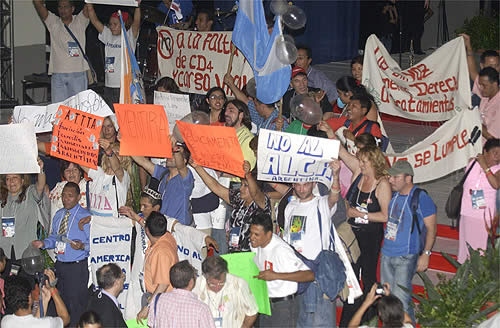
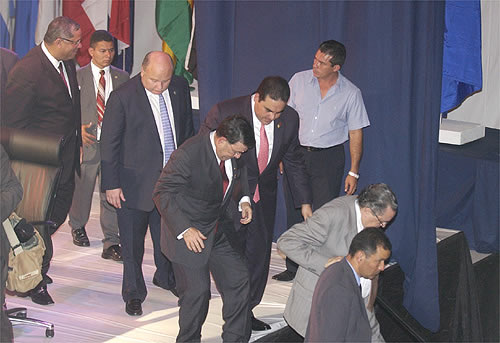
HIV positive activists and allies stage a surprise public protest at the 3rd Latin American and Caribbean Forum on HIV/AIDS at the November 11th closing ceremony in El Salvador; Bottom photo: Elias Antonio Saca, President of Costa Rica and Abel Pacheco, President of El Salvador hurry off the stage to avoid answering protesters.

After more than 10 years of work for an AIDS-prevention agency in the United States, another December 1st rolls around and you become a little disengaged from all the World AIDS Day awareness events and press releases. You grow weary when your own agency organizes a Latino AIDS Awareness Day event and includes women, youth and faith based initiatives in the day's activities but neglects the gay community - at least in its promotional materials and workshop planning (but secretly suspect that all those faith-based prevention funds coming down from the government have something to do with it as well as the involvement of the not so gay friendly Hispanic Federation). You remain HIV negative but see friends become HIV positive over time, you remember those friends who have passed away (Antonio Hernandez, you are always in my heart!) and you pray that the current right-wing assault on anything gay is just a last desperate all-out attack which will fall on its empty logic sooner than later (it's a major barrier to develop prevention messages that are based on increasing gay men's self worth as a means to prevent HIV infection and transmission - and actually work - rather than HIV prevention based on making gay men feel scared or pathologized)

So when there are things that give you a bit of hope and give you reason to continue working in the field, it's better to share, no?

From November 8th through the 11th of this year, El Salvador hosted the 3rd Latin American and Caribbean Forum on HIV/AIDS (organized by CONCASIDA). The only major North American coverage I saw of the event was articles highlighting the presence of actress Ashley Judd, yet, over "3,000 politicians, police chiefs, doctors and activists" met at a time when key questions are being raised about the availability of HIV/AIDS treatments throughout Latin America and the impact of free trade agreements - which the United States have been aggressively pursuing to their economic benefit and include stricter regulations - and increasing barriers - to access to HIV meds in the region.

It is not at all easy to keep up with complex governmental trade treaties, much less to be at the table when concessions are made or deals are brokered between governments. And, though I am privy to an e-mail list that is amazingly up to date on the impact of these treaties on HIV prevention world-wide, the language used on the list is English which keeps most Latin American HIV activists in the dark (I know of no similar Spanish-language list).

So when I read news that a large group of HIV positive activists and allies interrupted a series of speeches by governmental leaders by walking into the convention center and holding banners questioning the trade treaties and shouted down some of the Central American presidents who were speaking on the podium, I though "Damn! Great for them!"

Unfortunately, local media such as La Prensa Grafica and El Diario de Hoy mostly disregarded the activists' demands and went as far as to call them misguided and quoted El Salvador government officials who did not waste time in denouncing the protests calling them politically slanted and orchestrated. La Prensa Grafica said that the government was even considering taking legal action against some of the protesters.

In a statement released by the protesters they said the following:
The protest at the closing day ceremony happened because a large number of participants such as ourselves were tired of so the posturing by not only the governmental authorities [present] but also the funding agencies and some individuals 'representing society and people living with HIV/AIDS' who completely forgot how they reached their positions.
They also denied that any one person had manipulated them or orquestrated the protest, or that the protesters were affiliated with a specific political group. They did express fear that there'd be efforts to take action against them due to the public nature of the protest and reminded journalists that in a free democracy they should have the right to protest.

Fortunately, renowned AIDS activist Richard Stern, from the Costa Rica-based Augua Buena Association saw the government response as what it was: An attempt to dissuade public criticism of their HIV policies and intimidate activists and quickly moved to secure international support for the protesters.

Thanks to Richard, UNAIDS released the following statement on November 19th, 2005:
UNAIDS recognizes the efforts made by the Salvadorian National AIDS Programme and all the other organizers of the FORO/CONCASIDA2005 conference and the High Level Presidential Forum on HIV/AIDS for these highly successful events. We believe that the Conference will result in a stronger commitment to HIV/AIDS by all the stakeholders in Latin America and the Caribbean.

AIDS is a shared concerned and all partners need to make their contribution in order to ensure good follow-up to the commitments made at the Conference ultimately leading towards a stronger response to the epidemic in the Region.

Civil society, and in particular people living with HIV/AIDS, are essential partners who are at the forefront of the AIDS response in all Latin American and Caribbean countries.

Their full engagement and energetic activism give voice to the voiceless and make an essential contribution towards pushing the agenda on key HIV treatment and prevention issues. In this context, building a true and open partnership between civil society and governmental partners is a key strategy for an effective response to the epidemic.

An open, considerate and fruitful dialogue between civil society, governmental and all other stakeholders in a country, where all partners listen to one another and each is able to express their views and opinions in a respectful way and without fears of consequences for their safety and well being, is the only way to ensure that our collective response to the HIV/AIDS epidemic moves successfully forward. UNAIDS is committed to play its role in facilitating such dialogue and strengthening partnerships throughout the Region.

Many contacts among PLWA, Civil Society, Government representatives, international organizations and others have being done by the UNAIDS regional office since yesterday, and it seems to us that the situation in the region is taking the route of dialogue. It is our understanding that meaningful conversation have started between the Government, PLWA and civil society.

Best regards,

Nancy Andrade-Castro
UNAIDS
Directora Regional a.i
So, to all those HIV/AIDS activists who were corageous enough to raise their voices and show their faces in demanding access to treatments for Latin America and the Caribbean, my hat goes off to you! On World AIDS Day, your actions are what keeps me going in this field.

Wednesday, August 24, 2005

Beneath the Radar: Aruba, the Cherokee Nation and the Mayan Indians

Just beneath the radar, there have been some interesting developments on the same-sex marriage front in the Caribbean and among indigenous groups in the United States and Central America.

· Yesterday, Aruba’s Superior Court said that the government had to register the Dutch marriage of two women, Aruban-born Charlene Oduber-Lamers and Dutch-born Esther Oduber-Lamers, under laws established when the Caribbean island was a Dutch colony. Unlike former British colonies in the Caribbean (i.e. - Bahamas, Turks & Caicos, Jamaica and Belize), Dutch colonies (i.e. - Aruba and the Dutch Antilles) never inherited anti-sodomy statues from their colonizers which – in general – makes them supposedly less homophobic. Nevertheless the ruling is already creating tensions between the Aruba government and Holland as Aruba is determined to make a final appeal before the Dutch Supreme Court arguing “that Dutch law also grants the island the right to self-rule - permitting it to ignore Holland's legalization of gay marriage” and that “the civil code [does] not allow for same-sex marriage and that it would go against Aruba's way of life.”


· Just as in the case of the Oduber-Lamers, Dawn McKinley and Kathy Reynolds are a lesbian couple who are also struggling to have their marriage recognized by a different nation: The North-American Cherokee nation. Both had received a marriage certificate when they exchanged vows in May of 2004 but its official filing was stopped when Todd Hembree, a member of the tribe and attorney, sued to have it blocked arguing that he would suffer grave harm if the marriage was allowed to stand. In June of 2005, the tribe adopted language limiting marriages to couples of different sex. And, while on August 3rd a tribal court dismissed the suit saying that Mr. Hembree had no standing to file the suit and could not show how he would be harmed by the women’s marriage, on August 10th a group of Cherokee Nation Tribal Councilors filed another petition requesting a temporary injunction while also arguing that recognition of the women’s marriage would cause irreparable harm to the tribe. On August 15th, the court granted the injunction. A hearing will soon be held and debate still simmers.


· In the meantime, down in Guatemala, similar rifts were exposed recently among Maya tribe members when an unsigned Mayan Wajxaqbib’ No’ Indian Defense press release was sent out on July 6, 2005, which, among other things, stated:

Gays have risen as a result of the social decomposition in the midst of the 20th century. We cannot rationalize this issue since it does not fit within our culture as indigenous people, just as it also stands against the development of humanity according to nature’s principles…

If they were born with this defect or learned it later, we cannot, or there should not be any room for these same things to continue happening or by copying other countries’ behaviors.

It should not be strange that countries that are politically, militarily or economically powerful are the ones which have the most gays, since they are responsible for the atrocities committed against poor communities, they are the ones who export their filth and pollute our communities.

Just as the Unites States and other wealthy nations are the ones who export all type of transgeneric products, industrial pollution, chemical warfare, lack of culture, assimilation and illnesses such as AIDS and others.

This type of attitudes or customs are an inheritance from the ‘democracy’ of industrialized countries, who lack spirituality and who – currently – only see the human self as a cybernetic machine, with whom they can do as they please.

Countries such as Guatemala could not remain behind and those who govern us are the premier degenerates. Now these [governing bodies] put the legalization of gay matrimony in their agendas – is it perhaps because they cannot see the principal problems that afflict the nation?

Local non-profit, Amigos Contra el SIDA (Friends Against AIDS) picked up on the release and immediately demanded an apology, stating that it was irresponsible for a marginalized and oppressed minority to attack another, defending the right for gays to marry and adopt children, reiterating their respect for the Maya tribes and sharing anecdotes about the repression of gays in Guatemala under the hands of the police and the government.

The call to action by Amigos must have had an internal impact in certain Maya circles because, on July 31st, 2005, the Wajxaqbib’ No’ Indian Defense released an
“Error Notice Related to the Press Release Sent Out on July 6th about the Gays:”

We assume institutional responsibility for the enormous error caused by an individual’s opinion, the limited articulation of ideas on the subject in the press release, and not our institution’s political or ideological stand.

We ask for forgiveness from all those persons and institutions that received this degrading expression which caused great damage, to people and institutions that assume their full right to sexual diversity, we let you know that the position of the Indian Defense is related to the defense and respect of the rights of every person as an individual or a collective.

Though this apology is apparently the official statement that the Defense is sending out to people who contact them on the issue, to date, Amigos have yet to receive the statement directly. Amigos remain open to talking to the Maya leadership on these issues the Defense admit having little knowledge of or much familiarity.