Showing posts with label el salvador. Show all posts

Sunday, July 08, 2012

US Embassies in Latin America celebrate LGBT pride


Photo: Members of the US Embassy in Panama participate in the annual Sexual Diversity March that took place in Panama City on May 25th of 2012 (From the Embassy's flickr photo account).

[NOTE: Updated on July 18th, 2012. Latest updates at the bottom of this post]

It would be hard to overstate just how amazingly LGBT-friendly the US State Department has been under the leadership of Hillary Clinton even as she prepares to depart later this year.

I first took note of the changes at hand in January of 2011 when the U.S. Ambassador to Honduras took the highly unusual step to publicly put pressure on the Honduran government to investigate an increasing number of attacks and murders committed against dozens of transgender women throughout the nation.  That was soon followed by a Statement by President Barack Obama himself and offers from the State Department to provide intelligence and legal assistance.  It all culminated with Honduran authorities grudgingly announcing that they had launched a special hate crimes unit in November of that year.

Then came that extraordinary speech Secretary Clinton gave before the United Nations human rights office in Geneva in which she most memorably proclaimed 'gay rights are human rights' and made commitments to fight discrimination against members of the LGBT community throughout the world.

There was also the protracted fight over the confirmation of Mari Carmen Aponte as US Ambassador to El Salvador which some sought to derail in part because she had published a local essay in a Salvadorian newspaper applauding the Central American nation for the steps it had taken to prevent discrimination against its LGBT citizens.

That essay was published on June 2011 during pride month following directions from the State Department for embassies to be visible on LGBT human rights issues on a local level.

This year in her pride month remarks, Secretary Clinton made it a point to highlight the diplomatic work being done by US Embassies and Missions throughout the world on LGBT issues:
United States Embassies and Missions throughout the world are working to defend the rights of LGBT people of all races, religions, and nationalities as part of our comprehensive human rights policy and as a priority of our foreign policy. From Riga, where two U.S. Ambassadors and a Deputy Assistant Secretary marched in solidarity with Baltic Pride; to Nassau, where the Embassy joined together with civil society to screen a film about LGBT issues in Caribbean societies; to Albania, where our Embassy is coordinating the first-ever regional Pride conference for diplomats and activists to discuss human rights and shared experiences. And through the Global Equality Fund that I launched last December, we have strengthened our support for civil society and programs to protect and promote human rights.
With such strong public commitment from the State Department and Hillary Clinton it is no surprise Ambassador Aponte felt in her right and duty to be visible on the issue last year.

This year a number of US Embassies throughout Latin America felt the same way.

HONDURAS: On June 20th, US Ambassador to Honduras Lisa Kubiske tweeted "The US Government supports the Honduran LGBT community in their fight for equality and respect #humanrights #LGBTpride" on her Twitter account (she also sent the message in Spanish).

Critics of US support for Honduran president Porfirio Lobo Sósa quickly jumped on the comment and asked if US police and military funding to Honduras would be conditioned on ending killings against members of the LGBT community to which she indirectly replied "Many Honduran ‪#LGBT‬ have repeatedly told me how much they appreciate USG support of SVU which has arrested 12 ppl connected to LGBT murders."

It turns out that on the same day Ambassador Kubiske sent those tweets she was holding a public LGBT pride month event in which she reiterated some of the warnings her predecessor Hugo Llorens had given the Honduran government a year and a half earlier.

Here is a translated excerpt of her comments that day as reported by La Tribuna:
Honduras has serious issues towards the LGBT community because it does not respect their rights and for us that is a key issue. That's the reason why several officials from United States have come to Honduras to ascertain that investigations of these crimes are done in an effective and prompt manner... All vulnerable groups need protection and when crimes are committed against them they deserve an investigation and a proper judicial process.
El Heraldo also quoted the Ambassador as saying the following:
We certainly acknowledge the advances made during the previous year but we have to keep in mind that the number of violent attacks against the LGBT community have continued to increase, unfortunately.
La Tribuna also noted Interim Director for the USAID office in Honduras Ken Seifert was a guest of honor "announced" he was gay and read excerpts from his published novel "The Rising Storm".

USAID, as I wrote last month, is on the verge of launching an LGBT Global Development Partnership Initiative.

COSTA RICA:  US Ambassador to Costa Rica Anne Andrew celebrated an LGBT pride "roundtable" on June 27h inviting several Costa Rican LGBT advocates to her residence for breakfast.

On the Embassy's online site, Ambassador Andrew also highlighted the 2008 wedding of Cynthia Wang to an unnamed female partner and runs an essay from Ms. Wang on the meaning of LGBT pride.

Ms. Wang is the current Vice Consul in the American Citizen Services section of US Embassy in Costa Rica.

An excerpt from her essay:
Since we moved to Costa Rica my wife and I have felt extraordinarily well received. Some of our most intimate friends are ticos [ed. - a diminutive term for Costa Rican].  We feel a deep love and respect for this country and its culture and at a moment in time in which Costa Rica is debating LGBT rights let us hope that tolerance, compassion and a commitment to protecting human rights - a Costa Rican tradition - will also be reflected in public policies.  Here is hoping that the Costa Rican government and its civil society extends protections to all citizens, whether they be gay or heterosexual.
Two days before the breakfast roundtable Ambassador Andrews also posted the following video on YouTube under the Embassy's account...


CHILE: My friend Michael K. Lavers covered it for The Washington Blade just so I wouldn't have to and thus:
Jason Jeffreys of the U.S. embassy in Santiago spoke at the Gay Liberation and Integration Movement’s annual Equality and Human Rights for Sexual Diversity March. Jacqueline Vera, whose son Daniel Zamudio was brutally beaten to death in a downtown Santiago park in March, Education Minister Harold Beyer, a number of presidential candidates and lawmakers and Jon Benjamin, the United Kingdom’s ambassador to Chile, were among those who also participated.

“As the Human Rights Officer at the U.S. Embassy in Santiago, one of a number of policy objectives that Secretary [of State Hillary] Clinton has determined is the concept of equal protections for all, including the international LGBT community,” Jeffreys told the Blade. “I wanted to participate because I wanted to share with Chile the fact that the [U.S. government] stands with them in this regard.”

Jeffreys, whose boyfriend is Chilean, added that Zamudio’s death affected him personally. He attended candle light vigils and marches and spoke with Chilean politicians about what he described as the importance of anti-discrimination laws. Jeffreys also delivered a letter on behalf of the U.S. ambassador to Chile, Alejandro Wolff, to Zamudio’s family at his funeral.

“I jumped at the chance to be able to speak at this event to continue with this support,” he noted.
Chilean lawmakers in April passed an LGBT-inclusive hate crimes and anti-discrimination bill that had languished for seven years. President Sebastián Piñera and other leading politicians backed the measure in the wake of Zamudio’s death.
Apparently that is a grande latte cup in his hand. Are there Starbucks in Chile? Oh, and he only spoke in English according to the Embassy's website. ¡Inglés sin barreras!

Earlier in June, the Embassy also posted a podcast conversation with Julio Dantas, coordinator of Todo Mejora (the Chilean version of the It Gets Better Project) and Fulbright scholar Jenn Lerner who, according to the site, is conducting research on gay life in Chile.

PANAMA: If I hadn't asked my friend Augutín Clement, I probably would have missed this one.  It turns out that on June 25th the US Embassy in Panama actually sent a contingent to participate in Panama City's annual pride march.

In the description accompanying a photo from the event the embassy stated the following:
President Obama and Secretary of State Hillary Clinton have asked embassies throughout the world to promote and defend all human rights. Members of the US Embassy and their families participated in the Gay Pride March in Panama to celebrate diversity, promote tolerance and support the fight against HIV/AIDS.  This was the US Embassy's first official participation in support of this initiative in Panama.
"The US Embassy rocked," says Augustín, "They had shirts that said 'Estamos Unidos' ['We Are United'] and as they went by people shouted 'Long live, Obama! Long live equality!' It was truly moving."

That's a photo of Agustín, his hubby César Pereira and Duty Chief of Mission John Law as featured on the embassy's flickr account.

Johnathan D. Farrar, the current US Ambassador to Panama, did not join the contingent but he did invite Augustín to the embassy's July 4th celebration in honor of his advocacy for LGBT rights in Panama.

ECUADOR: A number of embassies not mentioned in this post did not necessarily actively participate in local pride events or held pride events of their own but added pride proclamations from Obama and Clinton on their websites as was the case with the US Embassy in Ecuador. Unlike those other unmentioned countries, they also went a step further.

On June 22nd, the embassy also released a statement by Ambassador Adam E. Namm in which he applauded Obama and Clinton for their pride month declarations and highlighted the embassy's role as one of several "co-sponsors of the GLBTI Pride Week activities in Quito" (others include UNAIDS and several local and national government agencies).

La Républica says that embassy staff participated in the inauguration of this year's film festival and a conference on human rights and the LGBT community.  In addition the paper says that the embassy promoted a "High Heel Race" in which men tried to outrun each other while wearing high heels.

The event is similar to annual events that take place in Washington, DC. and Madrid, Spain.  According to the paper, the embassy said that the event was meant to make people think about the role of social gender norms.  El Comercio has a photo gallery.

Interestingly, while it didn't receive as much media attention as Mari Carmen Aponte, Ambassador Namm was also among a number of Obama diplomatic appointees whose confirmation was blocked by Senate Republicans for months on end.  The lynchpin was Florida Republican Senator Marco Rubio who also had a large role in keeping Aponte's appointment in check until it became politically unsustainable for him to continue voting against their confirmation.

Ambassador Samm started serving in his current diplomatic position on May 31st, a year after the seat had been vacated.

EL SALVADOR: Finally, while Ambassador Aponte returned to El Salvador on June 30th and a bit late to celebrate LGBT pride, it was particularly gratifying to see her receive such a warm welcome despite claims from certain US Senators that she was not welcome there.

It is also particularly satisfying to see some of the most homophobic conservative religious elements in El Salvador and the United States recoil in frustration.  I won't translate this piece but will leave a link here for posterity.

Thank you, Madam Secretary Hillary Clinton.

--- UPDATES ---

MEXICO: On July 12th the US Embassy in Mexico invited a number of guests to the embassy and presented their entry into the "It Gets Better" project.  The video went live on YouTube on July 16th.


On their Facebook page, the embassy described the video as follows:
The US Embassy in Mexico has supported members of the LGBT community.  In this video we have included representation from the art, business and government worlds (including members of our Embassy).  All have come together to give an anti-bullying message to be shared with the It Gets Better Project.
And on the embassy's blog they host a post by my friend Enrique Torre Molina about the video's launch which includes a cute photo of Enrique hanging out with Gabriel Gutierrez Garcia and other friends at the event ("The Embassy Gets Better" - Spanish).

SPAIN (not part of Latin America, of course, but part of Ibero-America): On July 17th, 2012, the US Embassy in Spain held a historic first meeting with some of the top leaders of the LGBT movement in the country.  They included Pedro Zerolo, Carla Antonelli, Augustín López, Raúl Garcia, Toni Poveda and Boti G. Rodrigo, the current president of the Spanish State LGTB Federation (FELGBT).


On their Facebook page, the embassy posted additional images and described the meeting as follows:
Ambassador Alan D. Solomont met with leaders of the LGBT community in Spain at his residence on July 17th. They had a conversation about the history of LGBT rights in Spain, their successes and their challenges during the last few years and on how the Embassy can continue supporting human rights.  Participants showed enthusiasm for recent comments made by President Obama in favor of gay marriage in the United States and suggested steps the United States might take to support LGBT rights - particularly in countries were those communities suffer great persecution. Referring to comments made by Secretary Clinton in Geneva in December of 2011 that "gay rights are human rights and human rights are gay rights", the Ambassador expressed his wish that this roundtable would only be the beginning of closer relationship between the Embassy and LGBT groups in Spain.
Reactions:

Thursday, June 14, 2012

Mari Carmen Aponte confirmed as U.S. Ambassador to El Salvador after Democrats break Republican filibuster


Led by Nevada Senator Harry Reid, this afternoon Senate Democrats were finally able to break a Republican-led filibuster against the Obama administration's nominee for U.S. Ambassador to the United States, Mari Carmen Aponte, and gain her confirmation.

Nine Republican Senators, including Florida Senator Marco Rubio, joined 53 Democrats in invoking cloture securing the 60 votes needed to break the filibuster. Minutes the Senate confirmed the new Ambassador by voice vote before adjourning for the week.

A rising political star and possible Republican vice presidential nominee, Rubio had drawn withering criticism for voting against her last year not on her merits but because he wanted to use the vote to pressure the Obama administration to adopt his conservative interests in the Caribbean and Central America.

It didn't help that Ms. Aponte had actually served as interim ambassador for fifteen months before she was forced to step down when a confirmation failed to materialize last year.  She now will return to El Salvador after a six month absence.

Rubio, who is a Cuban-American, was particularly assailed by the Puerto Rican press who saw his vote as a possible nail in the coffin on the diplomatic career of a well-respected Puerto Rican figure.  In December he tried to make amends by saying he was ready to vote for Ms. Aponte and to bring some of his Republican colleagues to vote for her as well.

Yesterday, on the eve of the vote, Rubio was singing a different song indicating he had no idea how his Republican colleagues would vote and preemptively washing his hands of any responsibility should the confirmation fail to materialize.

In a statement released after the vote Rubio continued to whine accusing Democrats of "playing divisive ethnic politics" and trying to "divide two groups of Hispanics." LOL.

Particularly egregious, at least to me, was South Carolina Republican Senator Jim DeMint's ultra-homophobic stand against the Aponte nomination, taking specific issue with an OpEd she wrote for an El Salvador newspaper saluting the Central American nation's effort to protect the rights of LGBT Salvadoreans.

Let's take one more look at statements he made on the floor of the Senate's Foreign relations Committee last year:


Today,  let's savor DeMint's failure to sustain the filibuster. He was among the 37 'nays' earlier this afternoon.

Related:

Friday, November 18, 2011

Senator DeMint to Obama: Stop promoting human rights protections for LGBT communities outside the United States

NOTE: This entry has been cross-posted at The New Civil Rights Movement. Thanks to NCRM Editor David Badash for hosting the post there as well.

When President Barack Obama named Puerto Rican lawyer Mari Carmen Aponte as his choice to become the U.S. Ambassador to El Salvador in 2009, the nomination ran smack into a wall set up by Republican Senators who simply refused to vote on a wide array of diplomatic candidates nominated by the president.

At preliminary hearings at the time, conservative South Carolina Republican Senator Jim DeMint led the charge against Aponte raising several "issues" including ludicrous rumors that she might very well be a Communist infiltrator.

Facing an obstructionist Republican Senate, Obama waited until a congressional recess to pull several of the nominees out of the regular nomination process and use his presidential powers to appoint them as interim ambassadors.  That meant that they could immediately start serving as diplomats but would have to eventually face confirmation hearings at the end of the next calendar year from the date in which they were appointed.

Among those who were appointed for interim posts on August of 2010 was Aponte.

On a related matter, on June 27th of this year U.S. Secretary of State Hillary Clinton held the third annual LGBT pride event to happen at the U.S. Department of State under her watch.

In an extraordinary speech before staff from the Department of State and members of the U.S. diplomatic corps, Clinton saluted their work on promoting respect for LGBT communities throughout the world. An excerpt from the full speech:
There is the tremendous work that our diplomats have been doing in regional and international institutions to strengthen a shared consensus about how governments should treat their citizens. And we’ve made the message very consistent and of a high priority. All people’s rights and dignity must be protected whatever their sexual orientation or gender identity.
The very next day El Salvador's La Prensa Gráfica published an opinion piece by Ambassador Aponte titled "For an end to prejudice, wherever it exists".  An excerpt from the article (full translation at the end of this post):
Last March, before the Human Rights Council at the United Nations, the United States, El Salvador and eighty-three other nations signed a pledge to eliminate violence against members of the LGBT community; additionally, on May of 2010, Salvadorean President Mauricio Funes signed Decree 56 which prohibits all forms of discrimination by the government of El Salvador on the basis of sexual orientation or identity. I applaud efforts by the government of El Salvador in support of the LGBT community both on the national and the international level.
The OpEd drew an immediate and furious rebuke from a small but powerful group of right-wing conservative religious leaders from El Salvador and other Latin American countries.

On July 6th, ACI Prensa reported that 42 so-called "pro life" and "pro family" organizations from the United States and Latin America had signed a statement rejecting the opinion piece ("Civil groups energetically reject the gay ideology of the United States in El Salvador").  A translated excerpt:
Aponte's article is essentially a cover for those so-called 'gay rights' which are actually an attempt to disguise an absolute imposition of the LGBT lobby's ideology on Catholic countries such as El Salvador - a position promoted by the Obama administration and by his Secretary of State Hillary Clinton in particular.

It's a position taken as a ploy to impose gender ideology - which stems from the tenents of feminism and homosexual thinking - and use it to promote the idea that the differences between a man and a woman are merely social and not biological or based on nature.
As for the risks of such ideology being "imposed" on El Salvador by the United States? The actual statement released by the organizations made comparisons between the United States and the Roman Empire in the following way:
The fallen Roman Empire was considered to be modern and progressive.  Babies were aborted, newborns were murdered, and - similarly - people would engage in homosexual, bisexual and incestuous relationships, pedophilia, zoophilia and orgies. Such decadence weakened said empire and led to its fall.
Salvadoran cultural observer Marvin Aguilar took the homophobic religious doomsayers to task a week later in an OpEd that ran in La Página ("In consideration of what was said by the U.S. Ambassador"). A translated excerpt:
In the Tuesday, June 28th edition of La Pagina Gráfica, Mari Carmen Aponte wrote about the policies of the current U.S. president which which observe June as the month in which the United States commemorates LGBT pride.

She argued in favor of combating violence, hate and misconceptions about a specific community of individuals. She explained the efforts made by the current government she represents in understanding that the rights of homosexuals are Human Rights and described how [homosexuality] was no longer classified as a pathology or a perversion that should be corrected or silenced.

Nowhere in the text authored by the Ambassador did she refer to any intent by the government she represents to intervene directly in the culture, tradition and values of El Salvador.
Which brings us to this:  As an recess appointee, Aponte must be confirmed by the U.S. Senate before the end of this year to be able to keep her post and, once again, Senator DeMint is the one leading the charge against her.  But now, instead of the Cuban infiltrator charges, DeMint is questioning Aponte's strong support for the protection of LGBT communities in El Salvador.

From a November 8th confirmation hearing before the Foreign Relations Committee...


And a partial transcript...
I would like to ask unanimous consent to submit for the record an opinion piece published in El Salvador by Ambassador Aponte in June of this year.  In her OpEd, Ms. Aponte, presuming to represent the view of all Americans, in strongly promoting the homosexual lifestyle, wrote that "everyone has the responsibility to inform our neighbors and friends about what it means to be lesbian, gay, bisexual and transgender." The OpEd upset a large number of community and pro-family groups in El Salvador who were insulted by Ms. Aponte's attempt to impose a pro-gay agenda in their country.

I would also like to ask unanimous consent to submit, for the record, a response to the OpEd from a coalition of more than three dozen groups and a letter from Salvadorean groups to the United States Senate asking the Senate to oppose Ms. Aponte's confirmation and I quote "We respectfully request that Ms. Aponte be removed from her post as soon as possible so that El Salvador may enjoy the benefits of having a person as a government representative of your noble country."

I would like to apologize to the Salvadorean people on behalf of the United States and reassure them that most Americans share their values. Ms. Aponte's personal, professional and political contact over many years raises numerous questions of judgement. I will vote 'no on Ms. Aponte's confirmation and strongly recommend my colleagues do the same.
In an OpEd published the next day in the conservative website Human Events, DeMint singled out Aponte's praise for Hillary Clinton ("Aponte's Agenda").
Aponte praised Secretary of State Hillary Clinton for her previous remarks that “gay rights are human rights” and also noted gay pride month is celebrated with “parades, festivals, and educational campaigns” in the United States where the gay rights movement “celebrates its identity throughout the country.”
That's right.  Senator DeMint is urging the U.S. Senate not to appoint Aponte as U.S. Ambassador to El Salvador based on an OpEd in which she saluted the government of El Salvador for their own initiatives to protect their LGBT populations.

Aponte, who was at the hearing, defended herself against DeMint's accusations when she had a chance to reply. "The OpEd reflects the policies of the Obama administration, the Salvadorean government and sixty-three other countries," she said to La Prensa, "It was not drafted as an insult to anyone."

Salvadoran columnist Marvin Aguilar, in an OpEd column published in La Prensa on November 10th, described DeMint's attempts at getting rid of Aponte as follows:
Catholic fundamentalists in El Salvador, skipping over historical papal lessons, have begun a Christian crusade to cleanse El Salvador of Mari Carmen Aponte. They say she is a destroyer of national family values, that she promotes heinous sinfulness and, in adition, some say that she even likes the arts.  Leave it up to us, the Latin American beggars, to be more papal than the Pope when it comes to defend conservative beliefs, customs and traditions which are - of course - shared by all Salvadoreans.

Love unites but hate also brings people together.  That's the way that local Catholics with an European pedigree have built an alliance with Jim DeMint, U.S. Senator from South Carolina, who is - according to U.S. political analysts, the most conservative congressmember in the Senate. He is a member of the Tea Party and is a member of the Foreign Relations Committee of the U.S. Senate.

In sharp contrast to Salvadorean Catholic leader Archbishop Escobar Alas, DeMint has promoted prayer in schools; in contrast with people from El Salvador, he is in favor of abortion when the life of a mother is at risk; he does not want undocumented Salvadoreans living in the United States and is in favor of deporting them unlike other Catholics; he supported the Iraq invasion and when he finally visited Honduras in 2009, he met with Roberto Micheletti even though our country had not recognized his de facto government.

Nobody is perfect, least of all politicians whether they are from the U.S. or El Salvador, but... What is someone who is a Protestant Baptist and the son of divorced parents doing creating alliances with Salvadorean Catholics who sustain that divorce is a sin? What sexual agenda unites them against Mari Carmen Aponte?

Senator DeMint has publicly said that gays, single mothers, heterosexuals in civil unions as well as sexually active persons should not be hired as school educators.  Similarly, he also has been and advocate that, if government does not have the authority or the legal tools to restrict homosexuality, it also should not be promoted through the legalization of gay marriage. And that is why he has echoed the tumultuous and sad complaints shouted to heaven by the increasingly strident Salvadorean Christian movement that has taken its lobbying activities to U.S. grounds.

Senator DeMint has said that his statements [on homosexuality] are based on his personal beliefs and should not be interpreted as issues he wants or should bring up as a Senator. It's surprising, then, that he is now opposing a column written by the U.S. Ambassador in La Prensa Gráfica which only sought to explain the vision of the Obama government as related to the gay community in the United States.

A tiny drop of fundamentalist fanatics cannot represent the ocean of Salvadoreans who respect the ways of other nations.
Aguilar is making reference to several on the record comments DeMint has made in the past ("Sen. Kim DeMint: Gays and unmarried, pregnant women should not teach public school", The Huffington Post, Oct. 2, 2010).

Covering last week's hearing, La Prensa also mentions that Marco Rubio, U.S Senator from Florida and Tea Party darling, asked Aponte if she had felt pressured to write the OpEd piece.  Aponte reminded the Senator that she has written a regular opinion column for the paper and that she had written on LGBT issues specifically from a human rights viewpoint.

I have yet to find a full transcript or video of the hearing but Senate Republicans, in voting against Aponte, but her written testimony can be downloaded in PDF form here. Three former Salvadorean presidents traveled to Washington, DC, last month to support her confirmation ("Felix Rodriguez: In U.S. National Interest, confirm U.S. Ambassador to El Salvador", Miami Herald, Nov. 5, 2011).

I have translated Ambassador Aponte's "controversial" OpEd on LGBT rights. As you read it, please ask yourself who is seeking to impose certain values on El Salvador: Ambassador Mari Carmen Aponte of South Carolina Senator Jim DeMint.

Clearly for DeMint this is not only about Aponte. This is a rebuke against any attempt by the U.S. government to promote policies that extend human rights protections to LGBT populations throughout the world.

For an end to prejudice, wherever it exists
by Mari Carmen Aponte - As published in Spanish in La Prensa Gráfica on June 28th, 2011

On May 31st, President Obama proclaimed June of 2011 as the pride month for lesbian, gay, bisexual and transgender (LGBT) people.

"The history of the gay, lesbian, bisexual and transgender community in the United States," says the President's proclamation, "is the story of our parents and children, our mothers and daughters, our neighbors and friends who continue the task of making our nation a more perfect union."

In the U.S., June is recognized as Gay Pride Month, a month during which the LGBT community celebrates its identity throughout the country through parades, festivals and educational campaigns.

When Congressman Barney Frank, who is openly gay, was asked why they should be proud of such a natural and innate human characteristic, he said "We are proud to stand up to hatred, prejudice and violence, specially when it is so difficult to stand up and say 'This is me'; To do so should make us feel extremely proud".

No one should be subjected to abuse because of who he is or who he loves. Homophobia and the brutal aggression that [gays] often endure are often based on a lack of understanding about what it truly means to be homosexual or transgender. We should work together too prevent negative perceptions through education and offering support to people who confront those who promote hate.

A year ago, Secretary of State Hillary Clinton, with great passion, stated "gay rights are human rights."  In the same way, we believe people should not be stripped from their rights on the basis of their sexual preference or orientation.  For that reason, the United States will continue to support the elimination of violence and discrimination based on sexual orientation on a worldwide basis.

Last March, before the Human Rights Council at the United Nations, the United States, El Salvador and eighty-three other nations signed a pledge to eliminate violence against members of the LGBT community; additionally, on May of 2010, Salvadorean President Mauricio Funes signed Decree 56 which prohibits all forms of discrimination by the government of El Salvador on the basis of sexual orientation or identity. I applaud efforts by the government of El Salvador in support of the LGBT community both on the national and the international level.

However, the responsibility does not only lie in the hands of governments. Everyone has the responsibility to contribute whether it's by confronting intimidation or violence when it happens in our schools or worksites, or by helping to inform our neighbors and friends about what it means to be lesbian, gay, bisexual or transgender. As our nations advance, we also experience an ongoing transformation on what it means to be a citizen in a democratic society.  Together, as governments and as individuals, we can work to break the cycle of violence and discrimination.

It is the responsibility of each generation to bring our nations closer to fulfilling the promise of equality.  Progress takes time, but history is on our side when we come together to demand an end to prejudice, wherever it exists, and to celebrate the great diversity of the Americas.

Reactions:

Monday, July 02, 2007

Gay Pride in Latin America: Bolivia, Ecuador, Panama, El Salvador, Chile & Colombia

July 1, 2007: In Bogota, Colombia, the gay community mourned the death of 11 deputies that had been held in captivity by the FARC guerrilla for more than five years. The black banners and shirts also were meant to show the community's anger at the Senators that used a legislative procedure to derail a same-sex partnership bill at the last possible minute back in June (image from El Tiempo)

You might have seen coverage of pride marches in Spain and Brazil elsewhere so we'll skip those (just Google both and see what comes up or, better yet, browse GayNewsWatch.com for related stories).

We have already written about last week's rally in the Dominican Republic. Here is a look at other pride marches and events in Latin America that took place over the weekend that might have received less attention in these latitudes.

Cochabamba, Bolivia: Santa Cruz and the capital city of La Paz might have observed gay pride events in previous years but this year it was the Andean city of Cochabamba to launch their first pride event ever (abuove-right press conference image taken from Los Tiempos).

On Sunday, Los Tiempos reported that the previous day's gathering at the city's main plaza was attended by thousands of individuals who "danced with transsexuals, gays and lesbians."

"I didn't know Miss Cochabamba was so tall!" said an older woman as she posed for a photo with the Queen of the Gays, stated the reporter.

The paper took note of the visible trans presence and the lack of confrontations or disruptions that have marred pride events in other Bolivian cities.

Guayaquil, Ecuador. El Comercio reports that 300 people showed up for an afternoon of artistic shows at an outdoor plaza on Thursday, June 28th. The event, which began last year, was organized by the Friends for Life Foundation under the theme of "The problem is not homosexuality... The problem is homophobia." The Foundation has posted images of the event over on their blog here and here.

Panama City, Panama.
The Association of New Men and Women of Panama (AHMN), observed pride by releasing their first ever "Top Ten Most Homophobic Panamanians" list which included television personalities, religious leaders and politicians.

At least one of the nominees expressed surprise at being nominated: Critica Libre columnist Julio Cesar Caicedo told the AFP "I am not a homophobe."

San Salvador, El Salvador. EFE reports that hundreds of people, including representatives from half a dozen HIV prevention and gay rights organizations participated in a gay pride march through the streets of San Salvador. Under the theme of "Diversity in Action" well-known gay-right activist William Hernandez stated that there was a lack of funding and institutionalized support for anti-homophobia trainings or campaigns or for HIV prevention campaigns specifically targeting the gay community.

Santiago de Chile, Chile. Last week the Chilean arm of Amnesty International said that two leading gay rights organizations, MUMS and MOVILH, had received anonymous threatening messages through the internet in advance of Sunday's pride fair. In June MOVILH's website had also been hacked twice also by unknown put self-proclaimed skinheads who posted offensive messages and images instead of the usual content.

Fortunately MOVILH's portal is back in MOVILH's hands and they report no incidents of violence at Sunday's cultural fair which celebrated both LGBT pride as well as the organization's 16th anniversary. They also have a photo gallery of the day's proceedings here (if people seem a bit bundled, keep in mind that it's currently winter down in Chile).

La Nacion had perviously reported that, parallel to the day's events there would also be a second annual "kiss-a-thon" organized by MUMS in a show of support for anti-discrimination legislation.

Bogota, Colombia. Organizers of Bogota's pride march also denounced internet-based threats from anonymous self-described "skinheads" on the eve of Sunday's event. Fortunately, the march drew an estimated 10,000 participants despite cold rainy weather and there were no reports of any disruptions or clashes although a group of pro-gay skinheads did participate.

Organizers of the event, led by the Colombian LGBT rights advocacy organization Colombia Diversa, had planned to wear black shirts in protest of last month's 12th hour defeat of a landmark bill that would have given same-sex couples in Colombia some partnership rights. But on Sunday the black banners and shirts also served as a powerful symbol that the LGBT community in Colombia stood together with the rest of the country in mourning the death of 11 councilmembers who had been held in captivity for five years by the FARC guerilla organization (the FARC say that the kidnapped men died in a confrontation with armed forces while the Colombian government has categorically denied any rescue mission or military activity against the FARC in the area).

In addition to those visible expressions of sadness, Fabian David, a young man who marched along with his boyfriend, noticed another key difference from marches in years past: "The majority of are not wearing masks," he told El Tiempo, "This is because there is a sense of increased comfortability with the issue."

El Tiempo has a gallery of images here.

Friday, May 18, 2007

IDAHO 2007 in Latin America

Most of the world, except for the United States, celebrated their own private and not-so- private IDAHOs (short for International Day Against Homophobia) as Doug Ireland reports on his blog.

Information over on the IDAHO website indicates the following activities took place in Latin America and the Caribbean:

• Brazil: Among several activities that took place in different cities throughout the giant nation, Grupo Gay da Bahia organized a "Day without Homophobia." During the event they honored members of the LGBT community lost to homophobic violence by writing their names on colorful handkerchiefs and hanging them on a line with clothespins. Photos here.

• Guyana: The Society Against Sexual Orientation Discrimination (SASOD) screened "Songs of Freedom" a documentary by Jamaican born director Phillip Pike that takes a look at homophobia in Jamaica. In doing so, organizers hoped to call attention on "the need of Caribbean societies to battle homophobia as one of the prejudices which retard the development of society." The country, which is located to the right of Venezuela and above Brazil at the north of the South American continent is populated by English-speakers and has stronger ties to Caribbean culture than to Spanish speaking South American countries.

• Venezuela: IDAHO reports that the Caracas-based Asociación Civil Unión Afirmativa (Affirmative Civil Union Association) was to hold a kiss-a-thon in front of the Venezuelan Supreme Tribunal to ask the court to rule on a petition submitted more than two years ago to determine if the Venezuelan constitution grants certain partnership rights to same-sex couples. I couldn't find coverage in the local press.

Newspaper articles from the last couple of days also reveal the following events in other Latin American countries:

• Mexico: The Human Rights Commission of the Federal District, the National Council for the Prevention of Discrimination and more than 60 non-profit organizations asked conservative Mexican president Felipe Calderon to designate yesterday as a "National Day Against Homophobia" (I don't think the president even replied) and highlighted a report that documented the murder of 337 individuals who were lesbian, gay, bisexual or transgender from 1995 through 2004. The organizations estimated that the number of murdered LGBT individuals might be much higher and reach into the 1,000's as homophobic violence still remains under reported in the country (La Jornada) [NOTE: A later article in La Jornada puts the number of murders at 387].

In the meantime, in Oaxaca, Amaranta Gómez Regalado also asked a local governor to designate the date of May 17th as a national day against homophobia (ADN Sureste). Amaranta was featured in the groundbreaking film "Juchitan: Queer Paradise" when she ran for political office as a muxe, neither a transgender woman nor a gay man, but a "third gender" accepted by Mexican indigenous communities as part of their culture much as some North-American indigenous cultures accept "two-spirit" individuals.

• El Salvador: Yesterday in San Salvador legislative members of the socialist political party Farabundi Marti National Liberation Front (FMNL) announced their support for a similar measure recognizing every May 17th as a "National Day Against Discrimination Based on Sexual Orientation and Gender."

The measure received a cold shoulder from members of the right-wing ARENA political party while more conservative members of the legislature reacted by insisting that the legislative body should be fighting for a same-sex marriage ban instead (El Diario de Hoy).

An amendment to the Salvadorian constitution banning same-sex marriages and adoptions by same-sex couples was approved a year ago by the Salvadorian National Assembly but still needs a second debate and vote before passage [NOTE: Both the article that describes yesterday's activities in El Salvador and a separate article also in El Diario that described the scene as LGBT advocates lobbied legislators referred to the activists as "high-heeled" or as "ladies" showing no editorial constraint in their homophobia, both by the reporters as well as the editors of El Diario. Pictured above, the great William Hernandez and members of his LGBT-rights organization Entre Hermanos, who we have featured before].

• Paraguay: The LGBT-rights organization Paragay announced a campaign to promote a bill that would amend an existing anti-discrimination law in order to protect specific social groups including gays and minorities from discrimination (Jakueke).

• Chile:
In Chile, the Homosexual Integration and Mobilization Movement (MOVILH) promoted conjugal visits for imprisoned gay, lesbian and transgender inmates (OpusGay).

• Argentina: The CHA launched an initiative to promote national and regional measures to ban discrimination, criminalization and persecution of individuals based on their sexual orientation and gender identity (Territorio Digital).

• Dominican Republic: Finally, in Santo Domingo, IDAHO was celebrated through an event recognizing the work of "seventeen individuals and eight institutions that have maintained a non-discriminatory attitude" towards gays and lesbians.

Among the honorees were El Nacional (who carried the story), the Presidential Council on AIDS and Elvira Lora, director of the cultural pages of another daily newspaper, Clave Digital.

Leonardo Sanchez, director of the gay-rights organization Amigos Siempre Amigos, announced the launch of a public campaign titled "Accept me as I am" (
El Nacional).

Thursday, March 22, 2007

El Salvador: A "shout out" from Sir Elton John

This week's issue of the UK's New Statesman has a "shout out" from Sir Elton John to LGBT rights advocates throughout the world, who often do their work in less than receptive environments and, in some cases, under the threat of violence or death.

In the essay, Sir Elton highlights the work of one of my heroes, William Hernandez of El Salvador's Entre Amigos, who has persevered even as attacks against him and members of his organization have increased and become increasingly violent over the last few years.

In December, reporter Doug Ireland wrote an article for Gay City News on William and Entre Hermanos which is available on his blog, Direland.

Today's issue of the UK's The Independent also has a profile and interview here.

All this is in no small thanks to Amnesty International which has long championed the work of Entre Amigos. For more information on their ongoing campaign to support this crucial organization please go here.

Tuesday, September 05, 2006

Yo quiero Taco Bell (and other articles you might want to read)

Lately there's been much out there that I wanted to blog about but little time to do so. Translating Spanish language information from Latin America takes inordinate amounts of time so posts on Latin American LGBT issues have been unfortunately missing from Blabbeando as of late. We'll try to remedy this as time allows in the near future. Still, there are some interesting English-language news that you might have missed out there so, without further ado, a list of recent articles of note:

Chalupeando: Advertising Age, the advertising business bible, runs a hilarious piece on Taco Bell's attempts to draw Latino costumers which have proved futile, analysts say "the problem is the product"

Progresando: The Washington Blade has a piece on Latinos en Accion, a Washington, DC-based Latino gay organization and their goal to find funding and a space for a drop-in center for the area's Latino LGBT community.

Inmigrando: The Toronto Sun reports on up to 150 HIV positive immigrants who decided to stay in Canada after the International AIDS Conference last month in Toronto. They have filed for refugee status and include at least one man from El Salvador. In a more extensive report, Canada.com puts the number of those seeking refugee status at 137 and say that it's been reported that "the majority of claimants are women" from African countries, including Uganda.

More madness from Jamaica: In the meantime, the Jamaica Gleaner has been following a story about the Jamaica Employer's Association (JEF) suggestion that businesses should test potential and current employees for HIV. The stance has drawn stern rebukes from the Medical Association of Jamaica, the government's own National AIDS Committee, and leading editorial writers.

Thursday, December 01, 2005

On World AIDS Day: A Little Noticed Protest in Central America


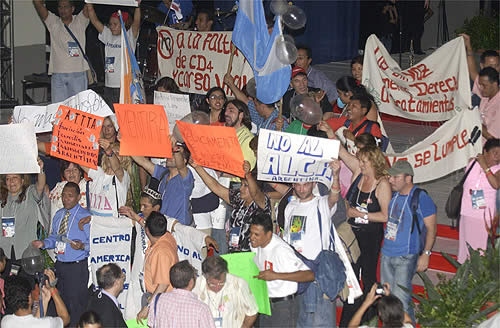
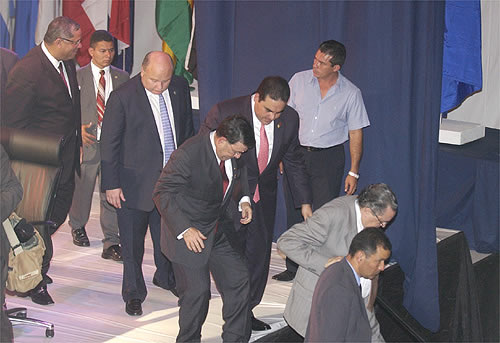
HIV positive activists and allies stage a surprise public protest at the 3rd Latin American and Caribbean Forum on HIV/AIDS at the November 11th closing ceremony in El Salvador; Bottom photo: Elias Antonio Saca, President of Costa Rica and Abel Pacheco, President of El Salvador hurry off the stage to avoid answering protesters.

After more than 10 years of work for an AIDS-prevention agency in the United States, another December 1st rolls around and you become a little disengaged from all the World AIDS Day awareness events and press releases. You grow weary when your own agency organizes a Latino AIDS Awareness Day event and includes women, youth and faith based initiatives in the day's activities but neglects the gay community - at least in its promotional materials and workshop planning (but secretly suspect that all those faith-based prevention funds coming down from the government have something to do with it as well as the involvement of the not so gay friendly Hispanic Federation). You remain HIV negative but see friends become HIV positive over time, you remember those friends who have passed away (Antonio Hernandez, you are always in my heart!) and you pray that the current right-wing assault on anything gay is just a last desperate all-out attack which will fall on its empty logic sooner than later (it's a major barrier to develop prevention messages that are based on increasing gay men's self worth as a means to prevent HIV infection and transmission - and actually work - rather than HIV prevention based on making gay men feel scared or pathologized)

So when there are things that give you a bit of hope and give you reason to continue working in the field, it's better to share, no?

From November 8th through the 11th of this year, El Salvador hosted the 3rd Latin American and Caribbean Forum on HIV/AIDS (organized by CONCASIDA). The only major North American coverage I saw of the event was articles highlighting the presence of actress Ashley Judd, yet, over "3,000 politicians, police chiefs, doctors and activists" met at a time when key questions are being raised about the availability of HIV/AIDS treatments throughout Latin America and the impact of free trade agreements - which the United States have been aggressively pursuing to their economic benefit and include stricter regulations - and increasing barriers - to access to HIV meds in the region.

It is not at all easy to keep up with complex governmental trade treaties, much less to be at the table when concessions are made or deals are brokered between governments. And, though I am privy to an e-mail list that is amazingly up to date on the impact of these treaties on HIV prevention world-wide, the language used on the list is English which keeps most Latin American HIV activists in the dark (I know of no similar Spanish-language list).

So when I read news that a large group of HIV positive activists and allies interrupted a series of speeches by governmental leaders by walking into the convention center and holding banners questioning the trade treaties and shouted down some of the Central American presidents who were speaking on the podium, I though "Damn! Great for them!"

Unfortunately, local media such as La Prensa Grafica and El Diario de Hoy mostly disregarded the activists' demands and went as far as to call them misguided and quoted El Salvador government officials who did not waste time in denouncing the protests calling them politically slanted and orchestrated. La Prensa Grafica said that the government was even considering taking legal action against some of the protesters.

In a statement released by the protesters they said the following:
The protest at the closing day ceremony happened because a large number of participants such as ourselves were tired of so the posturing by not only the governmental authorities [present] but also the funding agencies and some individuals 'representing society and people living with HIV/AIDS' who completely forgot how they reached their positions.
They also denied that any one person had manipulated them or orquestrated the protest, or that the protesters were affiliated with a specific political group. They did express fear that there'd be efforts to take action against them due to the public nature of the protest and reminded journalists that in a free democracy they should have the right to protest.

Fortunately, renowned AIDS activist Richard Stern, from the Costa Rica-based Augua Buena Association saw the government response as what it was: An attempt to dissuade public criticism of their HIV policies and intimidate activists and quickly moved to secure international support for the protesters.

Thanks to Richard, UNAIDS released the following statement on November 19th, 2005:
UNAIDS recognizes the efforts made by the Salvadorian National AIDS Programme and all the other organizers of the FORO/CONCASIDA2005 conference and the High Level Presidential Forum on HIV/AIDS for these highly successful events. We believe that the Conference will result in a stronger commitment to HIV/AIDS by all the stakeholders in Latin America and the Caribbean.

AIDS is a shared concerned and all partners need to make their contribution in order to ensure good follow-up to the commitments made at the Conference ultimately leading towards a stronger response to the epidemic in the Region.

Civil society, and in particular people living with HIV/AIDS, are essential partners who are at the forefront of the AIDS response in all Latin American and Caribbean countries.

Their full engagement and energetic activism give voice to the voiceless and make an essential contribution towards pushing the agenda on key HIV treatment and prevention issues. In this context, building a true and open partnership between civil society and governmental partners is a key strategy for an effective response to the epidemic.

An open, considerate and fruitful dialogue between civil society, governmental and all other stakeholders in a country, where all partners listen to one another and each is able to express their views and opinions in a respectful way and without fears of consequences for their safety and well being, is the only way to ensure that our collective response to the HIV/AIDS epidemic moves successfully forward. UNAIDS is committed to play its role in facilitating such dialogue and strengthening partnerships throughout the Region.

Many contacts among PLWA, Civil Society, Government representatives, international organizations and others have being done by the UNAIDS regional office since yesterday, and it seems to us that the situation in the region is taking the route of dialogue. It is our understanding that meaningful conversation have started between the Government, PLWA and civil society.

Best regards,

Nancy Andrade-Castro
UNAIDS
Directora Regional a.i
So, to all those HIV/AIDS activists who were corageous enough to raise their voices and show their faces in demanding access to treatments for Latin America and the Caribbean, my hat goes off to you! On World AIDS Day, your actions are what keeps me going in this field.