In the four years since Argentina became the first Latin American country to pass a marriage equality law 9,362 same-sex couples have decided to get hitched according to the latest numbers released last week.
The law would not have become a reality without the years of patient and expert lobby work of the Argentine LGBT Federation (FALGBT) and this week the agency decided to mark the anniversary by accompanying a Russian lesbian couple as they received their marriage license (same-sex couples can get married in Argentina regardless of immigration status or nationality).
Marina Mironova and Oxana Tamofeeba are seeking political asylum in the South American country and news of their wedding came on the same week that Russian president Vladimir Putin arrived in the country to visit Argentine president Cristina Fernandez de Kirchner.
Putin has been pillared as of late for his lack of action and outright defense of several so-called "anti gay-propaganda" laws that have flowered in Russia under his watch and as the relationship between Russia and the United States has increasingly deteriorated he has looked to left-wing governments in Latin America for support.
Last week alone he touched ground in Cuba, Nicaragua, Brazil and Argentina and met their respective presidents Raúl Castro, Daniel Ortega, Dilma Rouseff and Cristina de Kirchner and also connected with Evo Morales of Bolivia, Nicolás Maduro of Venezuela and Fidel Castro as well. None challenged him on Russia's homophobic policies at least publicly.
In the meantime a more personal story was taking place behind the scenes.
Four years ago Esteban Paulón was single 32 years of age and fighting for marriage equality with the FALGBT as a volunteer. Yesterday at 36 and as president of the organization he married the love of his life Pablo Cirlini.
As Argentine Senator Rubén Giustiniani put it yesterday on Twitter "When we passed the marriage equality law one of its principal advocates used to say 'I don't even have a partner!', today Esteban Paulón gets married. Congratulations!"
Cuando sancionamos el Matrimonio Igualitario1 de sus principales impulsores decía:"yo no tengo ni pareja",hoy se casa.@epaulonlgbt Fecidades
— Rubén Giustiniani (@rgiustiniani) July 19, 2014
In the days before the wedding the couple made the usual arrangements and applied for a marriage license. To their surprise - four years after Argentina passed their marriage equality law - the marriage license application they were given at the Santa Fe notary still listed spaces where a "husband" and a "wife" could sign the document.
Others shared similar stories: @alejodip also said that when he and his partner applied for a marriage license in
Santa Fe he also had to write his name in a line where the word "Ms." had been
penciled out and the word "Mr." had been penciled in.
My friend Scott Rose brought this to my attention yesterday and I find it both desperate and hilarious.
As the battle for marriage equality in the United States winds down and the anti-gay National Organization for Marriage slips into irrelevance, the organization has been desperately trying to rally participants for one last hurrah: The so-called "2014 March for Marriage" scheduled for June 19th.
As in years past, NOM's president Brian Brown has turned to New York State Senator Ruben Diaz, Sr. as his savior having shown proven ability to rally thousands of people to previous anti-gay rallies.
From one of Brian Brown's increasingly desperate newsblasts:
I just recently got off the phone with my good friend, New York State
Senator, Rev. Ruben Diaz, who will be speaking at the March again this year. He told
me that he plans to bring down over 100 buses to the March from the Bronx this year!
He is calling it the "Second Annual Bus Vigil to Washington." He plans to depart New
York at 4:00 am
in a spiritual convoy of activists coming to the nation's capital to
defend marriage! That's over 5,000 people — overwhelmingly
Latino and African-American constituents — that a single political and
spiritual leader wants to bring to Washington DC this summer!
Diaz is calling it the "Second Annual Bus Vigil to Washington" because in his pitches for the rally he actually never mentions the NOM or the word "marriage" for that matter.
Excerpts:
I'd like to invite you to participate in the "Second Vigil on Wheels to Washington." We will be traveling to Washington, DC - the nations capital - to testify and say that we are still a powerful church... We are offering any pastor or organization that wishes to accompany us to Washington a bus completely free of charge. Each bus holds 55 passengers and we will send the bus to any place you tell us to do so... The bus will pick you up there, will bring you to Washington and will bring you back to the same spot. And you won't have to pay for a single thing... Join us! Take advantage of the opportunity. Ask for your bus! Fill the bus! And let's go to Washington! Let's go on a trip! Visit the monuments in Washington and testify that Jesus heals and saves and is the King we await.
That's right. Reverend Diaz is selling the free bus rides to DC as an opportunity for people to visit the various monuments throughout the city. A wonderful opportunity for members of Latino churches throughout the area who might not get a lot of chances to visit DC.
This is not the first time Diaz has rallied people to anti-marriage equality demonstrations using deception. At previous rallies I have heard church leaders say that they had no idea they were being taken to such a rally and I have heard other religious leaders that they felt pressured to participate or risk losing the Senator's support.
But this is the first time Diaz has been caught at it so openly. Hilarious.
By the way, as long as you can fill a bus with 55 occupants, Senator Diaz says he will send the bus wherever you want it to go and transport everyone to DC. All you need to do is call (718) 991-3161 and ask for Reverend Samaris.
Representatives of 47 Venezuelan LGBT organizations and their allies gathered outside the National Assembly in Caracas this morning and handed in 20,000 signatures asking legislators to consider a civil marriage equality bill in their next legislative session.
For months, LGBT organizations had canvassed for signatures throughout the country and earned the support of legislators affiliated with President Nicolas Maduro's government - including former president Hugo Chávez's brother - as well as opposition party politicians.
Efforts to bring these signatures to the capital have received comprehensive coverage by tightly controlled official media channels including the Venezuelan News Agency (AVN).
"It is our obligation to accept the proposals the people bring to us and it is our obligation to hand these proposals to the [National Assembly's] executive committee for them to assign the matter to the appropriate legislative commission," said socialist party member Elvis Amoroso.
Amoroso added "Our commander Hugo Chávez as well as the President of the Republic Nicolás Maduro always expected us to attend to those who govern us - the people of Venezuela - and here before us is part of those people we represent."
That's not quite accurate. As president the late Hugo Chávez rarely discussed LGBT issues and when he was asked about same-sex marriage in 2009 he said Venezuela wasn't ready for it and he personally didn't see it as a "good thing."
But, at least rhetorically, there seem to be signs of an increasing willingness to at least consider addressing the needs of Venezuela's LGBT community.
Estimated at 300, the crowd that gathered outside the National Assembly this morning chanted "If the Pope were gay, [same-sex] marriage would already be legal" as heard in this video clip from the AFP.
Here is Edgar Manuel Baptista from the Pro-Inclusion political party addressing reporters about the importance of the proposed marriage equality legislature:
Pedro Zerolo sends his support from Spain: There will be a day in which the untold history of how the Spanish Socialist Worker's Party (PSOE) and the Spanish National Federation of Gays and Lesbians (FELGBT) traveled to Latin America and planted some of the seeds for marriage equality in Argentina and Uruguay after securing passage of their own law in 2005. Those efforts were led by the Venezuelan-born attorney and Spanish councilmember Pedro Zerolo who never lost sight of Latin America despite living in Spain for more than two decades.
On January 7th, El Pais broke the devastating news that the long-time LGBT rights activist had been diagnosed with cancer. He has vowed to fight the illness but, amazingly and movingly, took time from his treatments to tape a message supporting these marriage equality efforts in Venezuela:
Pedro Zerolo: Dear friends, January 31st of 2014 will be a historic day in Venezuela. It marks the first step towards the recognition of LGTB men and women's equality and dignity. And I am specifically saying "dignity and equality" which means enjoying the same rights others do and with the same terminology. Friends, on January 31st a marriage equality bill will be presented before the National Assembly. A legislative bill properly vetted and supported by a social network that I am certain will make it a reality sooner than later. Why? Because love has to be legal. Love. Has. To. Be. Equal. Because it is a bill that does not attempt against anything or anyone but is in favor of a diverse Venezuela that has to recognize equal rights of all its citizenship. Because Venezuela belongs to all of us - including lesbians, gays, bisexuals and transgender individuals. Friends, from Madrid, I send my full support. If we did it in Spain, we can also do it in Venezuela. Venezuela can and has to be on time with a rendezvous with equality. It has to recognize the equality of its citizens. I am certain we will be able to accomplish this. That's why, from Spain, I send all my energy, all my strength and the strongest of hugs.
Same-sex couples with marriage licenses from Argentina ask the Venezuelan government to recognize their marriages: In the meantime, a number of couples holding marriage licenses from Argentina are also taking a different route and have gone to the courts to ask that their marriages be recognized by the Venezuelan government.
On November 30th of 2013 that petition was dismissed along with those of two other couples on the basis that the Venezuelan constitution made it clear that civil unions and marriages were only allowed for heterosexual couples (the petition handed to the National Assembly this morning asks that the constitutional language be changed to lift those restrictions).
But a week before their petition was denied Di Giacomo and Merentes were actually getting married in Argentina which allows marriages between same-sex couples from other countries (that's Mr. Di Giacomo and Mr. Merentes in the photo above receiving a marriage license from a judge in Buenos Aires on November 22nd).
Now they are joining two other couples who received marriage licenses in Argentina in challenging the government to recognize those marriages as valid.
The other two couples are Raymer Diaz and Edwin Erminy and Migdely Miranda and Giniveth Soto Quintana (pictured above at today's rally holding marriage licenses from Argentina).
Speaking to a reporter for the National Assembly's website, Ms. Soto explained that her wife Migdely was three months pregnant and that she wanted to be recognized as a married couple to protect her wife and their unborn child.
"We want the legislators of the National Assembly to recognize our child and our family," she said, "we are being forced to emigrate to other [South American] countries such as Argentina where these laws are recognized."
Ms. Soto also said she would be lobbying her uncle Fernando Soto Rojas, an influential member of the ruling socialist party and former president of the National Assembly to gather support for marriage equality among his colleagues.
Javier Suarez Pascagaza might be a bachelor but he has an uncanny resemblance to Marcus Bachmann and perhaps similar proclivities.
For one, they bot think homosexuality should be cured.
Not much has been seen of leading Colombian anti-gay marriage leader Javier Suarez Pascagaza since some former seminary classmates claimed he had been thrown out of Catholic school for being gay back in November. But the self-appointed director of the one man Husband and Woman Foundation finally emerged this week to promote a Senate campaign with some spectacular imagery straight of the very gay Pierre et Guilles cannon (see above).
This week, Suarez also denounced a re-election campaign ad by Senator Armando Benedetti featuring a gay couple and a lesbian couple in asking Colombians to be respectful of others:
Last year Senator Benedetti introduced a marriage equality bill in the Colombian Senate which was struck down by a majority.
Addressing Senator Benedetti in an interview with El Espectador published Monday Suarez said that the ad was "an affront and a threat to Colombian families and children" and said he would go to court to block it from being aired on national television.
"Two men might try to have as much sex as they want but they will never be able to get each other pregnant," he said, " and this is clear evidence that homosexuals do not have nor will ever have the same rights as those of a man and a woman."
"These are opinions that come from the bottom of the barrel and have been used to attack my good name and honor as well as the prestige of the [one man] Husband and Woman Foundation with the hopes of discrediting the full authority in which we have strongly and clearly opposed [same-sex marriage] regardless of any ideological, Christian or religious basis as they have also claimed... In response to such slanderous and damaging allegations we have launched a lawsuit on my behalf for the sum of five thousand million Colombian pesos against those who made the allegations, Marcela Sanchez of [the LGBT-rights organization] Colombia Diversa and El Espectador because they have no right to play with a person's image and lobby personal attacks against someone who has simply made strong legal arguments against same-sex marriage and adoption rights for gays."
Notice that he thinks being called gay is slanderous and damaging but he never comes out and denies being gay.
Lesbian senate candidate Elizabeth Castillo (right) who was also part of the debate and happens to be one of the first women to be granted a marriage license in Colombia - despite an unsuccessful court challenge by Mr. Suarez- put him in place:
"Mr. Suarez is prone to launching legal attacks and he does it badly," she argued, "He might claim to have gone to law school but he's not a lawyer; he might claim he has studied theology and it might be true but he's not a theologist and the way he has used the law is an affront to legal theory; he uses 'tutelas' and lawsuits in a manner that is totally inappropriate and in ways that create total confusion. Tomorrow I could easily go and sue him for five hundred million dollars or five million dollars because I feel personally afflicted by his systematic persecution against my marriage which I might point out is still valid despite his efforts."
The main question about Mr. Suarez is not his legal abilities (he has lost every effort to challenge the few same-sex marriage licenses that have been granted in Colombia) but who is funding his one-man efforts.
He clearly has an ally in the office of the ultra-homophobic and powerful Inspector Genera; Rafael Ordoñez but it is rumored that his anti-gay efforts and senate campaigns are receiving a lot of money from U.S. based religious institutions as well.
If you would like to support a truly inclusive Colombian senate campaign, please follow Elizabeth Castillo on Twitter (here) and YouTube (here). As if it needed to be said, full disclosure, the amazing Elizabeth Castillo is a friend of mine.
Scene from a 2013 marriage equality demonstration in France.
The Sochi 2014 Winter Olympics are only six weeks away and there are no signs that the Russian government is anywhere close to disavowing any of its recently enacted anti-gay policies despite international pressure.
I will certainly not go to Sotchi as long as minorities are treated the way they are under the current Russian legislation
— Viviane Reding (@VivianeRedingEU) December 9, 2013
Until now most of the international attention has focused on so-called "anti-gay propaganda laws" which ban the "promotion" of homosexuality but some have also expressed dismay about recent Russian efforts to clamp down on international adoptions as well.
The new Russian law banning adoptions by U.S. families that took
effect Jan. 1 erased the Nagels' plans to bring Timofey to America in
March. In all, it stranded more than 330 families who had already begun
stitching hoped-for Russian adoptees into the webs of their lives.
"We have all these sorts of feelings of grief that we could process —
if we didn't know he's still out there," said Andy Nagel, 31, an
assistant pastor at a Presbyterian church in Germantown, Md.
The estimated 1,000 Russian adoptions annually by American families
has been a tender subject in the Kremlin for years. Though an estimated
300,000 orphans languish in about 3,000 facilities across Russia,
handing them over to a former Cold War enemy can strike a painful note.
The occasional story of a Russian adoptee abused or neglected in an
American home — as in the case of 21-month-old Dima Yakovlev, who died
in 2008 when his American father left him in a hot car for nine hours —
sparks outraged headlines across the country.
But critics say the motivation for the ban was not so much concern over
potential harm — they point out that far more orphans die after being
adopted in Russian homes — as it was reprisal for a U.S. statute
focusing on human rights in Russia.
In effect the law applied to all same-sex foreign couples wishing to adopt as well as heterosexual couples from countries that allowed same-sex couples to marry.
The agreement would open up the possibility for Spanish heterosexual couples to adopt Russian children once again as long as Spain makes a commitment to keep Russian children from being adopted by same-sex couples. From the article:
The government has authorized the international accord on adoptions between Spain and Russia - pending since 2009 - during a meeting that took place on December 20th at the Council of Ministers.
The announcement was made by Vice President Soraya Sáenz de Santamaría, who said the accord was adopted at a meeting between Spanish and Russian authorities that took place on October 3rd in Madrid.
Last August the Russian Supreme Court which ordered a hold on any proceedings with countries that allow gay marriage until there was a bilateral accord guaranteeing the children would not be raised by homosexuals including in the case of orphans.
Since then 500 Spanish families have been affected and, as a result, negotiations between Madrid and Moscow had intensified. "We would like to renew these adoptions," said Santamaría.
Governmental sources tell the paper that the accord will be signed in January and might go into effect by April after Russian authorities had a chance to process the paperwork. In cases the adopted children are abandoned in Spain or lose their Spanish parents Russia also requires Spain to report where they have been relocated to make sure that even in those circumstances the Russian child does not end up being raised by a Spanish same-sex couple.
A sad development in the country that became the first Spanish-speaking nation to pass a marriage equality law back in 2005.
UPDATE #1: The pro-Putin Voice of Russia reported on December 23rd that bilateral adoption agreements with the U.K. and Israel were also in the works although it doesn't mention whether it would demand those countries place restrictions on same-sex parents.
It does say that an agreement with Ireland is on hold due to concerns that there were too many American couples with Irish passports who might try to circumvent the blanket ban keeping U.S. citizens from adopting.
UPDATE #2: It appears that Canada might also be considering signing a bi-lateral agreement with Russia to "unfreeze" a number of stalled adoptions in process ("Russia's gay marriage memo puts Canadian adoptions at risk", The Globe and Mail, Jan. 8, 2014).
You might remember back in May when Ecuadorian president Rafael Correa went on the offensive against marriage and adoption rights for same-sex couples and a gender identity bill currently making its way through the nation's legislature. There was enough of an international backlash for him to extend a semi-apology but he still stood behind his statements and proclaimed he was the best president the LGBT community in Ecuador had ever had.
One unintended consequence of the president's stand against marriage equality was the emergence of a marriage equality movement in Ecuador which had been dormant but jumped into action as LGBT advocates realized their president wasn't necessarily on their side.
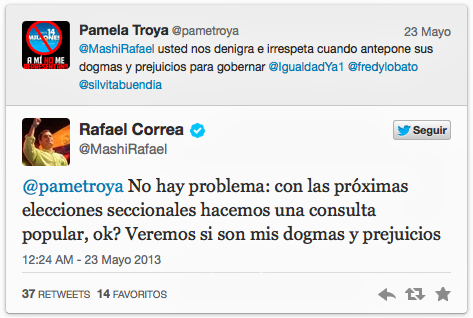
Among them was Pamela Troya who angrily denounced President Correa on Twitter telling him he was denigrating and disrespecting people like her by using dogma and prejudice to govern.
His response? "No problem," he twitted on May 23rd, "We'll launch a popular referendum in the next elections and we'll see if those dogmas and prejudice are my own."
Until now, Pamela and Gabriela had been the public face of the Civil Marriage Equality initiative but this week they announced that a second couple in Guayaquil would be filing paperwork to request a marriage license and this morning Santiago Vinces and Fernando Saltos did just that.
Carrying signs that read "Love is equality", "Without equality there is no liberty" and "Love does not discriminate" two dozen people including Pamela and Gabriela, attorney Silvia Buendia and television soap opera star Erika Velez acted as witnesses for the couple and marched with them as they made their way to the civil registry office and submitted their paperwork. As with Pamela and Gabriela, the court has 8 days to respond and the couple will appeal that decision if they are denied the right to marry.
Gabriela Correa and Panela Troya.
In defending his stance against marriage equality, President Correa highlighted his work in securing passage of a 2008 constitution which allowed civil unions for same-sex couples even as it also defined marriage as that between a man and a woman. At least on paper, the constitutional reform meant that same-sex couples would have all the rights of married heterosexual couples except for the right to adopt.
In practice, though, an upcoming study to be released by Silueta X which surveyed civil registry offices in Guayaquil found that only 1.2% of 2,805 same-sex couples had registered their civil unions in the five years since the constitution was adopted and, of 42 civil registry offices in the city, only two reported having recently completed a civil union registration. Silueta X says they will release the full results of the study on November 29th and report whether some registries are throwing roadblocks for same-sex couples who might want to enter into a civil union.
Advocates face an uphill battle in repealing constitutional language that bans same-sex marriages but President Correa's opposition certainly has lit a fire in them and as other countries in the region allow same-sex couples to marry it raises the bar for other regional leaders to follow.
There are signs that President Correa is willing to listen to some of these actions and appeals. At least on the issue of the gender identity bill he has continued to have a dialogue with transgender rights advocate Diane Rodriguez in the months since he publicly stated that he saw the bill as a Trojan horse attack on the institution of marriage.
In the meantime, while he "evolves", the resurgence of a visible LGBT rights movement in Ecuador is reason to rejoice.
UPDATE (Nov. 29th, 2013): It took just one day for the Ecuadorean government and its civil registry office to say Santiago and Fernando did not meet the qualifications for a marriage license since they were not a man and a woman. Helpfully, it did urge the couple to come back if and when they manage to gather enough proof to prove otherwise.
The Ecuadorean Civil Marriage Equality initiative has said that they expected the ruling and will be appealing it. They also say they are recruiting same-sex couples who might be interested in joining their movement and launch similar petitions before the civil registry offices of Ecuador.
News report (Spanish):
Additional info:
More photos of this morning's press conference and rally here.
Follow Ecuador's "Matrimonio Civil Igualitario" on Twitter here.
Barinas Gobernor Adán Chávez Frias signing marriage equality petition (photos by Luis Carlos Paredes Tapia, used by permission)
Argentina, Uruguay, Brazil and Mexico City recognize marriage equality. Courts in other regions of Mexico and in Colombia have also granted marriage licenses to same-sex couples. Advocates in Chile, Ecuador, Peru, El Salvador, Cuba and Costa Rica are demanding equal marriage rights. And here comes Venezuela.
Against all odds and despite the general polarization that defines Venezuelan politics, LGBT advocates on both sides of the political divide launched a signature gathering campaign earlier this year to force the National Assembly to take up the issue.
For all his years in power, it cannot be said that Chávez was particularly homophobic but he also was far from proactive on addressing the needs of LGBT Venezuelans or speaking about it publicly.
After those declarations and before his death earlier this year, Chávez and the Great Patriotic Pole party he lead increasingly embraced the LGBT community or the "sexually diverse" as they preferred to call it particularly when trying to draw away LGBT voters from the opposition.
In the meantime, LGBT advocates continue to collect signatures in support of a marriage equality law and on Wednesday they ran into Barinas state governor Adán Chávez Frias who was happy to add his sinature to the list.
Governor Chávez Frias happens to be the late president's brother.
It might reflect an increasing willingness among 'Chavistas' to embrace LGBT issues including marriage equality.
Related: The Facebook page for the coalition of LGBT organizations gathering signarures can be found here.
Photo by Luis Carlos Paredes Tapia, used with permission.
"We do not see [gays] as being a family or married or an integral part of the social fabric but as needing clinical, psychiatric, medical and spiritual care, if possible, to help acknowledge their condition so that they can reverse it and recover their gender identity" - Javier Suarez Pascagaza, Director of the Husband and Wife Foundation to HSB News, October 6, 2013.
"I don't think God created homosexuals. That would be an evil God" - Javier Suarez Pascagaza, Director of the Husband and Wife Foundation to Kien y Ke, October 28, 2013.
LEADER OF COLOMBIAN ORGANIZATION THAT SEEKS TO BLOCK MARRIAGE RIGHTS FOR SAME-SEX COUPLES AND BAN THEM FROM ADOPTING CHILDREN IS A GAY MAN, SAY FORMER JESUIT SEMINARY SCHOOL CLASSMATES
DESPITE HAVING FILED LAWSUITS CHALLENGING DECISIONS BY A NUMBER OF CIVIL COURT JUDGES WHO HAVE GRANTED MARRIAGE LICENSES TO FOUR SAME-SEX COUPLES SINCE JULY, THOSE MARRIAGES STILL ARE LEGALLY VALID; A COURT HAD ANNULLED TWO OF THEM BASED ON MR. SUÁREZ' LAWSUITS BUT A HIGHER COURT DETERMINED HE HAD NO LEGAL STANDING AND VACATED THE LOWER COURT'S DECISION.
The see-saw battle to win marriage equality in Colombia has taken a number of surprising turns but this one takes the cake.
Meet Javier Suárez Pascagaza, director of the Husband and Wife Foundation. Nobody had heard of Mr. Suárez or his "foundation" until he surfaced in July and declared he would legally challenge any civil court judge that dare grant a same-sex couple a marriage license.
The story so far: In 2011, the Colombian constitutional court gave the country's legislature an ultimatum: Grant same-sex couples the same rights as married couples by the summer of 2013 - whether they called it marriage or something else - or else all same-sex couples would automatically earn the right to get marriage licenses.
A marriage equality bill was introduced in Congress but it was quickly voted down and the court's deadline came to pass without the legislature addressing the core issue.
As the deadline approached, the country's powerful Inspector General Alejandro Ordoñez and the director of the agency that oversaw all notaries came up with a ploy to block same-sex marriages: They invented a contract called a "solemn union" and directed all notary officers to use it anytime a same-sex couple approached them and asked for a marriage license. The Inspector General's office also sent private memos to all notaries ordering them to keep track of every same-sex couple who asked for a marriage license and report it back to his office.
Marriage equality advocates saw through the strategy and took a different route: They urged same-sex couples to avoid heading to the notaries and instead they advised them to go before a civil court judge. A notary officer had full discretion in denying a marriage license without having to explain the decision while a civil court judge had to explain their decision in writing and a negative decision could potentially be appealed.
Then on September 20th, a different civil court judge granted Julio Albeiro Cantor Borbón and William Alberto Castro Francoa marriage contract.
On September 25th another civil court judge granted a marriage license to Claudia Zea and Elizabeth Castillo in what became front page news ("Marriage equality is a fact" declared El Espectador).
The rise of the Husband and Wife Foundation: These four victories also saw the sudden emergence of a brand new organization called the Husband and Wife Foundation and its director Javier Suárez Pascagaza.
After news of the first marriage emerged, Suárez announced himself as the head of the brand new foundation and vowed to take these judges to court and, at least initially, he was successful in getting a court to invalidate two of the four marriages.
Thankfully, legal advocates for the LGBT-rights organization Colombia Diversa challenged that ruling in higher court and won. Mr. Suárez was found not to have legal standing to launch the lawsuit which means that as of today all four marriages remain with legal standing.
In the meantime a Noticias UNO investigation of the foundation revealed that only two people were listed as officers - Mr. Suárez and his military brother Carlos Suárez Pascagaza - and its mission was to "promote the moral, ethic and religious morals of the family" despite many public assurances that the organization was not a religious institution. The investigation also also revealed closer ties to the Inspector General's office than Mr. Suárez had previously admitted (see full Spanish language video below)
Of all these charges, Mr. Suárez has expressed particular vehemence about allegations his foundation is in any way influenced by religion and has threatened to sue anyone who claims otherwise.
But in interviews he has repeatedly used the language of the religious right against gays: That gays cannot marry because they cannot procreate, that they need psychiatric attention to reverse their identity and that there is no way God created gays and lesbians because if that was the case God would be an evil entity.
Participants, among them priests and nuns, carried signs reading "God created a man and a woman," "No more gay marriages in Gachetá" and "Catholic Gachetá deserves respect" and congregated outside the offices of Judge Julio Gonzalez who had granted a marriage license to Claudia Zea and Elisabeth Castillo just days before.
Judge Gonzalez took to Twitter the next day to denounce the attempt at intimidation.
gacheta se alza contra los matrimonios igualitarios protestas públicas protagonizadas por párrocos e iglesias evangélicas @ColombiaDiversa
— julio Gonzalez H (@dedth33) October 9, 2013
"Gachetá rises against marriage equality, public protests with priests and evangelical churches as protagonists," he wrote.
Raúl Quintana, who also identifies as a gay man, says that it was clear to everyone at school that Mr. Suárez was gay and that he once heard him openly express his attraction to another man. Quintana alleges that he was open about his sexual identity and that the priests at the school were OK with it but that what bothered them and led to Mr. Suárez being kicked out was that he was being dishonest about it.
Asked about why he chose to come forward now, Quintano says:
"I can't stand the hypocrisy that almost always exists behind acts of homophobia. One day I read that a foundation had been created against marriage rights for gays and when I saw the name of Javier Suárez I did not associate it with that of my former classmate... Pascagaza, we used to call him by his last name because we thought it was funny. It left me cold so I decided to call Colombia Diversa and expose the double morality. Suárez has the least authority to point his finger at us."
Mr. Jácome says that most students knew which of the other students and priests were gay. "Who was I to judge [Mr. Suárez] for the mere fact he was part of a group I did not belong in, since I am straight."
He says that as long as students and priests remained chaste, the Jesuit school was actually pretty welcoming of people who identified as gay and he argues that in leading the fight against gay rights Mr. Suárez is actually turning his back on the tolerant teachings of the Jesuit school.
Mr. Jácome after he left the school and Mr. Suárez was let go he heard from others that Mr. Suárez traveled to the United States to work with a church interested in expanding their role in Latin America.
"You have to know that he comes from a very poor family," Mr. Jácome says, "Someone must be funding him because you need money to lead a foundation and launch lawsuits."
UPDATE:W Radio interviewed Mr. Suárez on Nov. 11th, 2013 and asked him about the allegations. In the audio, Mr. Suárez confirms he once sought to become a priest but abandoned that route, he made it clear he had agreed to the interview as long as he was not asked questions about his personal life, said that blaming someone as being gay was a common ploy by LGBT rights activists but ultimately did not disclose whether he was gay or not (full 20 minute Spanish-language audio here).
He also indicated he was considering filing lawsuits against anyone who was spreading "false" information about him. Interestingly he focused on the fact people were alleging his organization was religious rather than the allegation he might be gay.
VIDEO: Noticias UNO exposes the religious and political ties of the Husband and Wife Foundation and its director Javier Suárez (in Spanish).
Claudia Zea and Elizabeth Castillo were united in civil marriage on Wednesday in a low-key ceremony that remained secret until now (Photo used by permission courtesy of Paola Zuluaga)
MAJOR UPDATE #1 (Oct. 3, 2013): A judge in Colombia has struck down the first of two same-sex marriages performed in Colombia last week. The move comes after a one man anti-gay organization filed a constitutional challenge against the judge who officiated the first wedding as Colombia Reports reports ("Colombia judge annuls country's first marriage"). And while Claudia Zea and Elizabeth Castillo remain married, foes of marriage equality have also filed constitutional challenges against their marriage and vowed to challenge every other judge that decides to grant a marriage license to any same-sex couple.
MAJOR UPDATE #2 (Nov. 10, 2013): Since writing this post, lower courts annulled two of four same-sex marriages that have taken place since July. On appeal, though, those annulments were declared invalid as the person who challenged them in court was declared not to have legal standing by a higher court - which means all four same-sex marriages still have legal standing.
In addition, the person who challenged the judges who granted these marriage licenses though a phantom homophobic organization called the Husband and Wife Foundation was outed as a gay man himself by two former classmates at a Jesuit seminary school ("Leading opponent of same-sex marriages in Colombia outed as a gay man").
CORRECTION: An original version of this post contained the following phrase: "Argentina and Uruguay already allow marriages for same-sex couples and some regions in Mexico and Brazil do the same". After comments on this post and checking with LGBT advocates based in Brazil I have changed that phrase to read "Argentina, Brazil and Uruguay already allow marriages for same-sex
couples as well as Mexico City. Several Mexican states have also seen
same-sex couples get marriage licenses through court rulings." Particular thanks for the assistance of Bruno Bimbi, author of the definite tome on how Argentina became the first country in Latin America to pass a marriage equality law ("Marriage Equality"). He currently lives in Brazil and is an expert on the region.
If watching marriage equality advance throughout the United States has been moving and inspirational, the same can be said of Latin America as countries like Argentina, Brazil and Uruguay already allow marriages for same-sex couples as well as Mexico City. Several Mexican states have also seen same-sex couples get marriage licenses through court rulings.
Now you can add Colombia to that list.
In a surprising statement released on Wednesday, Colombian attorney and long-time LGBT-rights advocate Germán Humerto Rincón Perfetti announced that a .civil court judge had declared Julio Albeiro Cantor Borbón and William Alberto Castro Franco "united in civil matrimony" in a ceremony that took place on September 20th.
Then today the leading national newspaper El Espectador announced in its front page that Elizabeth Castillo and Claudia Zea had joined them on Wednesday when a second civil court judge also granted them a marriage license. "I join you in a legitimate civil matrimony with all the prerogatives and rights that civil law grants you and the same obligations imposed by civil law," said the judge before the couple signed their marriage license.
The uphill battle for marriage equality in Colombia has been years in the making and fraught with setbacks and false starts. Several same-sex civil union bills were introduced during the last decade without advancing legislatively. But a 2011 Constitutional Court ruling ordering Congress to find a way to grant same-sex couples the same rights as married heterosexual couples kicked the ball into motion. The Court left legislators wiggle-room in what to call the same-sex partnership measure and avoided mentioning the word "marriage" but it also said that if Congress had failed to act by the summer of 2013 same-sex couples would then automatically be eligible to apply for civil matrimony.
Congress did take up a marriage equality bill this April but a majority of legislators voted it down and, as the deadline set the Constitutional Court approached, the director if the agency that oversees notary officers throughout the country instructed them not to grant marriage licenses to same-sex couples and offer, instead, a trumped up norm called a "solemn union".
Marriage equality advocates led by Marcela Sanchéz of the LGBT-rights organization Colombia Diversa saw through the ploy and advised same-sex couples to avoid notary offices and instead head to the civil courts. The reason? Notary officers had been instructed to decline marriage license requests on the spot whereas a civil court judge would have to put in writing their arguments for or against granting a marriage license to a gay couple.
In fact, on July 24th a civil court judge stopped just short of granting a first marriage license while declaring Gonzalo Ruiz Giraldo and Carlos Hernando Rivera Ramírez legal spouses (their spousal union document reads "estado civil: casados" or "civil status: spouses." After the private ceremony, that particular judge spoke to media and made clear that she had not given them a marriage license.
There have been dozens of same-sex couples that have gone to notaries and officiated their "solemn unions" but the argument from Colombia Diversa is that a "solemn union" is a figure that has never existed and still does not exist in the nation's legal family code.
Colombia Diversa argues that the only existing norm recognizing the same marriage rights as those granted to heterosexual couples is marriage and, in light of the Colombian Congress's failure to act, same sex couples automatically have the right to marry.
But the Colombian government in the form of its Inspector General Alejandro Ordoñez has fought the Constitutional Court and its ruling every step of the way and has used his office to go after gay couples demanding that all notary officers alert him if any gay couple requests a marriage license.
Ordoñez has been so aggressive in challenging these rulings that the Constitutional Court itself has publicly admonished him twice and argued his office has no standing in these matters.
Lawyer Mauricio Albarracín argues that for a "tutela" to proceed the applicant has to prove these marriages violate a person's rights which Albarracín says will be impossible for Ordoñez to prove.
The issue will probably head back to the upper courts in the future but as of this week Julio Albeiro Cantor Borbon is married to William Alberto Castro Franco and Claudia Zea is married to Elizabeth Castillo.
Marriage equality has come to Colombia.
UPDATE (Sept. 30, 2013): Out lesbian Bogotá councilmember Angélica Lozano just twitted a photo of herself filing a claim against Inspector General Alejandro Ordoñez before the district attorney's office. It reads "Legally denouncing the Inspector General for abuse of authority and arbitrary and unjust acts against gays".
Denunciado penalmente el procurador por abuso de autoridad, actos arbitrarios e injustos contra homosexuales pic.twitter.com/v2iyZBJUPh
— Angélica Lozano (@AngelicaLozanoC) September 30, 2013
NYS Senator Ruben Diaz, Sr. reveals long-shot Democratic mayoral candidate Erick Salgado donated $4,000 for buses carrying New Yorkers to anti-gay rally in Washington, DC.
In a crowded political race it's not surprising to see candidates look for every opportunity to sell their message and in New York City that means finding ways to reach an incredibly diverse population not only in terms of ethnicity but also religion.
Of course, that sometimes means alliances with religious leaders and attending church services and events with large congregations.
In past years New York State Senator and Pastor Ruben Diaz, Sr. has shown the ability to bring large numbers of people to rallies against marriage equality here in New York as well as Washington, DC. So does that mean that his demonstrated power to influence a segment of the community is too rich an opportunity to pass up for a politician if Diaz invites you to an event?
OK, I'll give you this. Perhaps if Diaz himself pushed you to run as a mayoral candidate - as Diaz did with long-shot Democratic mayoral candidate Erick Salgado - you might feel obliged to attend.
But what if most mayoral candidates had no issue whatsoever in accepting the invite?
Well, that's what happened on April 13th when Diaz invited all mayoral candidates to a banquet celebrating the 25th year anniversary of Hispanic Ministers of New York Organization - the same organization that pulled together all those anti-marriage equality rallies - and actually got all but two of the leading mayoral candidates to attend.
Even better, for most of the ceremony Diaz had Brian Brown of the National Organization for Marriage sit to his right as a guest of honor.
Just a couple of weeks earlier Diaz had worked with the ministers' organization and NOM to send more than thirty buses full of people to protest against marriage equality outside the Supreme Court during the DOMA and Prop 8 debate.
U.S. Senator Chuck Schumer leading a chant of "Si Se Puede!"
Present at the April 13th banquet were NYS Comptroller Tom
DiNapoli, Bronx Assemblymembers Marcos Crespo and Luis Sepulveda, NYS Republican Committee Chairman Ed Cox and, of course, Bronx Borough President Ruben Diaz, Jr. - the Senator's son - who came out for marriage equality during the same week his father was riling against it in Washington.
Also among attendees were U.S. Senator Chuck Schumer promoting immigration reform, Republican mayoral candidates Joe Lhota and John Catsimatidis, independent mayoral candidate Adolfo Carrión and Democratic mayoral candidates John Liu, Bill Thompson and Erick Salgado.
That's a whopping six of the leading eight mayoral candidates with Christine Quinn and Bill De Blasio being the only ones not to show up (Full diclosure: I have publicly backed Quinn for mayor but have supported Bill Thompson in past elections and might have considered backing John Liu if it wasn't for some unanswered questions about his former and current fundraising teams).
Of course, attending an event like this rarely speaks for a candidate's view on certain issues. In fact every mayoral candidate who attended the event except for Salgado supports marriage equality but I am often asked why Diaz remains in power after all these years of demagoguing against the LGBT community and, unfortunately, here is the answer: He gets a pass by those in power who should know better.
NOM expenditures: As for Brian Brown, the event invite did not mention he would be in attendance but I find it hard to believe that people like Schumer were in any way unaware of the pro and anti-marriage equality rallies in DC just days earlier and knew exactly who NOM was as he sat next to Brian. To mayoral candidates who might not have known who he was it would not be a shocker that someone like him would be a guest of honor at the event fully knowing of Diaz's views about gays and lesbians.
The event did break some news: In a Spanish-language speech Diaz made at the end of the ceremony after most if not all of the mayoral candidates had left. As famously guarded as NOM is about the money they spend, Diaz revealed that NOM had spent $60,000 dollars on 30 buses used to transport hundreds of people to Washington, DC, for an anti-marriage equality rally outside the Supreme Court in March.
Diaz also said that NOM had brought a check for $25,000 to the banquet as a donation to the several radio stations used by the Hispanic Ministers of New York Organization to spread their anti-marriage equality message.
Another surprise: Diaz's mayoral candidate Erick Salgado also donated $4,000 for two additional buses to the anti-gay rallies in DC.
Direct quote from Diaz:
I wanted to let you know that for the march we did to Washington, thirty buses two out of 32 buses were paid by Erick Salgado - and thirty of them, the ones we ran from here, were paid by Brian Brown. All those buses. Each bus cost $2,000 and multiply thirty buses by two and you have $60,000 spent on the "Vigil on Wheels to Washington"
Diaz also said that all the previous rallies had been funded by NOM.
I took the liberty of posting an edited clip of the two hour event. Click on it to open it in a separate window and it will be easier to read my translated annotations. It must be said that by the time Brian spoke at the end most if not all of the mayoral candidates had left. Here is a link to a full version of the clip including speeches by each of the mayoral candidates who attended.
CORRECTION: An original version of this post contained the following phrase "Uruguay is the second Latin American nation to adopt a national marriage equality law following Argentina." Taking under consideration reader comments and after discussing the issue with marriage equality advocates based in Brazil, the phrase now reads "Uruguay is the third Latin American nation to adopt a national marriage equality law following Argentina and Brazil.
Same-sex couples in Uruguay began to marry yesterday after a required 90-day waiting period from the day president José Mujica signed a marriage equality bill into law.
But none of those couples earned the title of "first to marry". That's because on August 5th, the first day on which couples were able to apply for a license, a Civil Court judge headed to a hospital and granted a marriage license "in-extremis" to a man dying of cancer and his partner who sat by his bedside.
The name of the couple might never be known since they requested to remain anonymous.
Rodrigo Borda and Sergio Miranda, the first couple to apply for marriage in Montevideo on the 6th, hoped theirs would be the first marriage as the law went into effect yesterday and invited media to wait for them outside the private civil court ceremony at 11:30am.
International news agencies called them the first and AFP posted a video of the happy couple after the civil ceremony in which Miranda states “While in Russia they incite violence and hunt us down and kill us like
the Nazi regime, in Uruguay we can get married, we can celebrate love.
So I’m very happy to live in a country like Uruguay and not like Russia.
That’s all I have to say.”
Uruguayan press, though, report that Rubén López and Mario Bonilla, together for 21 years, were married earlier yesterday morning in the city of Mercedes. It was also the first time that they were able to register as the joint parents of Camilo whom they adopted 17 years ago. Screen cap of the couple with their son at the emotional wedding ceremony above, video below.
Of course, of the 20 or so couples who applied for a marriage license on Aug. 5th, no one knows if other couples married earlier than they did and kept their ceremonies private.
Uruguay is the third Latin American nation to adopt a national marriage equality law following Argentina and Brazil.
Language penalizing sexual contact between same-sex individuals was struck down from the penal code by the nation's Constitutional Tribunal in 1997. A year later the country adopted a new constitution which became the first in the Americas to grant sexual orientation protected status.
Under president Rafael Correa who was elected to office in 2007, further changes to the penal code made hate speech a crime and set fines and prison sentences for "those who incite hate against any
other person for reason of their sex, sexual orientation, or sexual
identification."
In a set back, the 2008 constitution enshrined marriage as being that between a man and a woman and limited adoption rights to heterosexual couples but it also granted same-sex couples civil unions that offered some legal protections including inheritance rights. Correa had initially argued that there was no need to limit marriage in the constitution but caved in to pressure from evangelicals and fundamentalists who demanded the ban. Gay couples have also had a tough time registering their civil unions.
In 2008, when Ecuadorian immigrant José Osvaldo Sucuzhañay was attacked and murdered on the streets of New York after he and his brother were mistaken for a gay couple, Correa said "Together we will fight to forever root out these abhorrent acts committed by certain maladjusted individuals, root them out from the face of the earth, from humanity: Xenophobia, homophobia and all kinds of discrimination, all kinds of violence."
An apology: Most recently and in the heat of his third re-election campaign, President Corréa lost his temper after a critic called him a "faggot" on a Facebook page and challenged the man to meet with him to let him show "who the real fag is." (VIDEO).
Members of LGBT-rights organizations were outraged and demanded an apology. They got two earnest apologies, one before the election (VIDEO) and one during his acceptance speech on the night he won a decisive vote for a third and final term (VIDEO). That was on February 17th of this year.
The reason for the second apology, Correa said, was because he didn't want the LGBT community to think he had apologized the first time for political gain. He added "I offer my full respect, my efforts and my commitment to eliminate all types of discrimination in this country."
Considering
Correa's considerable track record on LGBT issues, his seemingly heartfelt
apologies for using a derogatory word and his public commitment to protect the Ecuadorian LGBT
community you might think the next four years might bode well for said community barring, you know, a stunning turnaround. Well...
A stunning turnaround: The national debate the last few weeks have been consumed by a decision by Health Minister Carina Vance Mafla to approve the "morning after" pill. Conservative religious leaders are apoplectic about the decision and a group calling themselves "The 14 Million" swore millions of people would demonstrate against the government last Sunday (by most newspaper accounts only 2,500 showed up).
A day before the religious rallies President Correa used his weekly televised speech to "counter" the claims made by the so-called "14 Million" and in the process actually gave them much more than they probably expected.
Key points:
He denied his government was pushing for marriage equality and highlighted the constitutional ban he once called unnecessary saying that no other type of partnership could ever be considered a marriage except for that between a man and a woman.
He acknowledged there were current efforts in the national assembly to pass a gender identity law but mocked the legislator introducing the bill and promised to veto the bill if it ever reached his desk.
The shock and disappointment among leading Ecuadorian LGBT rights advocates was palpable on the social networks and many took to Twitter to demand an explanation from Correa on the eve of his inauguration.
Twitter wars: Silvia Buendía, who ran for political office during the last election, sent a tweet introducing Correa to a lesbian couple profiled in a newspaper article telling him "Dear President Correa, I present my friends Diana and Maribel, they love each other, they take care of each other, they are family"...
Pamela Troya who was recently profiled with her family in La Hora, angrily highlighted a key contradiction in the Presdent's statements from stands he had taken as recent as February. "President Correa, look at you statements from February 12th during the NEVER FORGET campaign", she wrote.
A screen capture image quoted statements Correa had made during a February 12th radio interview on the issue of a gender identity bill. "Choosing one's gender and name, I agree with that," Correa said, "that's liberty, each person in accordance to their sexual orientation should be able to choose their gender identity and register their name and their gender with the civil registry."
Using a marriage referendum as a threat: Pamela also tweeted "President Correa, you denigrate us and disrespect us when you use dogma and prejudice to govern."
This time it drew an angry response from President Correa himself. "No problem," Correa wrote, "I will set up a popular referendum during the next midterm elections and we will see if it's all about my dogmas and prejudices."
On Thursday, in an interview shot and aired a day before the inauguration of his third term Correa dug deeper in...
Key points:
"I am economically and socially progressive but very conservative when it comes to moral issues" Correa stated.
Correa argued that the gender identity law is actually a Trojan horse being used to impose "gay marriage" on Ecuador.
If Ecuador would follow worldwide trends and approve marriage equality, Correa argued, it would be akin to distributing drugs for free because drugs are also trendy (he then offered an immediate apology because, as he put it, drugs are illegal and homosexuality is not).
International LGBT reaction: That second interview got much more attention than his little seen initial statements a week ago. This time LGBT leaders from all of Latin America reacted.
The head of the largest LGBT-rights organization in Chile, Rolando Jiménez...
En general, el "Progresismo Latinoamericano" es conservador y autoritario Presidente de Ecuador lo confirma cuando cambio cultural lo supera
— Rolando Jiménez(@rjimenez_perez) May 25, 2013
"In general, 'Progressive Latin America' is conservative and authoritarian. The Ecuadorian president confirms this when cultural change steps ahead of him."
Cuban blogger Francisco Rodríguez (better known as Paquito el de Cuba) sent several tweets including this one:
"Rafael Correa embarrasses the left with his homophobia against marriage equality in Ecuador"
Colombian LGBT-rights activist Mauricio Albarracín who was instrumental in the advances in LGBT rights we have seen in Colombia...
@mashirafael Presidente Correa. Hacer referendo para decidir derechos de minorías es propio de derecha reaccionaria @pametroya @marcosruizq
— Mauricio Albarracin (@malbarracin) May 23, 2013
"President Correa: To put up minority rights up to a referendum belongs to reactionary right wing governments."
Maria Rachid, who was the head of the Argentine LGBT Federation when the country became the first in Latin America to pass a marriage equality bill tweeted this:
@mashirafael Lo respeto x muchas cosas, se equivoca en esto. Hay familias cuyos derechos no se respetan en Ecuador, usted puede repararlo.
— María Rachid (@mariarachid) May 25, 2013
"Rafael Correa, I respect you on many issues but you are mistaken on this one. There are families whose rights are disrespected in Ecuador and you can fix it."
Alex Freyre, who can claim with his partner José Maria di Bello the title of the first gay couple to ever get married in Latin America chose to go the humorous route:
Si conversamos 5 minutos con el bombón de Correa, aprueba el matrimonio igualitario por decreto.
— Alex Freyre (@AlexFreyre) May 24, 2013
"If they let me talk to that cutie of Correa for five minutes I'll make sure he approves marriage equality by presidential decree."
Correa was not moved.
Kids should only be adopted by heterosexual couples: On Saturday, a day after his inauguration ceremony, he appeared on his weekly television show, reiterated his newly minted "socially conservative" positions and added a few more. He also demanded gratitude from the LGBT community....
Key points:
"No other government has done more for the GLBTI community than mine," says Correa.
The LGBT community would never ask as much from a right wing government and is upset because they have an "all or nothing" strategy just like indigenous people.
Correa says LGBT groups hurt themselves and hurt the government by not acknowledging how much the he has done for them and should show gratefulness instead (he also says their rebellion threatens the stability of the country by opening the door to sponsoring future conservative governments).
Correa admits he once supported the gender identity bill (without mentioning he gave his full support just two months ago) and says he changed his mind when he suddenly realized it was a ploy to get to same-sex marriages (yeah, right).
He parrots the "14 Million" claim that family can only be that of "A man, a woman and a child" and that he opposes adoption rights for same-sex couples because adopted children should be raised by a "traditional" family.
The official Twitter account for the Presidency of Ecuador highlighted the president's statements.
"'I am not in favor of gay marriage' empathizes President Correa."
Gender identity law: The most heartbreaking reality in all of this is that a gender identity law Correa supported just two months ago lies in the balance and has now been trashed by the president.
Trans rights activist Diane Rodriguez has been calling Correa on this since he started this anti-LGBT crusade sending him a message on Twitter and asking him for a meeting...
Diane is the leading advocate for a gender identity law and has participated in several PSA's calling such a law...
She also ran for a local political office and as she stood on the voting line last year she tweeted about the humiliation she felt when she was forced by election officials to stand in the men's line despite asking to be allowed to vote on the women's line. It had nothing to do with marriage equality but perfectly illustrated why Ecuador needs a gender identity law.
Since all this broke, LGBT advocates have asked Correa to explain why he has turned his back on LGBT rights. Some have asked why he would even treat a presidential cabinet member as a second hand citizen.
So far Carina Vance has remained silent but Raul Vallejo - a former education minister and current Ecuadorian ambassador to Colombia expressed his disappointment:
El matrimonio debería ser institución q permita a 2 personas, sin perjuicio d su orientación sexual, proteger legalmente 1 proyecto d vida.
— Raúl Vallejo (@banano59) May 23, 2013
"Marriage should be an institution that allows 2 people to legally protect their plan for life, regardless of prejudice or sexual orientation," he stated.
Final point: Let's be clear here. Correa has tried to use his televised speeches to denigrate and blame the LGBT community for these series of homophobic statements but before his response to the "14 Million" movement he entirely supported the gender identity law and there was no active movement for marriage rights for same-sex couples in Ecuador.
Correa's statements are purely a president caving in to the fundamentalist religious leaders who drew only 2,500 to their rallies.
UPDATE: After asking for a meeting with the president, Diane was invited to the post-inauguration ceremony on May 27th, 2013 and shared this photo on Twitter. I asked her if she had a chance to speak to the president and she said she only had a chance to ask to speak to him on a later occasion and that Correa expressed a willingness to schedule a meeting.
How Is Soy Paper Made?
-
How is soy paper made from simple soybeans to delicate sheets? Discover the
fascinating process behind this versatile, healthy sushi wrap.
The fake populist.
-
The following article was written by my friend, *Chauncey DeVega*, for *Salon
Magazine. *
"Donald Trump is not a real populist. That fact will not cha...
Aquí estamos y no nos vamos…
-
En primer término, expreso mi mayor solidaridad con todas las personas que
—en este momento y en el pasado— han perdido sus empleos por los cambios en
GFR ...
Great Sex Games For LBGT Acceptance
-
The following are some great sex games for everyone to enjoy, regardless of
their sexual preference. They can be used in a number of different ways and
t...
Schön Küche Renovieren Aus Alt Mach Neu
-
cool gros einbaukuche weiss hochglanz einbauk c3 bcche from küche
renovieren aus alt mach neu Dieses ist erstaunlich, wie man Farbe aus einer
alten Tür e...
White Feminism Did Not Save Us
-
It is the morning after and my feed is full of angry posts about who is
responsible for this. I have a suggestion:
Back off from third party voters or eli...
Club Fonograma's Best Music Videos of 2015
-
*“Amor Fantasma”*
((The Plastics
Revolution))
10. Sefárdico
"One day, when you sober up, we can be the Coen Brothers or whoever you
want..." sighed by w...
Diversidad Capital: discriminación por edad
-
Esta semana en Diversidad Capital por Capital 21 hablamos sobre
discriminación por edad con: Ana Francis Mor. Humberto Álvarez. Victoria
Beltrán del Consej...
MIT Fellowship and Relocation
-
Very excited and grateful to begin a new chapter in my life. The
Massachusetts Institute of Technology has awarded me one of ten Knight
Science Journalism ...
The Years Of Writing Dangerously
-
Thirteen years ago, as I was starting to experiment with this blogging
thing, I wrote the following: [T]he speed with which an idea in your head
reaches th...
Joining the Trans Advocacy Network
-
Post by Christopher Argyros, Pride Agenda Transgender Rights Organizer I’m
excited to announce that the Pride Agenda has joined the nationwide Trans
Advoca...
Chess, anyone?
-
Art by MUROB
From Wikipedia...
Chess Records was an American record label based in Chicago, Illinois. It
specialized in blues, R&B, gospel music, early r...
Blabbeando does not claim credit for any images featured unless otherwise noted. Usually we try to give credit when we can. All visual content is copyright to its respectful owners.
If you own rights to any of the images, or are depicted thereof, and do not wish to appear here, please contact us for prompt removal.
The views expressed on this site are my own. They do not reflect the views of my employer, or any professional, or legal organization of which I am affiliated.




 Posts
Posts


