Showing posts with label uruguay. Show all posts

Friday, December 06, 2013

World Premiere: "Sambayón" from Dani Umpi


You want some unapologetic queer music from Latin America? You might as well head down to Uruguay where Dani Umpi has been rocking the charts with his unique style and extravagant gender-bending music videos.

Tonight I share with you the video premiere of his song "Sambayón"...


It comes from his 2011 album "Mormazo" which you can download from his personal webpage.

Also from "Mormazo" the video for the catchy "Trés Pasos" can be seen here.

And from his 2006 album "Perfecto" the astoundingly beautiful song and video for "No me vas a sacar a bailar" ("You won't take me out to dance").


To learn more about Dani Umpi...
  • Follow him on Twitter here.
  • Follow him on Facebook here.
  • Follow him on YouTube here.
  • Visit his website and download his music here.

Friday, August 23, 2013

And the first same-sex couple to marry in Uruguay is...


CORRECTION: An original version of this post contained the following phrase "Uruguay is the second Latin American nation to adopt a national marriage equality law following Argentina." Taking under consideration reader comments and after discussing the issue with marriage equality advocates based in Brazil, the phrase now reads "Uruguay is the third Latin American nation to adopt a national marriage equality law following Argentina and Brazil.

Same-sex couples in Uruguay began to marry yesterday after a required 90-day waiting period from the day president José Mujica signed a marriage equality bill into law.

But none of those couples earned the title of "first to marry". That's because on August 5th, the first day on which couples were able to apply for a license, a Civil Court judge headed to a hospital and granted a marriage license "in-extremis" to a man dying of cancer and his partner who sat by his bedside.

The name of the couple might never be known since they requested to remain anonymous.

Add caption
On August 19th, the state also recognized the marriage of Omar Salsamendi y Federico Macerattini (pictured  to the right) by recognizing their marriage a year earlier in Argentina.

Rodrigo Borda and Sergio Miranda, the first couple to apply for marriage in Montevideo on the 6th, hoped theirs would be the first marriage as the law went into effect yesterday and invited media to wait for them outside the private civil court ceremony at 11:30am.

International news agencies called them the first and AFP posted a video of the happy couple after the civil ceremony in which Miranda states “While in Russia they incite violence and hunt us down and kill us like the Nazi regime, in Uruguay we can get married, we can celebrate love. So I’m very happy to live in a country like Uruguay and not like Russia. That’s all I have to say.”

Uruguayan press, though, report that Rubén López and Mario Bonilla, together for 21 years, were married earlier yesterday morning in the city of Mercedes. It was also the first time that they were able to register as the joint parents of Camilo whom they adopted 17 years ago.  Screen cap of the couple with their son at the emotional wedding ceremony above, video below.


Of course, of the 20 or so couples who applied for a marriage license on Aug. 5th, no one knows if other couples married earlier than they did and kept their ceremonies private.

Uruguay is the third Latin American nation to adopt a national marriage equality law following Argentina and Brazil.

UPDATE: Over at Reddit, a user posted this photo of the U.S. Embassy in Uruguay. Supposedly it's in celebration of the marriage equality law going into effect :)


REACTIONS:

Saturday, February 06, 2010

Mexican supreme court will determine constitutionality of Mexico City's marriage equality law: NY Times

On December 29th Alex Freyre and José Maria Di Bello shocked the world by becoming the first gay couple to be allowed to marry in all of Latin America. Their marriage victory in Argentina came after a protracted court battle which ended when a Buenos Aires judge ruled that it was discriminatory to deny them the right to marry. A Buenos Aires court placed a stay on that ruling but the couple circumvented that last obstacle by traveling to Tierra del Fuego, where that municipality's Governor's Office allowed the marriage to proceed, making Latin American history at the end of 2009.

By some accounts, more than a hundred same sex couples in Argentina have filed marriage claims following Freyre and Di Bello's historic wedding but, as of now, there are still no laws allowing same-sex couples to marry anywhere in Argentina and no marriage bureaus willing to grant marriage rights to other couples.

is no law allowing those marriages to take place or a marriage bureau willing to start processing additional marriages. The matter is to be decided later this year when the Supreme Court is expected to take up the matter and determine whether the Argentinian constitution is indeed discriminatory in not allowing same-sex couples to wed.

Buenos Aires already enjoyed the reputation of being the first city in Latin America to have granted limited civil union benefits to same-sex couples in the year 2003. In 2007, Uruguay became the first Latin American country to adopt a country-wide same-sex civil unions measure. In 2009, the Colombian constitutional court stopped short of calling for marriage equality but ruled that same-sex partners had the right to the same rights as heterosexual couples. Mexico City and other Mexican localities have also passed limited same-sex civil union statutes since 2006. Some municipalities in Brazil and Ecuador have also passed similar measures. But it wasn't until December that Mexico City became the first municipality in all of Latin America to approve a law allowing same-sex partners to marry. The law goes into effect on Thursday, March 4th, and hundreds of couples are expected to take advantage of the opportunity to marry.

As you would expect, the measure, which also allows same-sex couples to have the same adoption rights as heterosexual partners, has drawn the ire of right-wing political parties and conservative religious groups. Mexico's attorney general has filed a suit to block the law before the Mexican supreme court. The court recently announced that it will accept the suit and determine whether the law is constitutional. But the suit won't reach the court until possibly the end of the year and, by then, hundreds of couples might have already married.

Today's New York Times takes a look at the law and its repercussions. I believe it gives too much credence to the conservative parties that are trying to derail the law but it is a worthy read ["Gay marriage puts Mexico City at center of debate"]. It is also the only English-language coverage that I have seen covering the right-wing challenges that await the landmark law in months to come.

So, come March 4th, please join me in celebrating the same-sex marriages that will take place in Mexico City and rejoice in their historic nature. But also know that the law faces incredible challenges in the future and that the marriage equality fight in Mexico, as in the United States, is far from won.

Thursday, May 14, 2009

Uruguay: President to lift ban on gays in the military

As The Huffington Post reported yesterday, a bill lifting the country's ban on gays in the military has reached the desk of the President of Uruguay and is expected to be signed into law in the following days (Rachel Maddow featured the news last night on her show - see above).

The Associated Press reports that the ban was implemented by the country's rulers during the dictatorship years (1973 to 1985) and had remained in the books since then.

Not surprisingly, today's El Pais says that retired military leaders are furious and have called it "a provocation" which will end up having detrimental effects on the Armed Forces' "morals."

Current officers, also interviewed anonymously, expressed surprise at the decree, which they say caught them off-guard, but were more open to the announced changes than the old guard.

Back in December of 2007, Uruguay became the first country in Latin America to allow civil unions between same-sex couples on a national scale.

UPDATE: President Vázquez signs the bill, President of Paraguay says that his country is not ready...

President Tabaré Vázquez has signed the bill into law according to Reuters.

"The Uruguayan government does not discriminate against its citizens based on their political condition, their ethnic condition or their sexual choice," said the president.

Reuters also reports that the president of neighboring Paraguay, Fernando Lugo, was also present at the bill signing and told reporters that he agreed with the need to end discrimination in his country as well. But, when asked about promoting a similar bill in Paraguay, he said that his country was far from being discussed, much less approved.

"In Paraguay the problem has not been presented" he said, "but, as a matter of fact, I am afraid it does exist. I believe that, in Paraguay, we often are late arrivals (and) we only tackle it after the fact."

Wednesday, December 17, 2008

Uruguay: Bill that would allow change of name and gender in public documents approved by Senate

"Minors under 12 years of age will be able to change registered gender with parents' permission": That's the sensationalistic headline for an article in El País on the Uruguayan senate's approval yesterday of a bill that would allow transgender individuals to legally change their name and gender in all public documents.

"Transsexuals have won half a battle," said El País. A version of the bill would have to be approved by the South American country's House of Representatives in order to become law.

The most heated exchange during the debate came when opponents argued that it would open the door to same-sex marriage. Their argument was that since the bill does not require gender reassignment surgery as prerequisite for a change of identity in public documents, and since those who change their identity would be allowed to "exercise of all the rights inherent in their new condition" including marriage to a person of the opposite gender, it would result in marriages by couples with similar sexual organs.

Proponents argued that the bill was not a same-sex marriage bill and that, in any case, it would only apply to a small number of individuals for whom the bill would greatly improve their personal lives.

A last minute agreement did result in an amendment to the bill's language which requires that "minors under 12 [years of age] should have permission from their parents to initiate the process." The language was added in response to opponents who said that children as young as four would be able to have access to the law without their parents' knowledge or oversight.

If the bill becomes law, it would require a person seeking to change their public documents to go before Family Court and submit an evaluation proving that the person has had at least two years of conflict with his or her gender identity. According to AFP, the two year requirement would be waived for those individuals who have previously undergone gender-reassignment surgery.

A temporary panel would be created to work with the Family Court on specific cases for what is expected to be an initial surge of requests (the panel would disband later as petitions decrease and Family Court staff become better qualified to oversee the process).

It would also require that the Civil Registry discretely inform a future spouse of a partner's previous change in gender.

Thursday, April 17, 2008

Uruguay: Gay couple become the first to be granted civil union license

Back in December, Uruguay made history when it became the first country in Latin America to adopt a national civil union law that included heterosexual as well as same-sex partners (civil unions and same-sex partnership rights have been recognized in cities and regions of other Latin American countries but - until Uruguay - not on a national scale).

In what is turning out to be a tremendous day for same-sex partnership rights in the region (see previous post), AFP is reporting that 68-year old theater director Juan Carlos Moretti and his partner of fourteen years, 38-year old Adrián Figuera, became the first Uruguayan couple to be granted a civil union license.

The civil court ceremony, presided earlier today by Judge Estrella Pérez Azziz, was said to be small in attendance and limited to close friends and relatives. It also came three months after the law was officially adopted.

The law grants same-sex couples and unmarried heterosexual couples certain rights pertaining to joint patrimony, the right to inherit each others belongings, access to pension payments in the case of the death of one of the partners and access to social security benefits. To apply, couples must demonstrate that they have had an uninterrupted relationship for at least five years.

Tuesday, December 18, 2007

Breaking News: Uruguay 1st Latin American country to allow same-sex civil unions

Reuters has the story here. An excerpt:
Uruguay's Congress legalized civil unions for homosexual couples on Tuesday in the first nationwide law of its kind in Latin America.

Under the new law, gay and straight couples will be eligible to form civil unions after living together for five years. They will have rights similar to those granted to married couples on such matters as inheritance, pensions and child custody.

What remains is a presidential signature but that is expected to come quickly.

Thursday, November 29, 2007

Uruguay to legalize same-sex civil unions in December

A reader of the previous post about Panama got ahead of me when he left a message that reads "BTW, Uruguay's House passed a civil unions bill today."

I've been too busy to write about it but I thought it was big enough news for an English language news source to report on it before the day was over.

I was right:

And for those of you who read Spanish, you can get additional details here:

Saturday, September 29, 2007

Los Dogos: World Gay Soccer Champs!

Today, Argentina's Los Dogos beat the defending world gay soccer champs Stonewall (from the UK) to become the world's top gay soccer team. Yay! But it doesn't mean there haven't been a few bumps along the way.

On Friday, according to La Capital, a Buenos Aires councilmember asked the Buenos Aires Human Rights Commission to officially denounce the tournament. Jorge Enríquez argued that it was one thing for the government to respect what individuals did in private and quite another to allow events that promote immoral practices such as the soccer tournament.

Councilmember Facundo Di Filipo, chair of the Human Rights Commission, called Enríquez' statements homophobic and said that it exposed a point of views that should have been left behind in the 20th century.

In the meantime, the absence of a Brazilian team at the tournament was blamed by some on an unwillingness by Brazil to support a gay or lesbian team and on generalized homophobia in a land that is supposed to be not only soccer-crazy but also tolerant of gays and lesbians.

Celeste Gay, the team from Uruguay which was said to be a contender for the championship but ultimately did not reach the final, was also rumored to be writing a complaint letter to the International Gay and Lesbian Football Association (IGLFA) calling into question the disorganized structure of the event and the prohibitive costs for some of the smaller international teams that would have wanted to participate (this according to AG Magazine).

Perhaps the most bizarre complaints about the event came in a scanned image from a newspaper that I have yet to identify (above) which says that some participants in the event were less than comfortable with the Mexican team's supposedly overtly affectionate way of celebrating each score with a kiss between playmates .

Ricardo Leon, director of Chilegay Deportes, traveling with the team from Chile, told the unknown paper "I haven't seen the Mexicans, but I can say that we don't do that. We are respectful athletes and we are representing our country, we did not come for relaxation."

Nestor Gamella, technical director for champs Los Dogos also said that he didn't like the Mexican team's field smooches. "To be gay does not mean being effeminate or ridiculous," he said.

Daniel Santoyo, a team member from Mexico's Tri Gay, didn't seem worried by the complaints raised about the kisses and might have added fuel to the fire, according to the paper, when he told some members of the press that during the tournament they were facing "very tall, very strong players and, well... also very handsome and blond and all that."

Despite all the kissing, El Tri failed to win a single match game but still went back home with a smile on their faces.

The final was seen by over 2,000 fans who, according to some reports, were drinking lots of Kilmes beer and eating something called choripanes. For those Argentineans among you, what are choripanes and are they as delicious as I think they might be just by name alone?

Friday, September 15, 2006

Colombia: TV PSA on behalf of same-sex couples

TO VIEW FULL VIDEO CLIP CLICK HERE (courtesy of Colombia Diversa)

[TRANSLATION - PSA: Vivieron en pareja 30 anos]

They lived as a couple for thirty years

They bought their home
They paid for their daily meals
They paid for their television set, their clothes, their stereo system
They paid for some books in monthly installments and some vacation evenings were put on credit

And now, she's been left alone
And the only thing she inherited were those vacation evenings for which she still owes the credit cards
And that's because her partner was another woman

The law does not recognize any of her rights
There is no right!

[CM& Television, for people's rights]

Back in March, we said that Colombia was poised to become the first nation in South America to extend some legal rights to same-sex couples on a national scale after conservative president Alvaro Uribe made a surprise announcement that, while he wouldn't support marriage for gay couples, he would back legislation to protect their inheritance rights and social security benefits. His remarks came during his re-election campaign at a time where some presidential candidates were backing full marriage rights for gays.

With the sudden announcement, a little-known bill that had been languishing in the Colombian Senate was brought back to life and almost reached the Senate floor for approval earlier this week. Though it's not the first time that a bill such as this has been drafted or reached the Colombian Senate floor (the last one, presented by Senator Piedad Cordoba reached the Senate floor but was thrown out on a technicality before debate even began), it would be the first time that such a bill enjoys the backing of a sitting Colombian president. Senate debate on the bill is now scheduled as the first order of business this coming Tuesday, September 19th.

Editorially, the major newspapers and television news opinion leaders in Colombia have always been progressive on this issue, with El Tiempo being the first major newspaper in South America to editorialize in favor of full marriage rights years ago (not surprisingly, they are urging passage of this bill as well).

Still, when the producers of "CM& News" launched a new public service campaign earlier this week to promote human rights in Colombia, it surprised me that they chose to do so with an amazing clip on behalf of legal rights for same-sex couples (apparently to coincide with the Senate debate). We'll have to wait to see if the bill becomes law.

As for the potential of Colombia becoming the first South American nation to pass nation-wide legal recognition to same-sex couples (some municipalities and districts in Argentina and Brazil already do but not nationally), that will probably not be the case as Uruguay seems poised to pass a national civil union bill in the next few days which seems to be even more comprehensive than the limited rights being debated in Colombia.

Monday, July 03, 2006

Blackface at Bogota Pride + Latin American Pride 2006


Some cities throughout Latin America celebrated gay pride this weekend including Santiago, the capital of CHILE, which observed it's first ever gay pride march and rally which drew 10,000 and a smaller "kiss-a-thon" which drew 1,500, according to some estimates. It was also a celebration of sorts for Chile's leading LGBT advocacy organization, MOVILH (which has a press release and a list of additional Spanish language coverage here), which is turning 15 years old this year [NOTE: That it was their first ever pride parade came as a surprise since back in September I had reported on another public LGBT demonstration in Chile which I thought was part of their observation of LGBT pride and now is apparent that it was just a public celebration of a decision by Chile's Education Ministry to adopt sexual-orientation non-discrimination language in the standard high-school sexual education curriculum].

AFP reports that close to 1,000 congregated and marched in VENEZUELA's 6th Annual LGBT pride celebration.

This is the same number of participants in Lima's LGBT pride celebrations in PERU according to
this AP article.

Buenos Aires, ARGENTINA, observed a trans-rights march which called for the elimination of "
repressive legislation" (Comunidad Homosexual Argentina, the country's largest LGBT advocacy organization, which organizes a larger LGBT pride parade in the fall, was not listed as a sponsor).

SentidoG.com also reports of pride marches in PARAGUAY and URUGUAY.

In the DOMINICAN REPUBLIC, participants did not march or rally but observed an end to the week-long indoor Human Rights Forum with the launch of a national coalition of a "GTH Alliance." El Nacional says that the goal of the Alliance, which would bring together HIV-service organizations and gay organizations in the Island nation, would be to "identify the issues that link HIV/AIDS and homosexuality, to coordinate national actions by gay, bi and trans men and other men who have sex with men, and to develop resources and tools to serve populations affected by the epidemic and to promote human rights to reduce risks in these populations."

Although they also called for a separation of church and state and for efforts to make the LGBT community in the Dominican Republic more visible, the language of the resolution betrays the fact that most of the event seemed more an HIV-prevention and treatment intervention rather than an LGBT rights, mobilization or visibilization effort which explains, to some degree, why there is no mention of the gay bar raids and closings of a couple of weeks back.

Finally, Bogota also saw 10,000 people march through the streets of the capital of COLOMBIA (other Colombian cities observed smaller pride parades as well). This was the 10th annual LGBT pride march which "El Tiempo" indicated converted it into an annual tradition while stating that the massive turn out was due to the fact that there was much to celebrate, including a mostly ceremonial statement released by Bogota's Mayor, Lucho Garzon, which said that the city will officially respect the rights of the LGBT community (a Bogota locality, Chapinero, had also announced earlier that they would provide institutional support for the launch of an LGBT Center while in Medellin, the city council adopted a "Public Policy for the Prevention and Attention of the Sexual Violence" affecting the LGBT community.

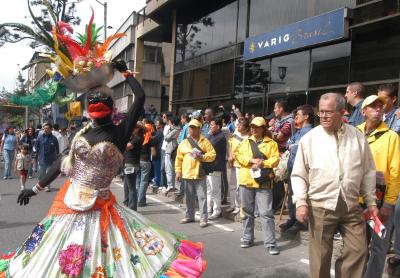
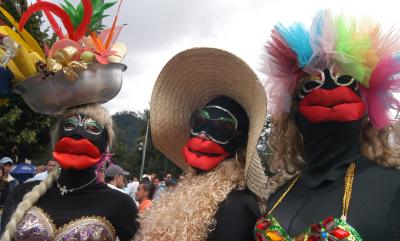
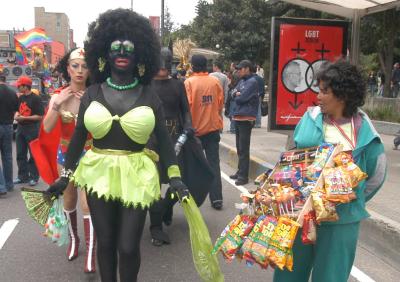
At the above links you might find photos of the different events which show the usual drag-queens, rainbow flags and gathered multitudes. I was particularly struck by the three pictures above of participants at Bogota's LGBT pride march
(from a photo gallery by Roger Triana at El Tiempo's link above).

I'm uncertain how and when Colombia adopted some of the blackface imagery that used to be prevalent in the United States during the last century and is mostly considered racist and defamatory nowadays in the United States (with some exceptions, which include a famous black US drag performer who has championed a certain comedian who uses blackface to make fun of blacks who is featrured in said drag performer's new CD)

Now, Colombia has not undergone a black civil rights movement process as the United States has, which is why I am often shocked by the racism I see on Colombian television, society and culture whenever I go back (considering the fact that there is a large black and mestizo community, particularly in the coasts). What makes it more insidious is that it's not self-consciously racist but simply accepted as mindless caricatures and sometimes even embraced by blacks in Colombia (something that unfortunately is not restricted to Colombia but also other Latin American countries).

LGBT organizations in Colombia have openly participated in recent demonstrations calling for a stop to racism and protections for the civil rights of black communities in Colombia (as a matter of fact, Piedad Cordoba, a leading Senator in calling for the recognition of civil union rights for gay couples in Colombia is herself black and also a leader in the country's black-rights movement).

In any case, it is painful that on a day when I should celebrate that more than ten thousand people filled the streets of Bogota calling for the recognition of LGBT rights, some saw it fit to celebrate by using some of the racist blackface costume imagery.