Showing posts with label nicaragua. Show all posts

Wednesday, December 17, 2008

Nicaragua: 75 LGBT activists from the Central American region meet in Managua

Seventy-five lesbian, gay, bisexual and transgender delegates from different Central American countries congregated this past week in Nicaragua's capital city of Managua for what participants are calling the first such region-wide encounter, reports El Nuevo Diario ("First gathering on sexual diversity comes to an end", Dec. 15, 2008).

Bismark Moraga, the coordinator of the gathering, said that he hoped that the meeting would bring a bout a new political vision on a regional level that would result in advocates demanding that their governments promote the recognition and respect for the rights of the LGBT communities including the right to education and health coverage as well as protection from discrimination.

The event, which was sponsored by the Norwegian embassy in Nicaragua, was organized by the Center for International Studies and the lesbian-rights organization SAFO.

The event served as the launching venue for a new study that takes a look at gay life in Managua which revealed, among other things, that there are high levels of unemployment among LGBT community members who live in the city.

Nicaragua: Gay US citizen murdered, authorities suspect 'crime of passion'

Nicaragua's El Nuevo Diario reported on Saturday that 45 year-old Jackson Briceño, a former US resident who had moved to the Central American country two years ago "to enjoy his savings, after a life of work in the United States", died on the way to a hospital after being found at home with five stab wounds ("When love kills", Dec. 13, 2008).

Authorities interviewed a 16 year-old nicknamed "La Chilo" who neighbors identified as the Briceño's partner but released him and said that he had not been at Briceño's residence on the night of the attack. The teenager, who lives in a poor rural area 15 miles away from Briceño's residence, was said to have been dating the man for eight months, often staying overnight.

“There was blood on the pillows, on the bed's mattress and all over the floor in the house," said an anonymous witness, "the scene was horrible, since it looked as if they had spilled red paint everywhere. When we were able to see that the man was being taken out by firemen and the police, we saw that he had wounds and blood all over his body."

The forensic unit has revealed that a bloody knife was recovered near Briceño's home and that they also found strands of hair belonging to a man at the scene of the crime and have ruled out that a woman might have committed the crime. The police is investigating the killing as a possible "crime of passion." The first, they say, that they have seen between individuals of the same gender in more than eight years.

"Whoever killed him tried to make sure that he wouldn't be left alive," said Sergio Cano, the forensics expert.

Nueva Ya reports that Briceño operated a foreign currency exchange business.

Tuesday, August 26, 2008

Panama: President Martino Torrijos Espino repeals sodomy statute

An update: Last year after I stated that Nicaragua had become the last Spanish-speaking country in Latin America to remove a sodomy statute from its books, journalist Rex Wockner unearthed a 1949 law in Panama which penalized "clandestine prostitution, procurement (proxenetismo), sodomy and all vices of sexual degeneration not specified under this Decree will be sanctioned with penalties imposed by the Director of the Department of Public Health" with up to one year in prison or a $500 follar fine.

Good news! In his syndicated International News column dated August 14th, Rex says that on July 29th Panamanian president Martino Torrijos Espino signed a decree repealing the law.

"According to Amnesty International," Rex says, "11 nations in Central America, South America and the Caribbean continue to ban gay sex -- Antigua and Barbuda, Barbados, Belize, Dominica, Grenada, Guyana, Jamaica, Saint Kitts and Nevis, Saint Lucia, Saint Vincent and the Grenadines, and Trinidad and Tobago. All of the countries are former British colonies."

Wednesday, November 14, 2007

Nicaragua: Sodomy statute disappears from the books

[UPDATE: Apparently Nicaragua was NOT the last Spanish-speaking Latin American country with a sodomy statute. In following up the Nicaragua story, reporter Rex Wockner has unearthed a law in Panama that still penalizes gay sex. Read about it here]

In a surprising and historic development when it comes to LGBT rights in the region, gay Nicaraguans woke up yesterday to the news that consensual sex with their partners will no longer be a crime as of March of 2008.

In adopting a new national penal code on Monday, the Nicaraguan National Assembly sidestepped the longstanding law that penalized sodomy between members of the same-sex with up to five years in prison by overwhelmingly voting to approve a new civil code that simply did not mention it.


In doing so it removed the last anti-gay sodomy statute in Spanish-speaking Latin American countries (I believe that Belize and Guyana are now the only countries in the American continent that still have such statutes and I invite others to correct me if that is not the case).


Nicaragua's La Prensa reported
on Tuesday that the elimination of the sodomy statute had been a surprise to most observers but not to representatives who were involved in drafting the language of the new code.

The president of the Nicaraguan Parliament's Commission of Justice and Legal Issues, José Pallais, explained that legislators had sought to "modernize" the penal code by not using it to regulate behavior based on the State's moral codes but by strictly addressing legal violations.


"We are not creating a Code of the Catholic Church here," he said, "we are creating a democratic Code under modern principles and principles of legality."


Nevertheless Pallais expressed dismay that another measure, seeking to relax laws penalizing abortions did not get enough legislative support to pass.


According to La Prensa the new Penal Code will go into effect on March of 2008.

Friday, October 26, 2007

Updates: Gay Mexican denied US asylum, Alvaro Orozco, bi-national couples

Political asylum denied to Mexican gay man: In this week's Gay City News, Arthur Leonard describes the failed attempt by a Mexican gay man to gain political asylum in the United States based on sexual orientation.

Leonard writes "The U.S. Court of Appeals for the 2nd Circuit, based in New York City, has ruled in an unpublished decision that the current level of anti-gay persecution in Mexico is not sufficient to justify granting a withholding of removal for a gay immigrant who claimed to fear persecution if returned to that nation."

But what strikes me, once again, is the mistakes made by the applicant in submitting his claim: 1. He applied after the statutory 1-year window of opportunity imposed by the US on asylum seekers and 2. He had no legal representation at the asylum hearing (he argued that his attorney failed to show up but my experience is that an applicant can ask for the interview to be postponed if his attorney is not present - though I'm not sure if this varies from court to court). The fact that he had not personally experienced past persecution while living in Mexico, though sometimes surmountable in an asylum claim if you present evidence, did not help his case.

Alvaro Orozco: Speaking of asylum, this time in Canada, there has been no better luck for Alvaro Orozco, the young man from Nicaragua that was ordered deported back in August after courts originally questioned whether he was truly gay. His attorneys tried to get a stay of removal earlier this month but the courts refused to grant it. A new order of deportation was handed down on October 4th.

Oh, Canada! But not all news from Canada have been as dire. Emilio and Tom, friends of mine whose bi-national immigration story I've featured here from time to time, can breathe a sight of relief: On October 11th they became permanent residents of Canada, or, as Tom put it on their blog "We finally made it after 20 months of waiting and Emilio is now officially safe from US tyranny!"

Understandably, they are looking forward to the move up north even though it will be sad to see them go (we promise a visit or two).

Tom and Emilio are featured in "Through Thick and Thick" so the news might be a spoiler of sorts if you haven't watched it. Below is a YouTube preview of the Sebastian Cordoba documentary. More on the issues faced by same-sex binational couple in the US at the Immigration Equality website here.


Oh, Argentina? Speaking of same-sex binational couples, former New York Blade editor and current blogger Chris Crain, who already changed his country of residence to Brazil in order to live with his Brazilian partner, Anderson, recently wrote on his blog that their next place of residence will be Argentina after options to remain in Brazil dried out. Ultimately, though, Chris says that, like Tom and Emilio, they might take a look at Canada as an option as well.

Wednesday, August 15, 2007

Update: Alvaro Orozco goes into hiding after failing to get refugee status in Canada

Back in February we told you about Alvaro Orozco, a young man from Nicaragua who was appealing a Canadian refugee court decision not to grant him asylum based on his fears of persecution as a gay man if he was sent home (Nicaragua is the only remaining country in Central America that still has laws against sodomy between consenting adults which can carry jail terms of up to four years).

The case drew international attention when the court not only denied Orozco refugee status but questioned whether he was truly gay. On Thursday Orozco lost his appeal and was ordered to leave the country when the appeal court ruled that he faced no risks if he went back to Nicaragua.

In a written statement sent to press Orozco said: "I feel very concerned about my safety in Canada because now I do not have legal status in this country. If they send me back to Nicaragua, I can face persecution by the government and the Catholic community who judge gay life as sodomy."

On Monday Orozco told CBC news that he had gone into hiding as a result of the decision: "Most of the time, I'm hiding because I'm not supposed to be anywhere. I feel like a fugitive. It's really bad."

Orozco and his legal advisers hope that Canadian Immigration Minister Diane Finley will see fit to intervene and grant him a stay on humanitarian grounds, the only way that Orozco will be able to remain legally in Canadian soil.

For updates, check Mr. Orozco's refugee campaign website
here.

Thursday, May 10, 2007

Updates: Chad Ferreira, circumcision, Alvaro Orozco, Colombian 'asylum tragedy'

Chad Ferreira: The Bay Area Reporter continues it's coverage of the altercation in San Francisco's Castro district that led to the death of Chad Ferreira (pictured) in January of 2006.

Last week reporter Ed Walsh described opening statements made at a trial that will determine whether 26 year old Kyle Adams committed manslaughter by beating Ferreira so hard that he caused Ferreira to fall and fracture his skull when his head hit a sidewalk curb or if he is, as he claims, innocent and just acting in self defense.

Today, the Reporter describes Adams turn on the stand and his side of the story, some of which differs with witness statements and includes details were not originally provided to the police department when he was first charged.

The paper says that closing arguments after the print edition of the Reporter went to press and that the case went to the jury at 3:10pm yesterday.

Circumcision as HIV prevention: The New York City department of Health and Mental Hygiene held it's community forum on the issue of male circumcision as a possible HIV prevention tool. I was not able to attend but both Gay City News and the New York Blade covered the arguments and the reaction.

Alvaro Orozco: In February we told you about a decision by Canada's Immigration and Refugee Board not to grant asylum to a young Nicaraguan gay man, Alvaro Orozco, partly because they argued that if Orozco wasn't sexually active when he left Nicaragua at the age of thirteen, he could not assert that he knew he was gay then. The Orozco case and his ongoing efforts to appeal that decision receives a coverline in the current issue of The Advocate. For more on the case and on how you can help, please visit his website.

In United States political asylum news, Arthur Leonard calls an April 25th ruling that turned down an asylum application by a Miami-based Colombian gay man "Another asylum tragedy." Leonard says that the court not only denied asylum but also outed him in the process and now is sending the man back to Colombia despite having arguably shown credible evidence of fear of persecution if sent back.

Thursday, March 22, 2007

Update: SF vigil in memory of Ruby Rodriguez this Friday

PRESS RELEASE
For Immediate Release

Contacts:
Tina D’Elia, Hate Violence Survivor Program Director
(415) 777-5500 ext. 304

Alexandra Byerly, EL-LA Program Coordinator
(415) 864-7278

Community Mourns Murder of Latina Transgender Woman
Requests Attendance at Vigil to Demand Change

San Francisco, California (March 22, 2007) – A Nicaraguan transgender woman, Ruby Rodriguez, 24 years old, was murdered on Friday, March 16, 2007. Her body was found on the corner of Cesar Chavez and Indiana Streets in the Mission District of San Francisco. The murder is currently under investigation by the San Francisco Police Department. Community United Against Violence (CUAV), EL-LA, San Francisco LGBT Community Center, TRANS Project, allies, and community members will hold a community vigil in her honor on Friday, March 23, 2007 at 6:00PM, on the corner of 24th Street and Mission Street in the Mission District.

Organizers request that the community bring a white candle to the vigil. There will also be an additional altar set up on Cesar Chavez and Indiana Street, and community members are encouraged to bring flowers, photographs, cards and good wishes to this site. Let us not forget Ruby. She was an exceptional woman who was intent on improving her life. Ruby participated in various support groups and language classes, and idolized Chicana singer Selena.

This murder comes at the heels of at least two other violent deaths of transgender women of color in the San Francisco Bay Area over the past six months. Transgender people, particularly low-income transgender women of color, are disproportionately poor, homeless, criminalized and imprisoned as a result of systemic discrimination in our daily attempts to access safe housing, healthcare, employment, and education.

Unfortunately, Ruby’s murder is not an exception, but an everyday fear for many transgender people who are targeted and brutalized by institutions and society at large. Our communities mourn Ruby’s death and ask for a renewed commitment to real safety for transgender communities. It is vital that the Mayor’s Office, the San Francisco Police Department, and the District Attorney’s Office work to end the cycles of criminalization, poverty, and violence in transgender communities and communities of color.

Please direct any questions about the vigil to Tina D’Elia or Alexandra Byerly. If anyone has any information regarding Ruby’s murder, please contact Inspector Karen Lynch at (415) 553-1388 or Inspector Tom Cleary at (415) 553-9569 of the SFPD Homicide Unit.

---
Community United Against Violence works to end violence against and within the LGBTQQ communities, providing free and confidential counseling, advocacy, and education in English and Spanish. CUAV’s crisis line is (415) 333-4357.

Updates: Aviance attackers guilty, IL unease on Obama and gays, Orozco gets a break in Canada

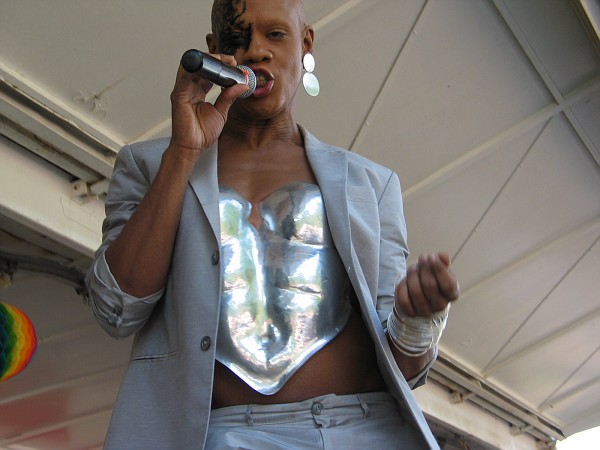
Din Da Da: Four people have pleaded guilty in last summer's attack against performer Kevin Aviance (pictured) and are expected to be given prison sentences ranging from six to fifteen years when they are sentenced in early April. They had faced prison sentences of up to 25 years if convicted of first degree assault as a hate crime.

Obama unease in IL: It has been ten days since the Chicago Tribune reported that General Peter Pace - the current joint Chief of Staff and military leader in Iraq - called homosexuality "immoral." Today, the Tribune explores the lingering unease among lesbian and gay supporters of presidential candidate Barack Obama over how the Illinois Senator first responded to the General's comments.

Late word from the Chicago Sun Times blogs is, though, that the Obama camp might be forming a "gay advisory panel"(courtesy of Lynn Sweet).

Canadian court defers removal of gay Nicaraguan: A young Nicaraguan gay man who made his way to Canada as a teen and was denied political asylum back in February, in part because the court said he wasn't gay enough, has been granted a second removal deferral which means that he can stay in Canada up until August 9th, 2007. This undoubtedly gives his legal team precious additional time to build his case and appeal the ruling on humanitarian and compassionate grounds.

If you would like to help Alvaro Orozco stay in Canada, please visit his website for additional information.

Saturday, February 10, 2007

Update: How you can help Alvaro Orozco

Thanks to my post on Wednesday, I have been contacted by the law firm working on behalf of Alvaro Orozco, the 21 year old Nicaraguan young man who is fighting deportation proceedings in Canada after the Immigration and Refugee Board refused to grant him asylum based on fear of persecution for being gay.

The reason? After a live long-distance video interview with Mr. Orozco, the court deemed that he wasn't gay enough and that it was unclear how Mr. Orozco could know he was gay at twelve years of age when he ran away from home as he wasn't sexually active during his teen years.

Today The Globe and Mail reports that Mr. Orozco's new lawyers have won a small victory: He will not be deported on Tuesday as scheduled as the Canadian Justice Department has granted a two month deferral (though they could have decided to grant him refugee status instead and did not do so).

I am working on sending published articles on the treatment of gays and lesbians in Nicaragua over the last 5 years that support Mr. Orozcos' fear of persecution should he be deported to Nicaragua.

What you can do:

A website has been set up on Alvaro's behalf at: Alvaro Orozco

Once there, you can get information on a letter writing campaign that might help to sway the Minister of Citizenship and Immigration to grant asylum for Mr. Orozco (including sample letters).

To find out more about the case you can connect to video reports here and here (even if they were conducted before the two month deportation deferral).

Wednesday, February 07, 2007

Canada: Gay Nicaraguan denied asylum because he wasn't sexually active as a teen

A 21 year old Nicaraguan man has been denied asylum in Canada because the country's Immigration and Refugee Board did not believe that he was gay, says today's Globe and Mail.

Alvaro Antonio Orozco
(pictured) who says he was 12 when he ran away from his home in Nicaragua, describes a harrowing journey through Mexico and across the Rio Grande into the United States, where he was captured by immigration authorities and spent close to a year being held in a Houston detention center. He was released after agreeing to return to Nicaragua on his own volition.

Instead he made his way to Toronto in 2005 after finding out through the internet that the country offered asylum to immigrants based on fear of persecution based on sexual orientation (he says that he never applied for asylum in the United States because a religious institution that offered him assitance as an immigrant warned him against it). It was only in Canada, he says, that he was able to finally come out and live as a gay man.


Unfortunately his previous life in the closet became an issue for the Immigration and Refugee Board as they ruled not to grant asylum "because he wasn't sexually active during his teen years, and wasn't clear about his sexual orientation when he fled Nicaragua at the age of 12."


His lawyer, El Farouk Khaki, says that the ruling exposes the Board's prejudiced view that gay teens are more sexually active than their heterosexual counterparts. He will ask the country's Immigration Minister, Diane Finely, to grant a stay of removal on humanitarian grounds. He will also seek to reopen the refugee claim "arguing there was a breach of natural justice because the member failed to consider guidelines on treatment of a vulnerable person."


If those last minute appeals fail, Mr. Orozco will be sent back to Nicaragua on Tuesday, a country which still considers sodomy a crime.


Mr. Khaki, for his part, was honored at last year's 2nd Annual Pride Toronto Gala and Awards for his work as a founder of the LGBT Muslim group
Salaam Canada.

Wednesday, March 01, 2006

Latino boxers and gay paranoia

UPDATES to this post:
ORIGINAL post: Yesterday, the Nicaraguan news-daily La Prensa reported that there is an escalating - and homophobic - war of words and gestures being played by Nicaraguan two-time junior flyweight boxing champion Rosendo Alvarez and the Mexican pugilist and current world champ Jorge Arce as they prepare for a show-down in Las Vegas on April 8th.

According to
La Prensa, Alvarez claims that Arce instigated the exchange when he arrived in Nicaragua: "He started to say that my wife ruled over me and this is something that no man [likes to hear]. I have a good relationship with my wife. That was his error. He's getting into my personal life and I don't allow anyone to do this."

The article also says that Arce went on to blow kisses at Alvarez accross a crowded room at a promotional boxing event on Saturday night which almost led to a scuffle.

Alvarez told La Prensa: "No real macho man throws kisses at another man. Only gays do that. That's why I have no doubt that Arce is gay. But on April 8th I will make him a real man by giving him a true beating."


Arce, for his part, said that it wasn't the first time that Alvarez called him a gay man but that the allegations didn't bother him: "I found out that [Alvarez] loses his head quickly, so now he will have to deal with it because I will continue to harrass him, and once he's bothered, I will knock him out so he doesn't have to worry about these delicate things."


Of course, there's nothing new about boxers questioning each others' masculinity and, sometimes, their sexuality. The subject has even made for the gripping 2005 documentary "
Ring of Fire: The Emile Griffith Story" which was also shown on the USA cable network. But why it is still so prevalent a tactic in boxing today remains shameful.

Alvarez was not the only Nicaraguan boxer to call a future sparring adversary gay this week: Today,
La Prensa also reports that Nicaraguan boxer Ricardo Mayorga, known for his outrageous, often homophobic statements, and his tendency to smoke cigarettes and drink alcohol during press events, told a roomful of reporters gathered at a Beverly Hills press event: "This faggot won't be able to stand the rhythm [of my punches], believe me, he will fall in knock-out on May 6th."

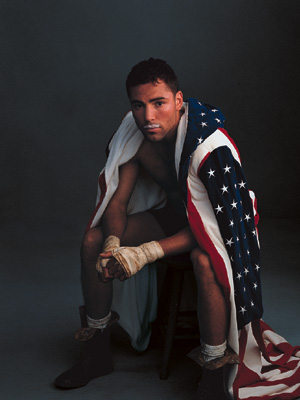
The supposed "fag" in question? Mayorga's next boxing match rival, Golden Boxing Boy himself, Oscar De la Hoya.

To De la Hoya's credit, he was unfazed.

Interestingly, both of the Nicaraguan boxers raising the gay flag are currently represented by infamous boxing promoter Don King.